

10 Euro (Republic of Malta) – Malta
Non-circulating coins
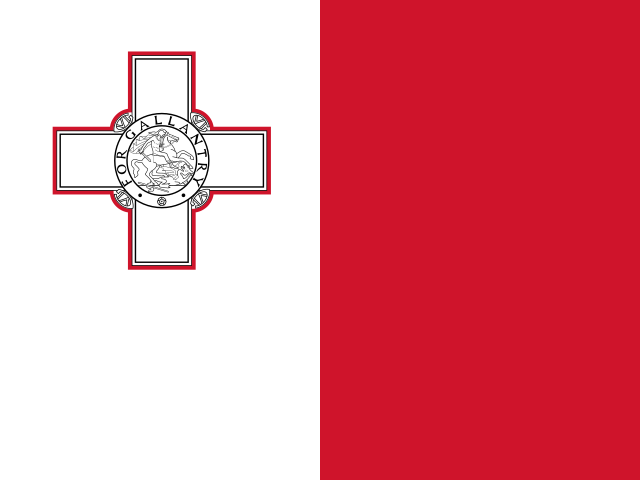
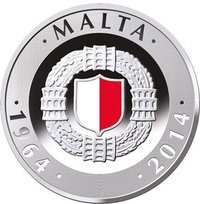
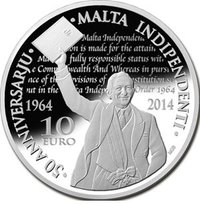
Commemoration: 40th anniversary of the Republic of Malta
Malta
Context
Material
References
KM: #Click to copy to clipboard166
Numista: #143650
Value
Exchange value: 10 EUR = $11.81
Bullion value: $75.41
Obverse
Reverse
Edge
Categories
| Symbols> Coat of Arms |
Mintings
| Year | Mint Mark | Mintage | Quality | Collection |
|---|---|---|---|---|
| 2014 | — | 5,000 | Proof |
Historical background
In 2014, Malta was firmly integrated into the Eurozone, having adopted the euro as its official currency on 1 January 2008. This move replaced the Maltese lira (or pound) and marked a significant milestone in the country's economic and political alignment with the European Union, which it joined in 2004. By 2014, the euro had been in circulation for six years, and the transition was considered complete and successful, with the population generally accustomed to the single currency. The Central Bank of Malta operated as part of the Eurosystem, implementing the single monetary policy set by the European Central Bank (ECB), which aimed to maintain price stability across the Eurozone.
The macroeconomic context in 2014 was one of steady recovery and resilience. Malta's economy consistently outperformed the Eurozone average, with robust GDP growth, low unemployment, and a stable financial sector. The currency situation was therefore characterized by stability and the benefits of Eurozone membership, including eliminated exchange rate risk with major trading partners, lower transaction costs, and enhanced investor confidence. This stability provided a solid foundation for key Maltese industries like tourism, iGaming, and financial services, which thrived in the predictable monetary environment.
However, Malta was not entirely insulated from broader Eurozone challenges. The lingering effects of the sovereign debt crisis, which peaked in 2012, meant that the ECB's policies, including historically low interest rates, were the prevailing reality. For Malta, this meant very low borrowing costs, which supported domestic consumption and investment but also posed challenges for savers and pension funds. Furthermore, as a small, open economy, Malta had to maintain strict competitiveness within the fixed exchange rate regime of the euro, as it could no longer devaluate a national currency to adjust. Overall, 2014 saw Malta benefiting from euro membership while navigating the common monetary policy landscape of a post-crisis Eurozone.
The macroeconomic context in 2014 was one of steady recovery and resilience. Malta's economy consistently outperformed the Eurozone average, with robust GDP growth, low unemployment, and a stable financial sector. The currency situation was therefore characterized by stability and the benefits of Eurozone membership, including eliminated exchange rate risk with major trading partners, lower transaction costs, and enhanced investor confidence. This stability provided a solid foundation for key Maltese industries like tourism, iGaming, and financial services, which thrived in the predictable monetary environment.
However, Malta was not entirely insulated from broader Eurozone challenges. The lingering effects of the sovereign debt crisis, which peaked in 2012, meant that the ECB's policies, including historically low interest rates, were the prevailing reality. For Malta, this meant very low borrowing costs, which supported domestic consumption and investment but also posed challenges for savers and pension funds. Furthermore, as a small, open economy, Malta had to maintain strict competitiveness within the fixed exchange rate regime of the euro, as it could no longer devaluate a national currency to adjust. Overall, 2014 saw Malta benefiting from euro membership while navigating the common monetary policy landscape of a post-crisis Eurozone.
✨ Legendary