

20 Korun – Czech Republic
Circulating commemorative coins
Commemoration: Year 2000
Czechia
Context
Year: 2000
Country: Czechia 
Issuer: Czech Republic
Period:
(since 1993)
Currency:
(since 1993)
Total mintage: 10,017,500
Material
Diameter: 26 mm
Weight: 8.43 g
Thickness: 2.55 mm
Shape: Tridecagonal
Technique: Milled
Alignment: Medal alignment
flip
References
KM: #Click to copy to clipboard43
Numista: #3969
Value
Exchange value: 20 CZK = $0.97
Inflation-adjusted value: 45.88 CZK
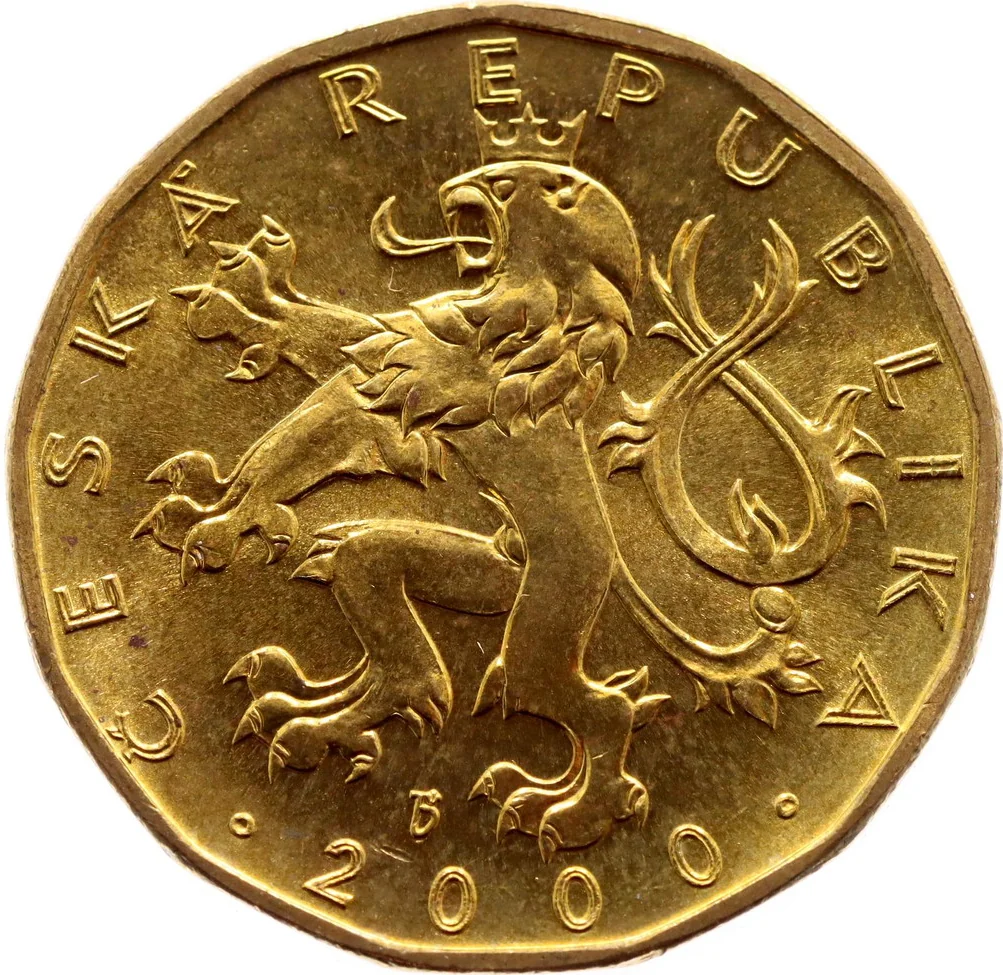
Obverse
Reverse
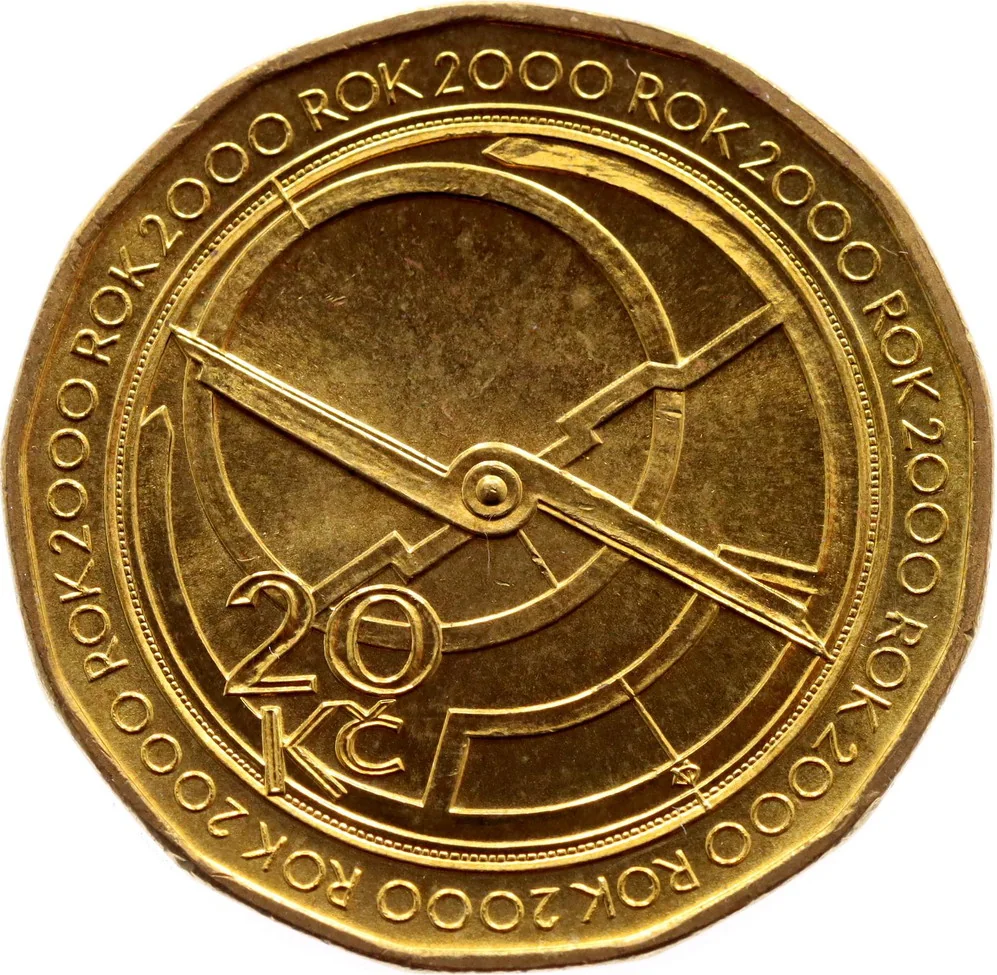
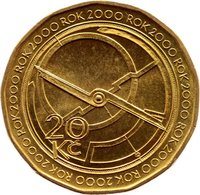
Description:
Astrolabe, engraver's mark (V in O) lower right.
Inscription:
20 Kč
ROK 2000 ROK 2000 ROK 2000 ROK 2000 ROK 2000 ROK 2000 ROK 2000 ROK 2000
ROK 2000 ROK 2000 ROK 2000 ROK 2000 ROK 2000 ROK 2000 ROK 2000 ROK 2000
Translation:
YEAR 2000 YEAR 2000 YEAR 2000 YEAR 2000 YEAR 2000 YEAR 2000 YEAR 2000 YEAR 2000
Script: Latin
Language: Czech
Engraver: Vladimír Oppl
Edge
Plain
Categories
| Event> Millennium |
Mints
| Name | Mark |
|---|---|
| Czech Mint | (b) |
Mintings
| Year | Mint Mark | Mintage | Quality | Collection |
|---|---|---|---|---|
| 2000 | b | 2,500 | Proof | |
| 2000 | b | 10,015,000 |
Historical background
By the year 2000, the Czech Republic's currency situation was characterized by stability and a deliberate, managed transition following the turbulence of the 1990s. The Czech koruna (CZK) was a fully convertible, free-floating currency, having successfully emerged from a fixed exchange rate regime that was abandoned during a currency crisis in 1997. This shift to inflation targeting by the Czech National Bank (CNB) in 1998 marked a pivotal move, prioritizing price stability over direct exchange rate management. Consequently, the koruna's value in 2000 was primarily determined by market forces, influenced by capital flows, interest rate differentials, and the country's evolving economic fundamentals as it progressed toward European Union accession.
The macroeconomic context in 2000 was one of recovery from a previous recession. The CNB maintained a relatively tight monetary policy to anchor inflation, which contributed to the koruna's strength, particularly against the euro (then still in its cashless introductory phase). This appreciation was a double-edged sword: it helped control import prices and inflation but posed challenges for export-oriented industries, a crucial sector of the Czech economy. Policymakers and businesses were thus navigating the trade-offs between a strong, stable currency and international competitiveness.
Looking forward, the dominant theme in the currency background of 2000 was the strategic path toward eventual Eurozone membership. The Czech Republic, having joined NATO in 1999, was deeply engaged in EU accession negotiations (concluded in 2002). While adopting the euro was a formal obligation of EU membership, no specific timetable was set. The national debate was already active, weighing the perceived economic benefits and transactional efficiencies of the euro against the symbolic and policy-making loss of the koruna as a key symbol of national sovereignty. Thus, the currency situation was stable but inherently transitional, with the long-term objective clearly focused on European monetary integration.
The macroeconomic context in 2000 was one of recovery from a previous recession. The CNB maintained a relatively tight monetary policy to anchor inflation, which contributed to the koruna's strength, particularly against the euro (then still in its cashless introductory phase). This appreciation was a double-edged sword: it helped control import prices and inflation but posed challenges for export-oriented industries, a crucial sector of the Czech economy. Policymakers and businesses were thus navigating the trade-offs between a strong, stable currency and international competitiveness.
Looking forward, the dominant theme in the currency background of 2000 was the strategic path toward eventual Eurozone membership. The Czech Republic, having joined NATO in 1999, was deeply engaged in EU accession negotiations (concluded in 2002). While adopting the euro was a formal obligation of EU membership, no specific timetable was set. The national debate was already active, weighing the perceived economic benefits and transactional efficiencies of the euro against the symbolic and policy-making loss of the koruna as a key symbol of national sovereignty. Thus, the currency situation was stable but inherently transitional, with the long-term objective clearly focused on European monetary integration.
🌱 Very Common