

1 cash – Yunnan Province
Add to wishlist
China
Context
Year: 1912
Country: China
Issuer: Yunnan Province
Period:
(1912—1949)
Currency:
(since 1912)
Demonetized: Yes
Material
Diameter: 18 mm
Shape: Round with a square hole
Composition: Brass
Magnetic: No
Technique: Cast
Alignment: Medal alignment
flip
References
KM: #
Numista: #39548
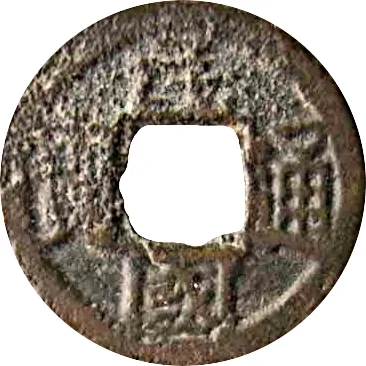
Obverse
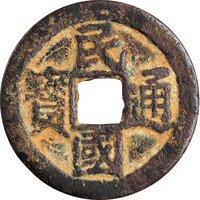
Description:
Four Chinese characters read vertically, right to left.
Inscription:
民
寶 通
國
寶 通
國
Translation:
The People's Treasure
Circulates in the Nation
Circulates in the Nation
Language: Chinese
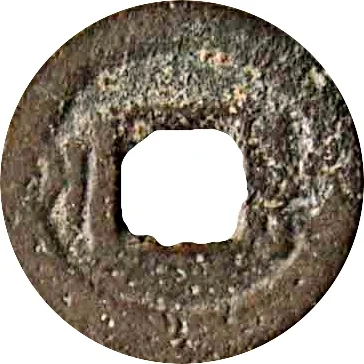
Reverse
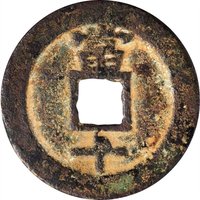
Description:
Left and right Chinese ideograms.
Inscription:
川東
Translation:
East of the River
Language: Chinese
Edge
Plain
Mintings
| Year | Mint Mark | Mintage | Quality | Collection |
|---|---|---|---|---|
| 1912 | — | — |
Historical background
In 1912, Yunnan Province found itself in a complex and fragmented monetary situation, a direct legacy of the late Qing dynasty's collapse and the province's early role in the Xinhai Revolution. The financial system was a chaotic mix of inherited, local, and emerging currencies. The primary circulating medium remained the silver tael, weighed in the local Kunping standard, alongside a dwindling supply of old Qing silver and copper "cash" coins. This traditional system was cumbersome and inefficient, hindering trade and governance.
Complicating this picture was the introduction of new currency by the militarily and politically assertive Yunnan provincial government under Governor Cai E. In 1912, the newly established Yunnan Provincial Bank began issuing its own paper notes, known as Yunnan dollars or Yunnan banknotes, denominated in a silver dollar unit. These notes were intended to fund government operations and military expenditures, particularly for planned campaigns into Sichuan and Guizhou. However, public trust in this new fiat currency was low, and it often circulated at a significant discount to silver, leading to inflation and economic uncertainty.
Furthermore, the situation was not isolated. Yunnan's borders saw the influx of foreign silver dollars, most notably the Mexican Silver Dollar and the British Trade Dollar from neighboring Southeast Asia, which were often preferred for their reliable silver content. The result was a multi-layered and unstable monetary environment where imperial-era coinage, new provincial paper, and foreign silver all competed. This currency disorder reflected the broader struggle of the early Republic of China, where provincial autonomy clashed with the need for a unified national financial system, leaving Yunnan's economy in a state of precarious transition.
Complicating this picture was the introduction of new currency by the militarily and politically assertive Yunnan provincial government under Governor Cai E. In 1912, the newly established Yunnan Provincial Bank began issuing its own paper notes, known as Yunnan dollars or Yunnan banknotes, denominated in a silver dollar unit. These notes were intended to fund government operations and military expenditures, particularly for planned campaigns into Sichuan and Guizhou. However, public trust in this new fiat currency was low, and it often circulated at a significant discount to silver, leading to inflation and economic uncertainty.
Furthermore, the situation was not isolated. Yunnan's borders saw the influx of foreign silver dollars, most notably the Mexican Silver Dollar and the British Trade Dollar from neighboring Southeast Asia, which were often preferred for their reliable silver content. The result was a multi-layered and unstable monetary environment where imperial-era coinage, new provincial paper, and foreign silver all competed. This currency disorder reflected the broader struggle of the early Republic of China, where provincial autonomy clashed with the need for a unified national financial system, leaving Yunnan's economy in a state of precarious transition.
💎 Extremely Rare