

50 cents – South Africa
Add to wishlist
Circulating commemorative coins
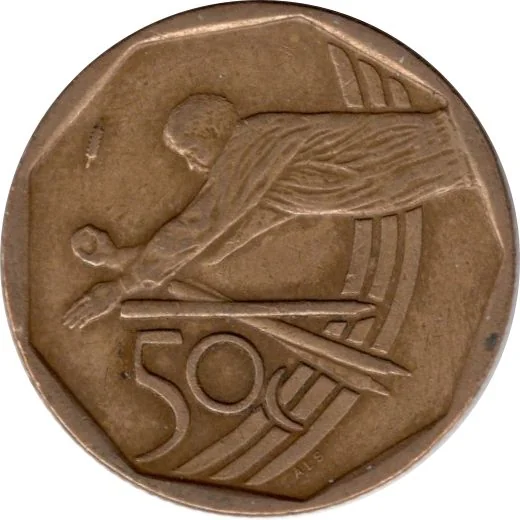
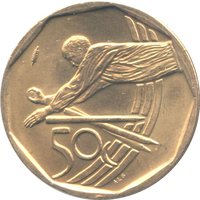
Commemoration: South Africa hosting the 2003 ICC Cricket World Cup
South Africa
Context
Material
References
Numista: #39391
Value
Exchange value: 0.50 ZAR
Inflation-adjusted value: 1.63 ZAR
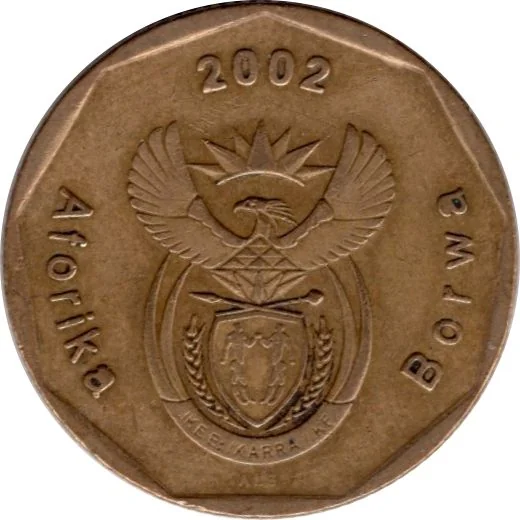
Obverse
Description:
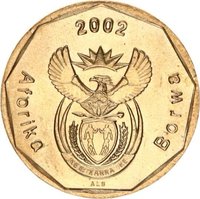
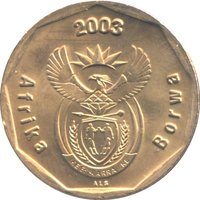
New national coat of arms, similar to KM#276 50 Cents but with a different legend.
Inscription:
2002
Aforika Borwa
ALS
Aforika Borwa
ALS
Translation:
2002
South Africa
ALS
South Africa
ALS
Script: Latin
Engraver: Arthur Sutherland
Reverse
Edge
Reeded
Mintings
| Year | Mint Mark | Mintage | Quality | Collection |
|---|---|---|---|---|
| 2002 | — | 11,749 |
Historical background
In 2002, South Africa's currency, the rand, was in a state of recovery and heightened volatility following a dramatic collapse in late 2001. That event, which saw the rand lose over 30% of its value against the US dollar in a matter of weeks, was triggered by a complex mix of factors. These included emerging market jitters after Argentina's debt default, domestic political tensions, and a critical report on the country's foreign exchange reserves. By 2002, the currency had stabilised at a significantly weaker level of around R10 to R11 to the dollar, compared to approximately R8 before the crisis, fundamentally reshaping the cost structure of the economy.
The weaker rand presented a double-edged sword for the South African economy. On one hand, it provided a substantial boost to key export sectors like mining and manufacturing, making South African commodities and goods cheaper on the global market. This supported economic growth and helped improve the current account balance. On the other hand, it sharply increased the cost of imports, fueling inflationary pressures. The South African Reserve Bank (SARB), under Governor Tito Mboweni, was therefore compelled to maintain a relatively tight monetary policy, keeping interest rates high to curb inflation despite the desire to stimulate broader economic growth.
Underlying the rand's volatility were persistent market concerns about South Africa's long-term socio-economic challenges. Investors closely monitored issues such as the pace of land reform, the government's handling of the HIV/AIDS pandemic, and the potential economic spillover from the crisis in Zimbabwe. While the ANC government under President Thabo Mbeki was committed to prudent fiscal and macroeconomic policy—epitomised by the Growth, Employment and Redistribution (GEAR) strategy—the currency market in 2002 remained sensitive to both global risk sentiment and any domestic developments perceived to threaten this stability.
The weaker rand presented a double-edged sword for the South African economy. On one hand, it provided a substantial boost to key export sectors like mining and manufacturing, making South African commodities and goods cheaper on the global market. This supported economic growth and helped improve the current account balance. On the other hand, it sharply increased the cost of imports, fueling inflationary pressures. The South African Reserve Bank (SARB), under Governor Tito Mboweni, was therefore compelled to maintain a relatively tight monetary policy, keeping interest rates high to curb inflation despite the desire to stimulate broader economic growth.
Underlying the rand's volatility were persistent market concerns about South Africa's long-term socio-economic challenges. Investors closely monitored issues such as the pace of land reform, the government's handling of the HIV/AIDS pandemic, and the potential economic spillover from the crisis in Zimbabwe. While the ANC government under President Thabo Mbeki was committed to prudent fiscal and macroeconomic policy—epitomised by the Growth, Employment and Redistribution (GEAR) strategy—the currency market in 2002 remained sensitive to both global risk sentiment and any domestic developments perceived to threaten this stability.
🌟 Uncommon