

10000000 lira – Turkey
Add to wishlist
Non-circulating coins
Commemoration: EuroBasket 2001
Turkey
Context
Material
Diameter: 38.61 mm
Weight: 31.47 g
Silver Weight:: 29.11 g
Shape: Round
Composition: 92.5% Silver
Standard: Silver ounce
Magnetic: No
Technique: Milled
Alignment: Medal alignment
flip
References
Numista: #393469
Value
Exchange value: 10000000 TRL
Bullion value: $71.89
Inflation-adjusted value: 703369600.00 TRL
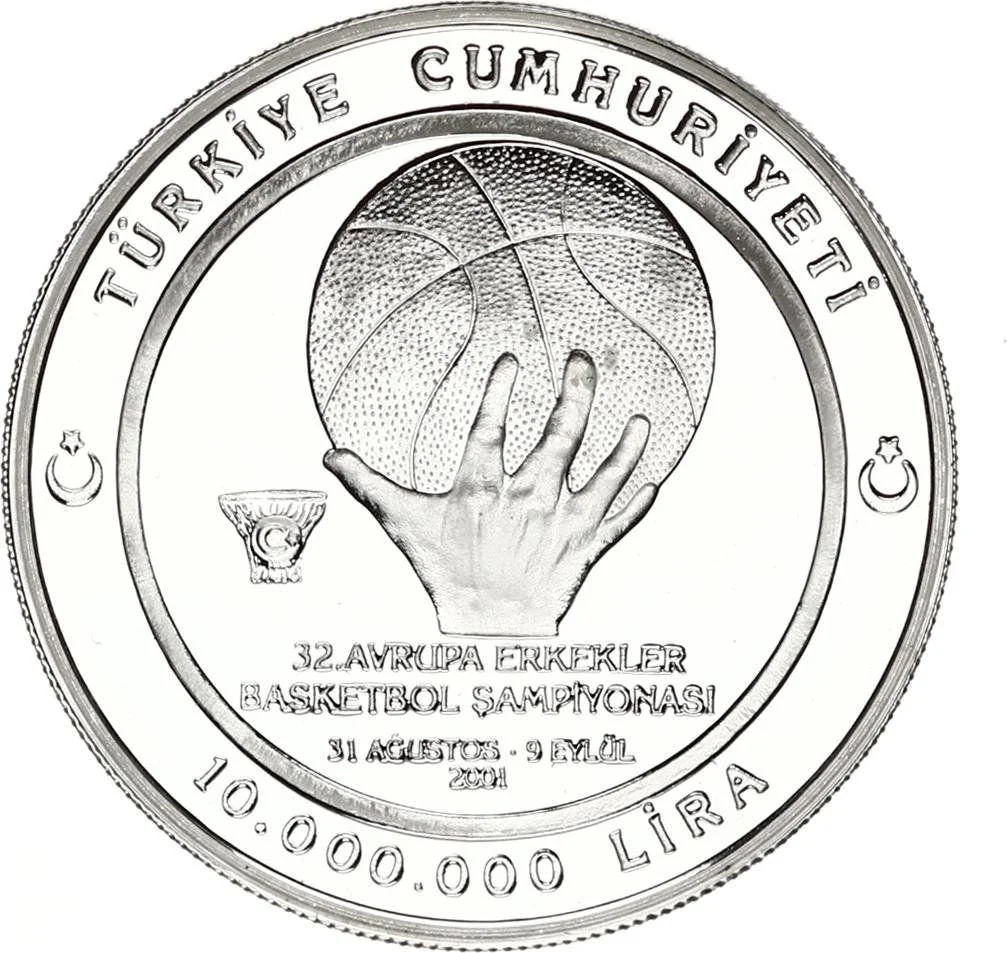
Obverse
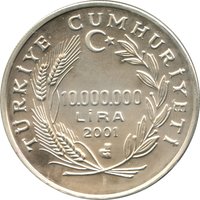
Inscription:
TÜRKİYE COMHURİYETİ
10.000.000 LİRA
32. AVRUPA ERKEKLER
BASKETBOL ŞAMPİYONASI
31 AĞUSTOS - 9 EYLÜL
2001
10.000.000 LİRA
32. AVRUPA ERKEKLER
BASKETBOL ŞAMPİYONASI
31 AĞUSTOS - 9 EYLÜL
2001
Translation:
TURKISH REPUBLIC
10,000,000 LIRA
32nd EUROPE MEN'S
BASKETBALL CHAMPIONSHIP
AUGUST 31 - SEPTEMBER 9
2001
10,000,000 LIRA
32nd EUROPE MEN'S
BASKETBALL CHAMPIONSHIP
AUGUST 31 - SEPTEMBER 9
2001
Script: Latin
Language: Turkish
Engraver: Nalan Yerlibucak
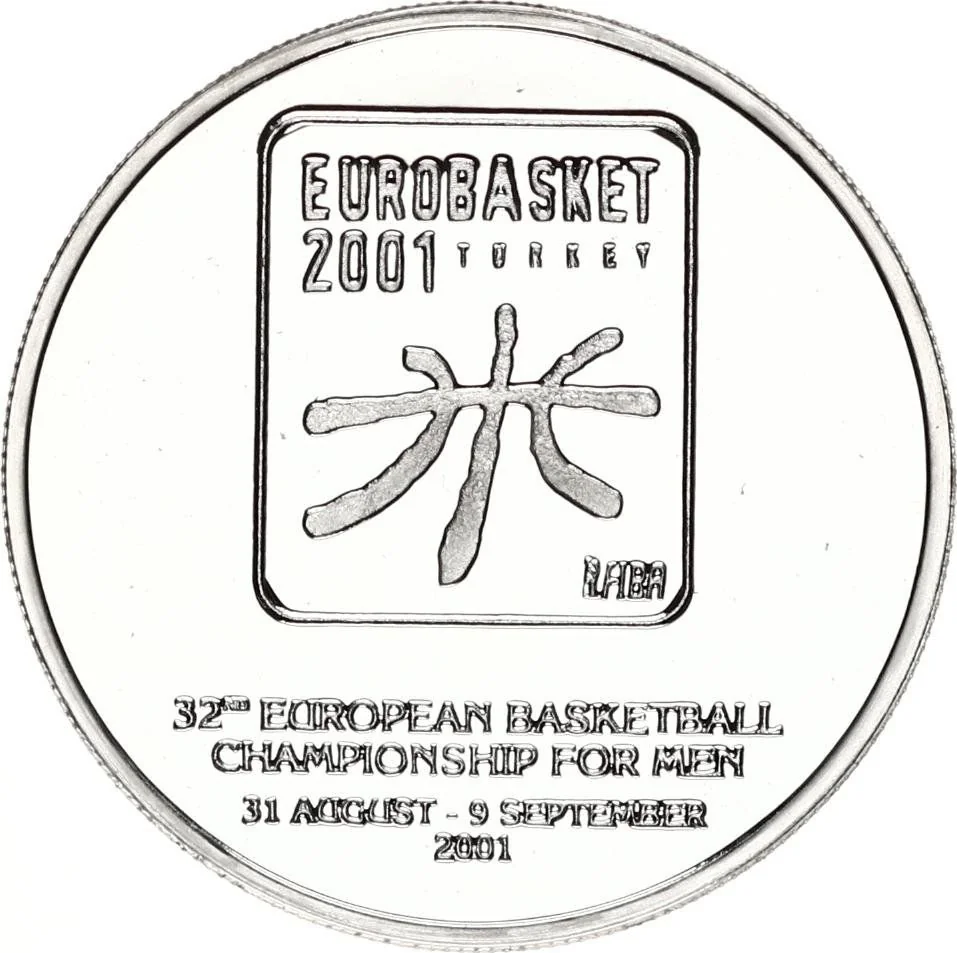
Reverse
Inscription:
EUROBASKET
2001 TURKEY
32ᵑᵈ EUROPEAN BASKETBALL
CHAMPIONSHIP FOR MEN
31 AUGUST - 9 SEPTEMBER
2001
2001 TURKEY
32ᵑᵈ EUROPEAN BASKETBALL
CHAMPIONSHIP FOR MEN
31 AUGUST - 9 SEPTEMBER
2001
Translation:
EUROBASKET
2001 TURKEY
32ⁿᵈ EUROPEAN BASKETBALL
CHAMPIONSHIP FOR MEN
31 AUGUST - 9 SEPTEMBER
2001
2001 TURKEY
32ⁿᵈ EUROPEAN BASKETBALL
CHAMPIONSHIP FOR MEN
31 AUGUST - 9 SEPTEMBER
2001
Script: Latin
Language: English
Engraver: Nalan Yerlibucak
Edge
Reeded
Categories
| Sport> Basketball |
Mints
| Name | Mark |
|---|---|
| Turkish State Mint | — |
Mintings
| Year | Mint Mark | Mintage | Quality | Collection |
|---|---|---|---|---|
| 2001 | — | 1,533 | Proof |
Historical background
The Turkish currency crisis of 2001 was a profound economic and political collapse, marking the most severe in a series of destabilizing events that began in late 1999. The context was a discredited crawling-peg exchange rate regime, adopted as part of an IMF-backed stabilization program to curb hyperinflation. This rigid system, combined with chronic fiscal deficits, a fragile and over-regulated banking sector laden with non-performing loans, and severe political uncertainty, created an economy acutely vulnerable to investor panic. The immediate trigger came in February 2001 during a heated public dispute between President Ahmet Necdet Sezer and Prime Minister Bülent Ecevit, which shattered market confidence in the government's ability to manage the economy.
The crisis unfolded with a sudden, massive flight of capital, forcing the Central Bank to spend billions of dollars in a futile defense of the Turkish lira. Within days, overnight interest rates skyrocketed to over 7,000%, and the lira lost nearly 40% of its value against the U.S. dollar. The banking system, which had borrowed heavily in foreign currency, was pushed to the brink of insolvency. The social impact was immediate and severe, with a sharp contraction in GDP, soaring unemployment, and a dramatic decline in living standards for millions of Turks.
In response, the government let the lira float freely and appointed Kemal Derviş as Minister of Economy, who orchestrated a radical new recovery program with strong IMF support. This program focused on aggressive banking sector restructuring, greater central bank independence, and a shift to inflation targeting. The 2001 crisis proved to be a pivotal turning point, leading to painful but foundational reforms that, despite subsequent challenges, established a more market-oriented framework for the Turkish economy in the following decade.
The crisis unfolded with a sudden, massive flight of capital, forcing the Central Bank to spend billions of dollars in a futile defense of the Turkish lira. Within days, overnight interest rates skyrocketed to over 7,000%, and the lira lost nearly 40% of its value against the U.S. dollar. The banking system, which had borrowed heavily in foreign currency, was pushed to the brink of insolvency. The social impact was immediate and severe, with a sharp contraction in GDP, soaring unemployment, and a dramatic decline in living standards for millions of Turks.
In response, the government let the lira float freely and appointed Kemal Derviş as Minister of Economy, who orchestrated a radical new recovery program with strong IMF support. This program focused on aggressive banking sector restructuring, greater central bank independence, and a shift to inflation targeting. The 2001 crisis proved to be a pivotal turning point, leading to painful but foundational reforms that, despite subsequent challenges, established a more market-oriented framework for the Turkish economy in the following decade.
✨ Legendary