

5 tolarjev (Battle of Sisek) – Slovenia
Add to wishlist
Circulating commemorative coins
Commemoration: 400th Anniversary of the Battle of Sisek
Slovenia
Context
Material
References
KM: #
Numista: #14318
Value
Exchange value: 5 SIT
Inflation-adjusted value: 28.38 SIT
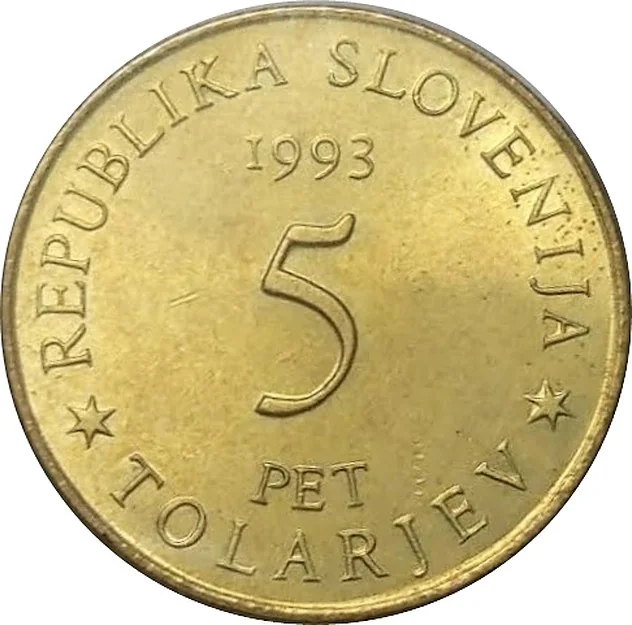
Obverse
Description:
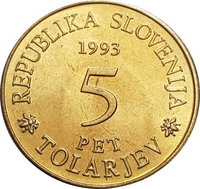
Value, date
Inscription:
REPUBLIKA SLOVENIJA
1993
PET TOLARJEV
1993
PET TOLARJEV
Script: Latin
Designer: Danilo Riznar
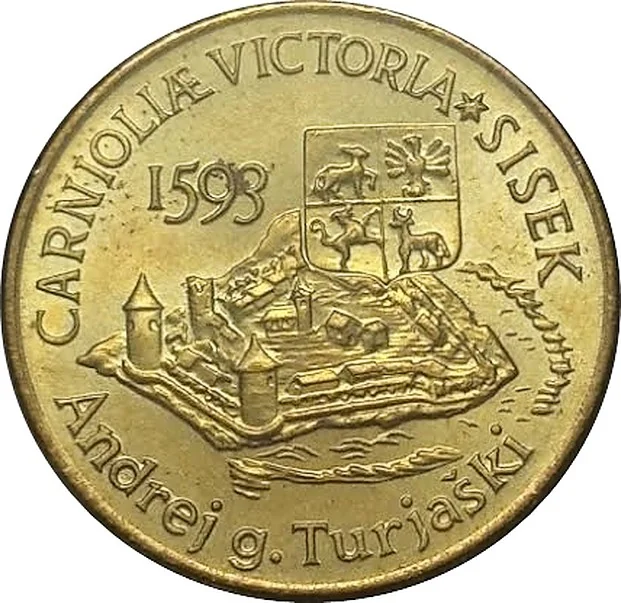
Reverse
Description:
Skyline, embrace, sunset
Inscription:
CARNIOLIÆ VICTORIA SISEK
1593
Andrej g. Turjaški
1593
Andrej g. Turjaški
Translation:
Carniola's Victory at Sisak
1593
Andreas of Thurn
1593
Andreas of Thurn
Script: Latin
Designer: Danilo Riznar
Edge
170 reeds.
Categories
| Building> Castle or fortification |
| History> War |
Mints
| Name | Mark |
|---|---|
| Kremnica | — |
Mintings
| Year | Mint Mark | Mintage | Quality | Collection |
|---|---|---|---|---|
| 1993 | — | 100,000 |
Historical background
In 1993, Slovenia was navigating the complex aftermath of its independence from Yugoslavia, achieved in 1991. A central challenge was establishing monetary sovereignty, as the country initially used the Yugoslav dinar, which was subject to hyperinflation and the monetary policy of the disintegrating federation. To break from this unstable system, Slovenia introduced its own temporary currency, the Slovenian tolar (SIT), in October 1991. However, 1993 was a critical year of consolidation, as the country moved beyond the initial emergency measure to solidify the tolar as a stable national currency.
The year was marked by the final and successful eradication of the hyperinflation inherited from the Yugoslav system. Through disciplined fiscal policy and a tight monetary regime managed by the newly established Bank of Slovenia, the country achieved rapid price stabilization. This was a remarkable turnaround, with inflation falling from over 200% in 1992 to just 31% by the end of 1993, setting a firm course toward single-digit inflation in the following years. The tolar was introduced via a dual-currency system and gradually gained public confidence, fully replacing the dinar and establishing itself as the sole legal tender.
Thus, the currency situation in 1993 was one of decisive transition and stabilization. The successful management of the tolar laid the essential groundwork for Slovenia's subsequent economic growth and integration into the international financial system. This period of monetary reform is widely regarded as a cornerstone of the country's early independence, providing the stability needed for broader economic restructuring and paving the long-term path toward eventual Eurozone membership, which would be realized in 2007.
The year was marked by the final and successful eradication of the hyperinflation inherited from the Yugoslav system. Through disciplined fiscal policy and a tight monetary regime managed by the newly established Bank of Slovenia, the country achieved rapid price stabilization. This was a remarkable turnaround, with inflation falling from over 200% in 1992 to just 31% by the end of 1993, setting a firm course toward single-digit inflation in the following years. The tolar was introduced via a dual-currency system and gradually gained public confidence, fully replacing the dinar and establishing itself as the sole legal tender.
Thus, the currency situation in 1993 was one of decisive transition and stabilization. The successful management of the tolar laid the essential groundwork for Slovenia's subsequent economic growth and integration into the international financial system. This period of monetary reform is widely regarded as a cornerstone of the country's early independence, providing the stability needed for broader economic restructuring and paving the long-term path toward eventual Eurozone membership, which would be realized in 2007.
🌱 Common