

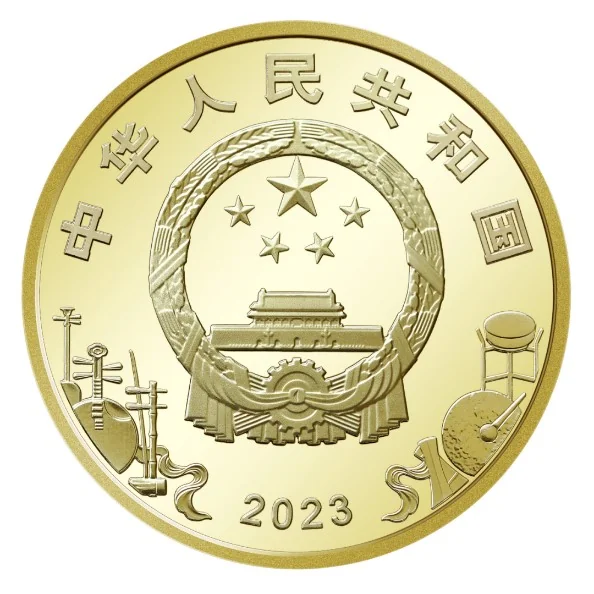

5 Yuan – People's Republic of China
China
Context
Year: 2023
Country: China 
Issuer: People's Republic of China
Period:
(since 1949)
Currency:
(since 1955)
Total mintage: 60,000,000
Material


References
KM: #Click to copy to clipboard2841
Numista: #390105
Value
Exchange value: 5 CNY = $0.73
Inflation-adjusted value: 4.99 CNY
Obverse
Reverse
Description:
The reverse features the iconic "Sheng" opera character, with colored highlights, decorative motifs, and the inscriptions "中国京剧艺术" and "5元".
Inscription:
5元
中国 京劇艺术
中国 京劇艺术
Translation:
5 Yuan
Chinese Peking Opera Art
Chinese Peking Opera Art
Script: Chinese (simplified)
Language: Chinese
Edge
Reeded
Mintings
| Year | Mint Mark | Mintage | Quality | Collection |
|---|---|---|---|---|
| 2023 | — | 60,000,000 |
Historical background
In 2023, the People's Republic of China navigated a complex currency environment characterized by managed stability amid significant economic headwinds. The central theme was the People's Bank of China's (PBOC) careful balancing act to support a faltering post-pandemic recovery—marked by weak domestic demand and a property sector crisis—while preventing excessive depreciation of the renminbi (RMB) against a strong US dollar. The PBOC set the daily USD/CNY reference rate persistently stronger than market forecasts, a clear signal of its intent to curb one-way depreciation bets and maintain currency stability as a cornerstone of financial confidence.
The RMB faced substantial downward pressure throughout much of the year, primarily driven by the wide interest rate differential with the United States, where the Federal Reserve maintained a hawkish stance. This led to capital outflow pressures and reduced foreign investment inflows. In response, the authorities utilized a full toolkit: beyond the daily fixing, they employed strong verbal guidance, reduced foreign currency reserve requirements for banks, and made measured interventions in the offshore market (CNH) to squeeze short-sellers. The overarching goal was to avoid a volatile, disorderly depreciation that could trigger capital flight and destabilize financial markets.
By the year's end, the policy focus had subtly shifted. While guarding against sharp volatility remained paramount, there was a growing tolerance for a slightly weaker currency to aid export competitiveness, a critical growth lever as domestic consumption struggled. The RMB's value against a basket of trading-partner currencies (CFETS index) was allowed more flexibility, reflecting a dual objective: managing the dollar-pair for stability while using trade-weighted depreciation to provide modest economic support. Thus, 2023 concluded with the RMB having experienced controlled depreciation against the dollar, but within parameters firmly orchestrated by Chinese policymakers to serve broader macroeconomic stability goals.
The RMB faced substantial downward pressure throughout much of the year, primarily driven by the wide interest rate differential with the United States, where the Federal Reserve maintained a hawkish stance. This led to capital outflow pressures and reduced foreign investment inflows. In response, the authorities utilized a full toolkit: beyond the daily fixing, they employed strong verbal guidance, reduced foreign currency reserve requirements for banks, and made measured interventions in the offshore market (CNH) to squeeze short-sellers. The overarching goal was to avoid a volatile, disorderly depreciation that could trigger capital flight and destabilize financial markets.
By the year's end, the policy focus had subtly shifted. While guarding against sharp volatility remained paramount, there was a growing tolerance for a slightly weaker currency to aid export competitiveness, a critical growth lever as domestic consumption struggled. The RMB's value against a basket of trading-partner currencies (CFETS index) was allowed more flexibility, reflecting a dual objective: managing the dollar-pair for stability while using trade-weighted depreciation to provide modest economic support. Thus, 2023 concluded with the RMB having experienced controlled depreciation against the dollar, but within parameters firmly orchestrated by Chinese policymakers to serve broader macroeconomic stability goals.




🌱 Fairly Common