

20 Euro (Ilmari Tapiovaara) – Finland
Non-circulating coins
Commemoration: 100th Anniversary of birth of Ilmari Tapiovaara
Finland
Context

Material
References
KM: #Click to copy to clipboard220
Numista: #387973
Value
Exchange value: 20 EUR = $23.63
Bullion value: $67.05
Inflation-adjusted value: 25.09 EUR
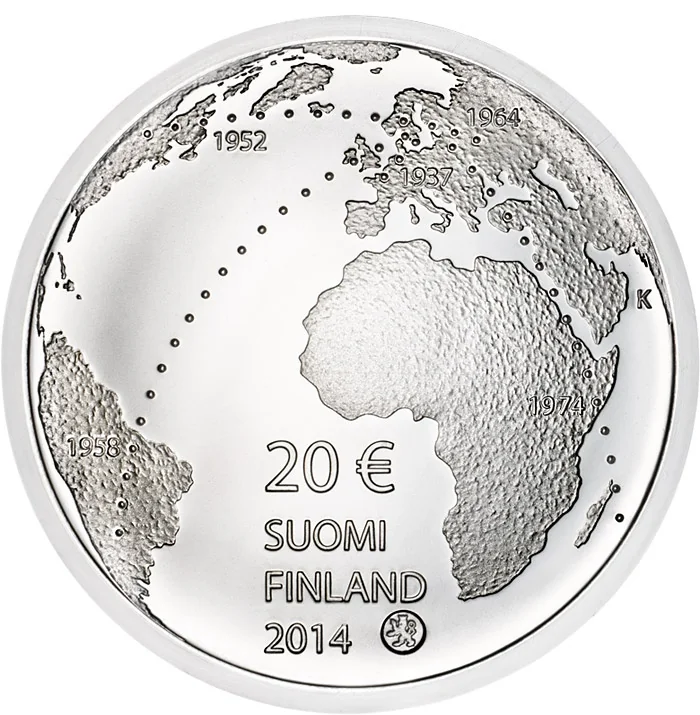
Obverse
Description:
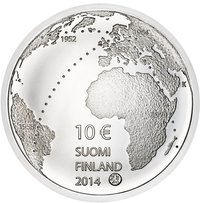
A world map showing Tapiovaara's travels from Finland to France, the USA, Paraguay, the Soviet Union, and Mauritius in 1937, 1952, 1958, 1964, and 1974, marked with outward lines and dates.
Inscription:
20 €
SUOMI
FINLAND
2014
K
1937 1952 1958 1964 1974
SUOMI
FINLAND
2014
K
1937 1952 1958 1964 1974
Translation:
20 €
FINLAND
FINLAND
2014
K
1937 1952 1958 1964 1974
FINLAND
FINLAND
2014
K
1937 1952 1958 1964 1974
Script: Latin
Designer: Harri Koskinen
Reverse
Description:
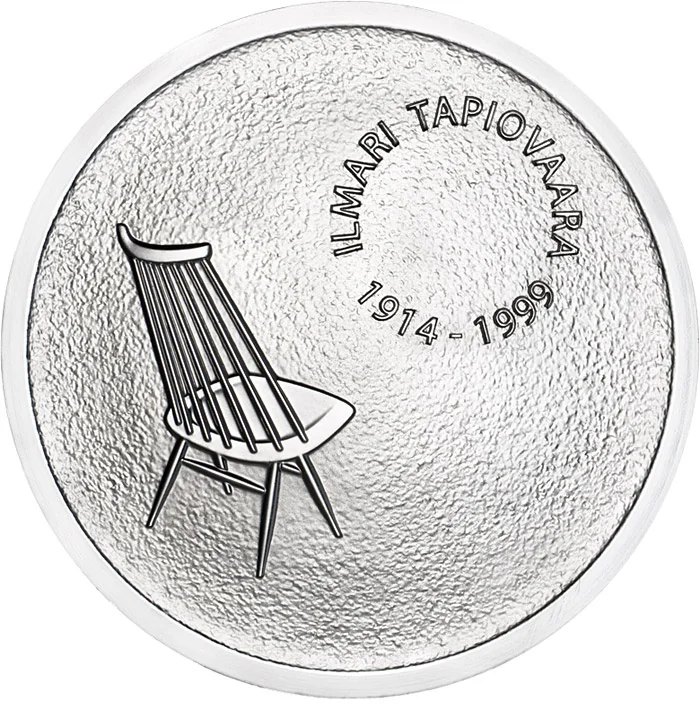
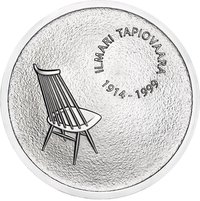
Photo of the Mademoiselle chair, labeled with "Ilmari Tapiovaara 1914-1999" in a circular layout.
Inscription:
ILMARI TAPIOVAARA
1914 - 1999
1914 - 1999
Script: Latin
Edge
Plain
Categories
| Event> Birth anniversary |
| Map |
Mints
| Name | Mark |
|---|---|
| Mint of Finland | — |
Mintings
| Year | Mint Mark | Mintage | Quality | Collection |
|---|---|---|---|---|
| 2014 | — | 5,000 | Proof |
Historical background
In 2014, Finland's currency situation was defined by its steadfast membership in the Eurozone, using the euro (€) as its sole legal tender since 2002. The country was not facing a domestic currency crisis, but rather navigating significant economic challenges within the common currency framework. These challenges were pronounced, as Finland was grappling with a triple shock: the decline of its flagship Nokia-led technology sector, structural problems in the traditional forestry and paper industry, and the economic repercussions of Western sanctions on Russia, a key trading partner. This led to a period of stagnant growth, rising public debt, and a loss of competitiveness relative to other Eurozone members, a situation often referred to as the "Finnish disease."
The euro's performance in 2014 provided a mixed backdrop. The European Central Bank (ECB), under President Mario Draghi, was actively employing accommodative monetary policy, including historic low interest rates, to combat deflationary risks and stimulate the struggling Eurozone economy following the sovereign debt crisis. For Finland, this meant benefiting from a stable and credible currency, but also being subject to a monetary policy stance that was arguably too loose for its specific cyclical position, potentially exacerbating issues like household debt. Furthermore, the euro's exchange rate against major currencies was a point of focus for export-oriented Finnish industries.
Domestically, there was no serious political movement to abandon the euro, as it was seen as integral to Finland's European identity and provided stability. However, the difficult economic climate fueled a broader debate about the country's future within the monetary union. Discussions centered on the need for profound structural reforms, fiscal consolidation, and improving cost competitiveness, as devaluation was not an option. Thus, Finland's 2014 currency situation was one of institutional stability with the euro, but set against a tense economic reality that tested the advantages and constraints of sharing a common currency during asymmetric national downturns.
The euro's performance in 2014 provided a mixed backdrop. The European Central Bank (ECB), under President Mario Draghi, was actively employing accommodative monetary policy, including historic low interest rates, to combat deflationary risks and stimulate the struggling Eurozone economy following the sovereign debt crisis. For Finland, this meant benefiting from a stable and credible currency, but also being subject to a monetary policy stance that was arguably too loose for its specific cyclical position, potentially exacerbating issues like household debt. Furthermore, the euro's exchange rate against major currencies was a point of focus for export-oriented Finnish industries.
Domestically, there was no serious political movement to abandon the euro, as it was seen as integral to Finland's European identity and provided stability. However, the difficult economic climate fueled a broader debate about the country's future within the monetary union. Discussions centered on the need for profound structural reforms, fiscal consolidation, and improving cost competitiveness, as devaluation was not an option. Thus, Finland's 2014 currency situation was one of institutional stability with the euro, but set against a tense economic reality that tested the advantages and constraints of sharing a common currency during asymmetric national downturns.
✨ Legendary