

2½ milliemes – Egypt
Add to wishlist
Egypt
Context
Year: 1933
Islamic (Hijri) Year:: 1352
Issuer: Egypt
Ruler: Ahmed Fuad I
Currency:
(since 1916)
Demonetized: Yes
Total mintage: 4,000,000
Material
Diameter: 19.94 mm
Weight: 3 g
Thickness: 1.5 mm
Shape: Octagonal
Composition: Copper-nickel
Technique: Milled
Alignment: Medal alignment
flip
References
KM: #
Numista: #10267
Value
Exchange value: 0.0025 EGP
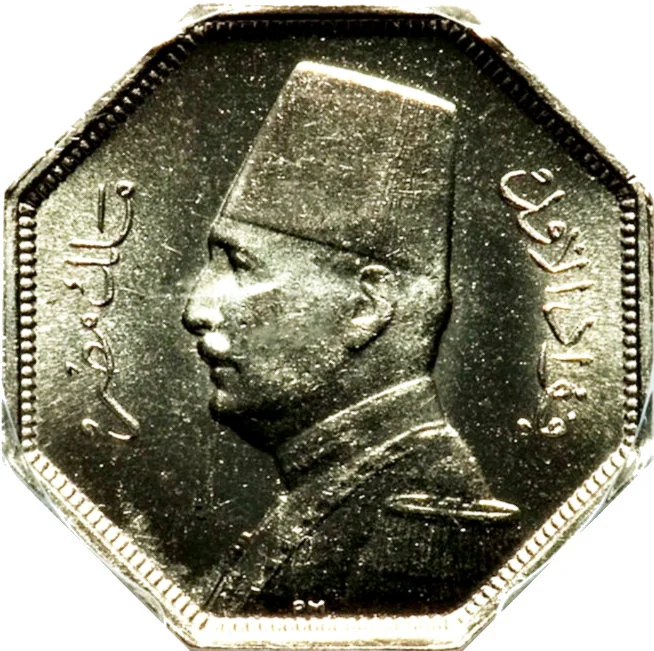
Obverse
Description:
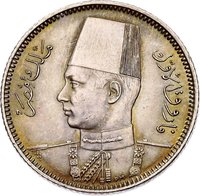
King Fuad I of Egypt.
Inscription:
فواد الأول
ملك مصر
ملك مصر
Translation:
Fuad I
King of Egypt
King of Egypt
Script: Arabic
Language: Arabic
Engraver: Percy Metcalfe
Reverse
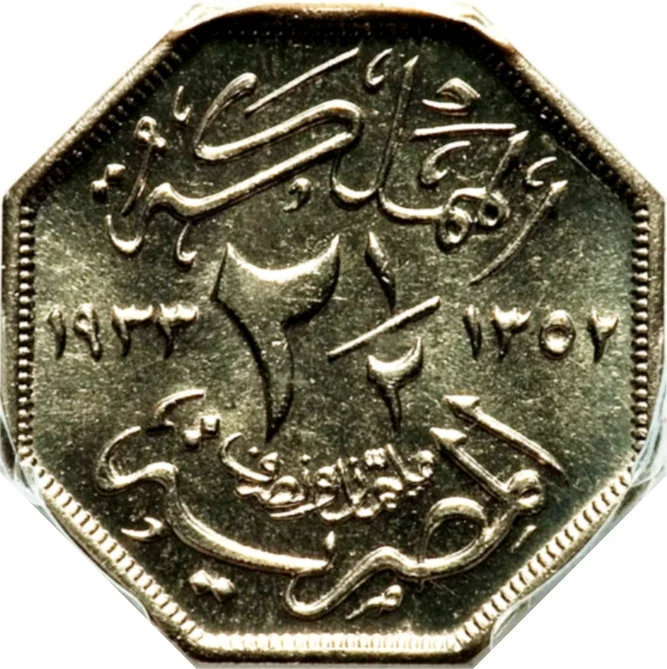
Description:
Denominations split dates.
Inscription:
المملكة المصرية
١٩٣٣
١/٢ ٢
مليمات مصرية
١٣٥٢
١٩٣٣
١/٢ ٢
مليمات مصرية
١٣٥٢
Translation:
Egyptian Kingdom
1933
1/2 2
Egyptian Millimes
1352
1933
1/2 2
Egyptian Millimes
1352
Script: Arabic (naskh)
Language: Arabic
Edge
Plain
Mints
| Name | Mark |
|---|---|
| Heaton and Sons / The Mint Birmingham | — |
Mintings
| Year | Mint Mark | Mintage | Quality | Collection |
|---|---|---|---|---|
| 1933 | — | 4,000,000 |
Historical background
In 1933, Egypt's currency situation was defined by its adherence to the Gold Exchange Standard and its close economic ties to Britain. The Egyptian pound (EE) was pegged to sterling, which itself was pegged to gold, creating a stable but externally dependent monetary system. This arrangement facilitated trade and investment, particularly with the British Empire, but also meant that Egypt's monetary policy was largely dictated by the Bank of England and the economic conditions in London, limiting Cairo's autonomous control over its own economy.
The stability of this system faced a significant test in 1931 when Britain abandoned the gold standard, causing sterling to depreciate. Egypt made the pivotal decision to follow sterling off gold, maintaining the peg. This choice, while protecting the vital cotton export sector by keeping Egyptian goods competitively priced in key markets, also imported the inflationary pressures of a devalued currency. The decision underscored Egypt's vulnerable position within the sterling bloc, prioritizing trade relationships over independent monetary management during the global turbulence of the Great Depression.
Consequently, the currency landscape in 1933 was one of managed dependency. The Egyptian pound's value was stable against sterling but fluctuated against gold-backed currencies like the US dollar. The economy remained heavily oriented around cotton exports, and the banking sector was dominated by foreign institutions. While this system provided a measure of stability during a period of global financial chaos, it highlighted Egypt's colonial-era economic structures and the constraints on its national financial sovereignty, setting the stage for future debates over economic independence.
The stability of this system faced a significant test in 1931 when Britain abandoned the gold standard, causing sterling to depreciate. Egypt made the pivotal decision to follow sterling off gold, maintaining the peg. This choice, while protecting the vital cotton export sector by keeping Egyptian goods competitively priced in key markets, also imported the inflationary pressures of a devalued currency. The decision underscored Egypt's vulnerable position within the sterling bloc, prioritizing trade relationships over independent monetary management during the global turbulence of the Great Depression.
Consequently, the currency landscape in 1933 was one of managed dependency. The Egyptian pound's value was stable against sterling but fluctuated against gold-backed currencies like the US dollar. The economy remained heavily oriented around cotton exports, and the banking sector was dominated by foreign institutions. While this system provided a measure of stability during a period of global financial chaos, it highlighted Egypt's colonial-era economic structures and the constraints on its national financial sovereignty, setting the stage for future debates over economic independence.
🌱 Common