

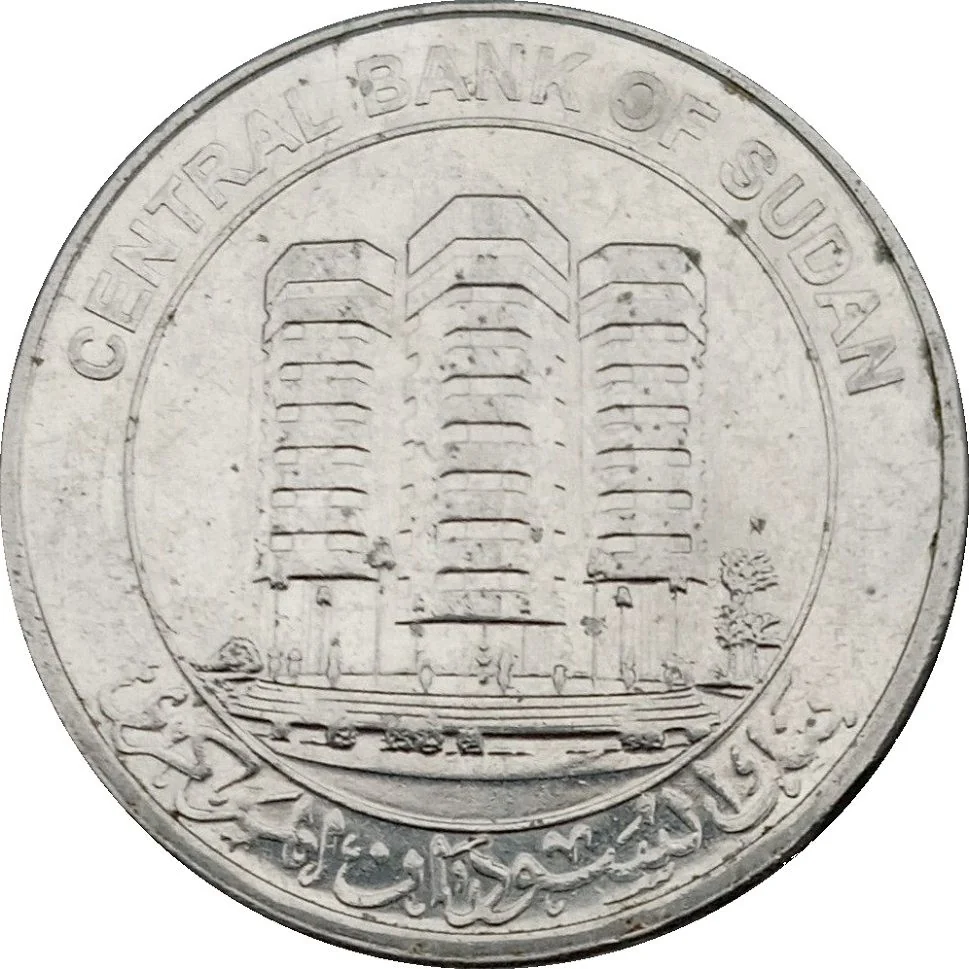
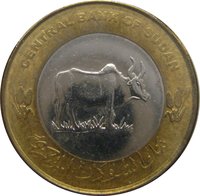
Obverse
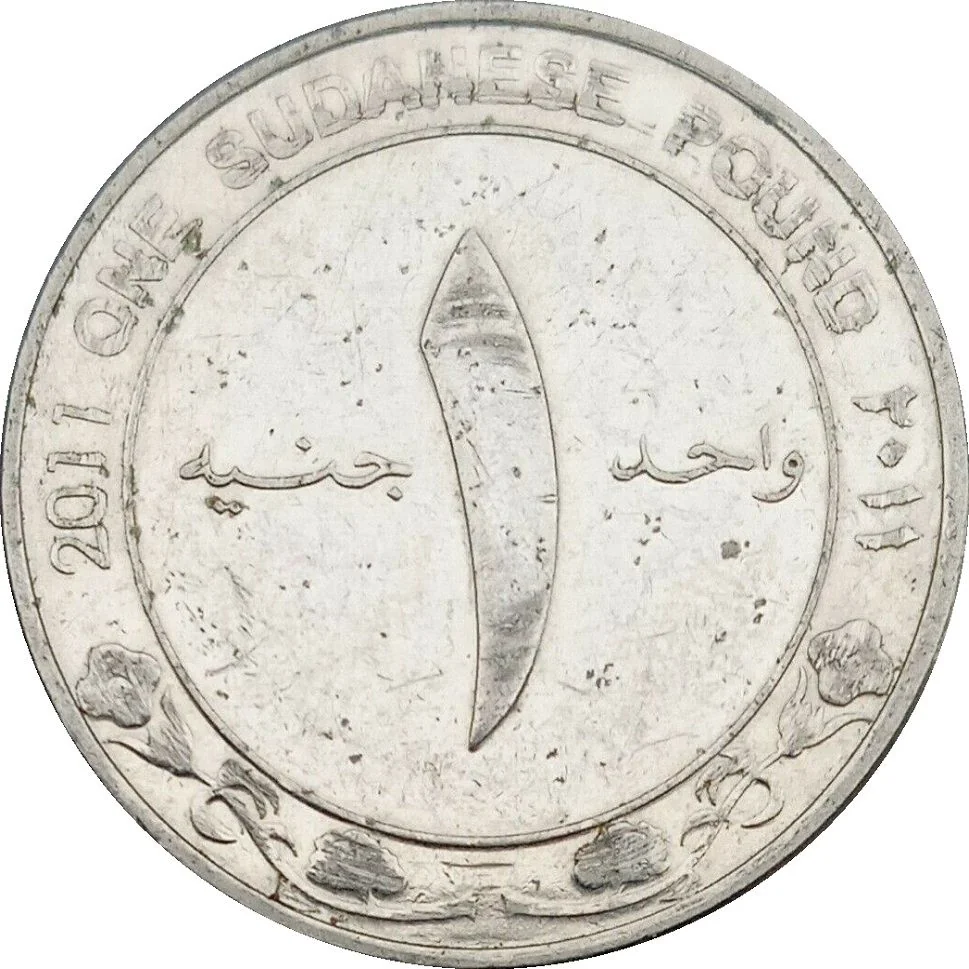
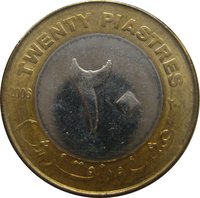
Reverse
Edge
Categories
| Building |
Mintings
| Year | Mint Mark | Mintage | Quality | Collection |
|---|---|---|---|---|
| 2011 | — | — |
Historical background
Following the secession of South Sudan in July 2011, Sudan faced an immediate and profound currency crisis. The new nation took with it approximately 75% of the unified country's oil reserves, devastating Sudan's primary source of foreign revenue and state budget. A critical and urgent question emerged: what would become of the Sudanese pound (SDG), which had circulated in both nations? The two governments had agreed that South Sudan would establish its own currency, but there was a contentious six-month transition period where the old Sudanese pound notes remained legal tender in both countries, creating significant monetary instability.
During this period, Sudan experienced severe economic shocks. The loss of oil income crippled the government's ability to fund imports or support the currency, leading to a drastic shortage of foreign exchange. This triggered a rapid devaluation of the Sudanese pound on the parallel black market, while the Central Bank of Sudan attempted to maintain an unrealistic official peg. Inflation, already high, began to accelerate sharply as the cost of imported goods soared. The situation was exacerbated by the circulation of large amounts of currency from the south, which Khartoum feared would flood back, further stoking inflation.
The crisis culminated in late 2011 with Sudan's decisive, but economically painful, policy response. Before the agreed-upon transition period ended, the Sudanese government suddenly announced the issuance of a new Sudanese pound, requiring citizens to exchange old notes within a very short timeframe. This was effectively a forced demonetization aimed at invalidating the currency held in South Sudan, protecting its foreign reserves, and gaining control over the money supply. While this move shielded the economy from a greater flood of currency, it inflicted hardship on ordinary Sudanese, especially those in border regions or with informal savings, and marked the beginning of a prolonged period of economic hardship and currency depreciation.
During this period, Sudan experienced severe economic shocks. The loss of oil income crippled the government's ability to fund imports or support the currency, leading to a drastic shortage of foreign exchange. This triggered a rapid devaluation of the Sudanese pound on the parallel black market, while the Central Bank of Sudan attempted to maintain an unrealistic official peg. Inflation, already high, began to accelerate sharply as the cost of imported goods soared. The situation was exacerbated by the circulation of large amounts of currency from the south, which Khartoum feared would flood back, further stoking inflation.
The crisis culminated in late 2011 with Sudan's decisive, but economically painful, policy response. Before the agreed-upon transition period ended, the Sudanese government suddenly announced the issuance of a new Sudanese pound, requiring citizens to exchange old notes within a very short timeframe. This was effectively a forced demonetization aimed at invalidating the currency held in South Sudan, protecting its foreign reserves, and gaining control over the money supply. While this move shielded the economy from a greater flood of currency, it inflicted hardship on ordinary Sudanese, especially those in border regions or with informal savings, and marked the beginning of a prolonged period of economic hardship and currency depreciation.
🌱 Common