

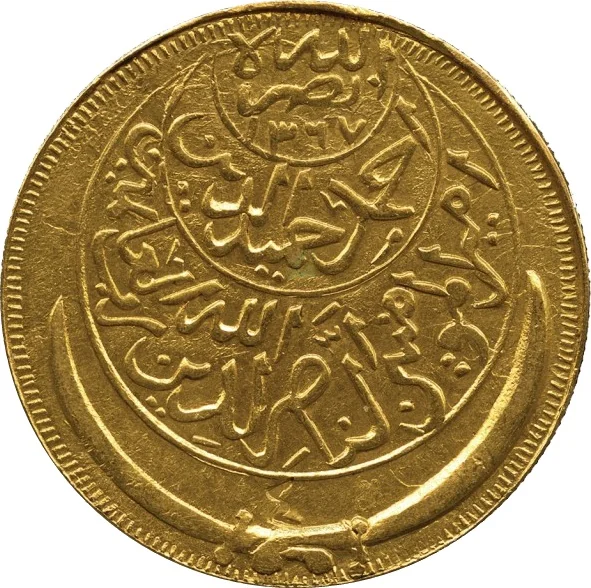
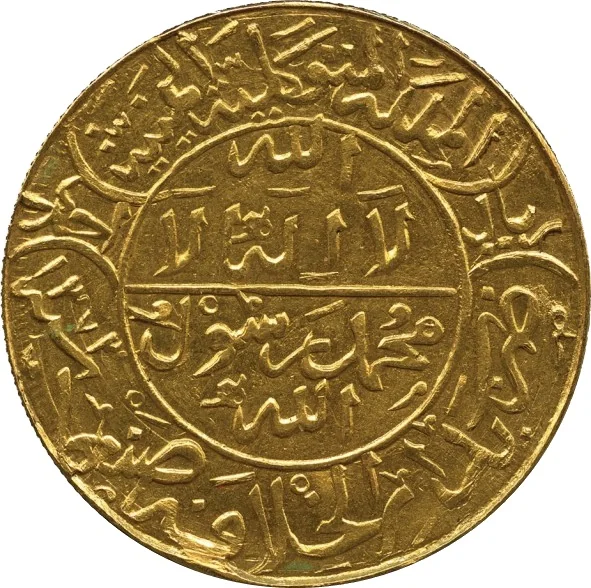
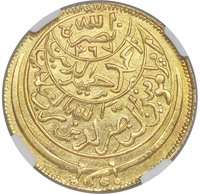
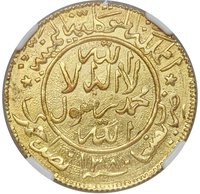
1 rial – Mutawakkilite Kingdom
Add to wishlist
Yemen
Context
Years: 1952–1953
Country: Yemen
Issuer: Mutawakkilite Kingdom
Ruler: Ahmad bin Yahya
Currency:
(1918—1974)
Demonetized: Yes
Material
Diameter: 40 mm
Weight: 31.24 g
Gold Weight:: 28.12 g
Shape: Round
Composition: 90% Gold
Standard: Silver ounce
Magnetic: No
References
Y: #
Numista: #142779
Value
Bullion value: $4319.43
Mintings
| Year | Mint Mark | Mintage | Quality | Collection |
|---|---|---|---|---|
| 1952 | — | — | ||
| 1953 | — | — |
Historical background
In 1952, the Mutawakkilite Kingdom of Yemen remained one of the world's most isolated and economically underdeveloped states, a condition directly reflected in its currency situation. The nation operated without a central bank or a formal, unified monetary system. The primary currency in circulation was the Yemeni Riyal, a large, silver coin minted in the kingdom, but its use was limited and it competed with a plethora of foreign and historical currencies. The economy was fundamentally pre-modern, relying heavily on barter, particularly in rural areas, with silver Maria Theresa thalers and British sovereigns serving as the most trusted stores of value for larger transactions and trade.
This fragmented system was a product of extreme isolation under Imam Ahmad bin Yahya's rule and the deliberate restriction of foreign influence. International trade was minimal and tightly controlled, with the main economic activities being subsistence agriculture and small-scale commerce. The lack of a paper currency or a banking infrastructure meant that the state's fiscal capabilities were severely constrained; government revenue came largely from taxes on agricultural produce and limited customs duties from the port of Al Hudaydah. Financial dealings with the outside world were conducted through a handful of foreign merchants and the exchange of physical silver.
Consequently, the currency situation in 1952 was one of stagnation and inertia, mirroring the kingdom's political and social order. It stood in stark contrast to the financial modernization occurring elsewhere in the Middle East. This archaic system would persist until the dramatic changes of the 1960s, first with the introduction of the first paper notes by Imam Ahmad in 1960, and then its complete overhaul following the revolution and establishment of the Yemen Arab Republic in 1962, which sought to integrate Yemen into the global economy.
This fragmented system was a product of extreme isolation under Imam Ahmad bin Yahya's rule and the deliberate restriction of foreign influence. International trade was minimal and tightly controlled, with the main economic activities being subsistence agriculture and small-scale commerce. The lack of a paper currency or a banking infrastructure meant that the state's fiscal capabilities were severely constrained; government revenue came largely from taxes on agricultural produce and limited customs duties from the port of Al Hudaydah. Financial dealings with the outside world were conducted through a handful of foreign merchants and the exchange of physical silver.
Consequently, the currency situation in 1952 was one of stagnation and inertia, mirroring the kingdom's political and social order. It stood in stark contrast to the financial modernization occurring elsewhere in the Middle East. This archaic system would persist until the dramatic changes of the 1960s, first with the introduction of the first paper notes by Imam Ahmad in 1960, and then its complete overhaul following the revolution and establishment of the Yemen Arab Republic in 1962, which sought to integrate Yemen into the global economy.
✨ Legendary