


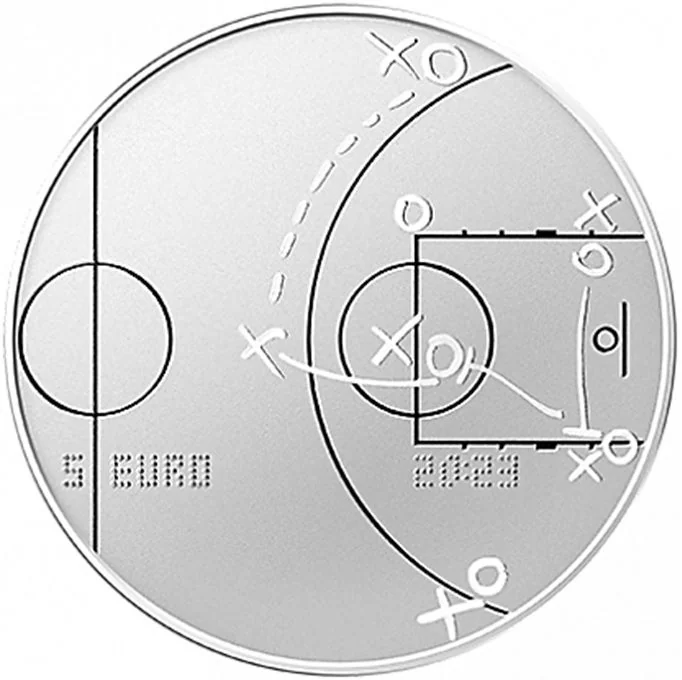
5 euro (Basketball in Latvia) – Latvia
Add to wishlist
Non-circulating coins
Commemoration: 100 years of basketball in Latvia
Latvia
Context
Material

References
KM: #
Numista: #384089
Value
Exchange value: 5 EUR
Bullion value: $56.16
Inflation-adjusted value: 5.55 EUR
Obverse
Description:
A gold-plated basketball on a rim, with "LATVIJAS BASKETBOLAM 100" arched below.
Inscription:
LATVIJAS BASKETBOLAM 100
Translation:
For Latvian Basketball 100
Script: Latin
Language: Latvian
Designer: Paulis Liepa
Reverse
Description:
A basketball court section showing a tactical play, with "5 EURO" and "20:23" at the bottom center.
Inscription:
5 EURO
20:23
20:23
Script: Latin
Designer: Paulis Liepa
Edge
The inscriptions "LATVIJAS BANKA" and "LATVIJAS REPUBLIKA", separated by rhombic dots. Gold-plated
Legend:
LATVIJAS BANKA ◊ LATVIJAS REPUBLIKA ◊
Translation:
LATVIJAS BANKA ◊ LATVIJAS REPUBLIKA ◊
Language: Latvian
Categories
| Sport> Basketball |
Mints
| Name | Mark |
|---|---|
| Rome | — |
Mintings
| Year | Mint Mark | Mintage | Quality | Collection |
|---|---|---|---|---|
| 2023 | — | 3,000 | Proof |
Historical background
In 2023, Latvia's currency situation was firmly anchored within the Eurozone, having adopted the euro as its official currency on January 1, 2014. This meant the national currency, the Latvian lats (LVL), was no longer in circulation, and all monetary policy was set by the European Central Bank (ECB). Consequently, Latvia's key financial challenges for the year were not about exchange rate volatility but were instead defined by the broader Eurozone's fight against high inflation and rising interest rates. The ECB's successive rate hikes throughout 2022 and 2023 aimed to cool the euro area economy, directly impacting borrowing costs for Latvian businesses and households.
The primary domestic economic concern related to currency was the persistently high inflation rate, which, though easing from its peak, remained among the highest in the Eurozone. Averaging around 9% for the year, inflation was driven by elevated energy and food prices, partly exacerbated by the ongoing geopolitical fallout from the war in Ukraine. This eroded purchasing power and placed pressure on living standards. However, the fixed exchange rate provided stability, shielding the country from the currency devaluation and capital flight risks that might have occurred had it still maintained an independent currency during a period of such economic pressure.
Looking forward, Latvia's financial stability within the euro framework in 2023 was seen as a net positive, ensuring secure integration into European supply chains and financial markets. The focus for policymakers was therefore not on currency management, but on using fiscal policy and national measures to mitigate the inflationary squeeze. This included government subsidies to manage energy costs and efforts to boost economic productivity and competitiveness within the single currency area, navigating the challenges posed by the ECB's restrictive monetary policy stance.
The primary domestic economic concern related to currency was the persistently high inflation rate, which, though easing from its peak, remained among the highest in the Eurozone. Averaging around 9% for the year, inflation was driven by elevated energy and food prices, partly exacerbated by the ongoing geopolitical fallout from the war in Ukraine. This eroded purchasing power and placed pressure on living standards. However, the fixed exchange rate provided stability, shielding the country from the currency devaluation and capital flight risks that might have occurred had it still maintained an independent currency during a period of such economic pressure.
Looking forward, Latvia's financial stability within the euro framework in 2023 was seen as a net positive, ensuring secure integration into European supply chains and financial markets. The focus for policymakers was therefore not on currency management, but on using fiscal policy and national measures to mitigate the inflationary squeeze. This included government subsidies to manage energy costs and efforts to boost economic productivity and competitiveness within the single currency area, navigating the challenges posed by the ECB's restrictive monetary policy stance.


💎 Extremely Rare