

20 baiocchi – Papal States
Add to wishlist
Vatican City
Context
Years: 1848–1856
Country: Vatican City
Issuer: Papal States
Ruler: Pius IX
Currency:
(1835—1866)
Subdivision: 20 baiocchi = 1 Doppio Giulio
Demonetized: Yes
Total mintage: 1,078,547
Material
References
KM: #
Numista: #38351
Value
Bullion value: $11.86
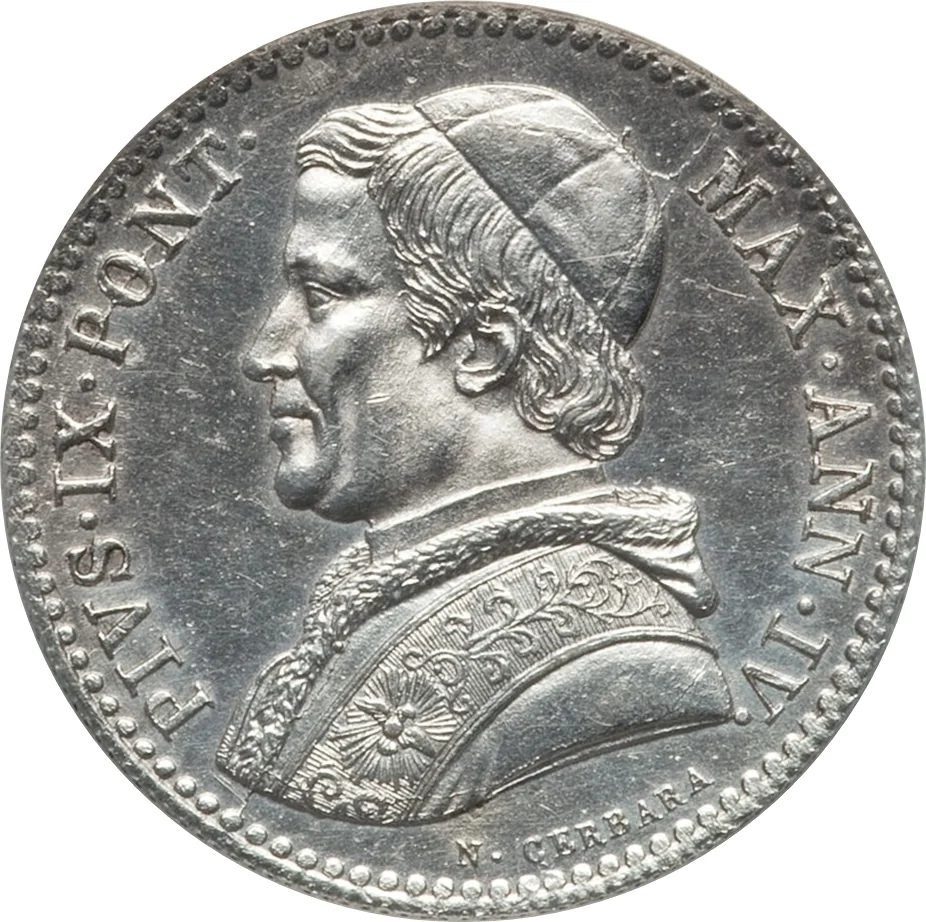
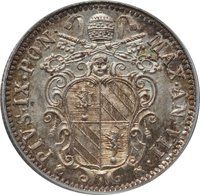
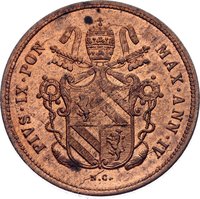
Obverse
Description:
Capped bust left.
Inscription:
PIVS·IX·PONT· MAX·ANN·IV·
Translation:
Pius IX, Supreme Pontiff, Year Four.
Script: Latin
Language: Latin
Engraver: Niccolò Cerbara
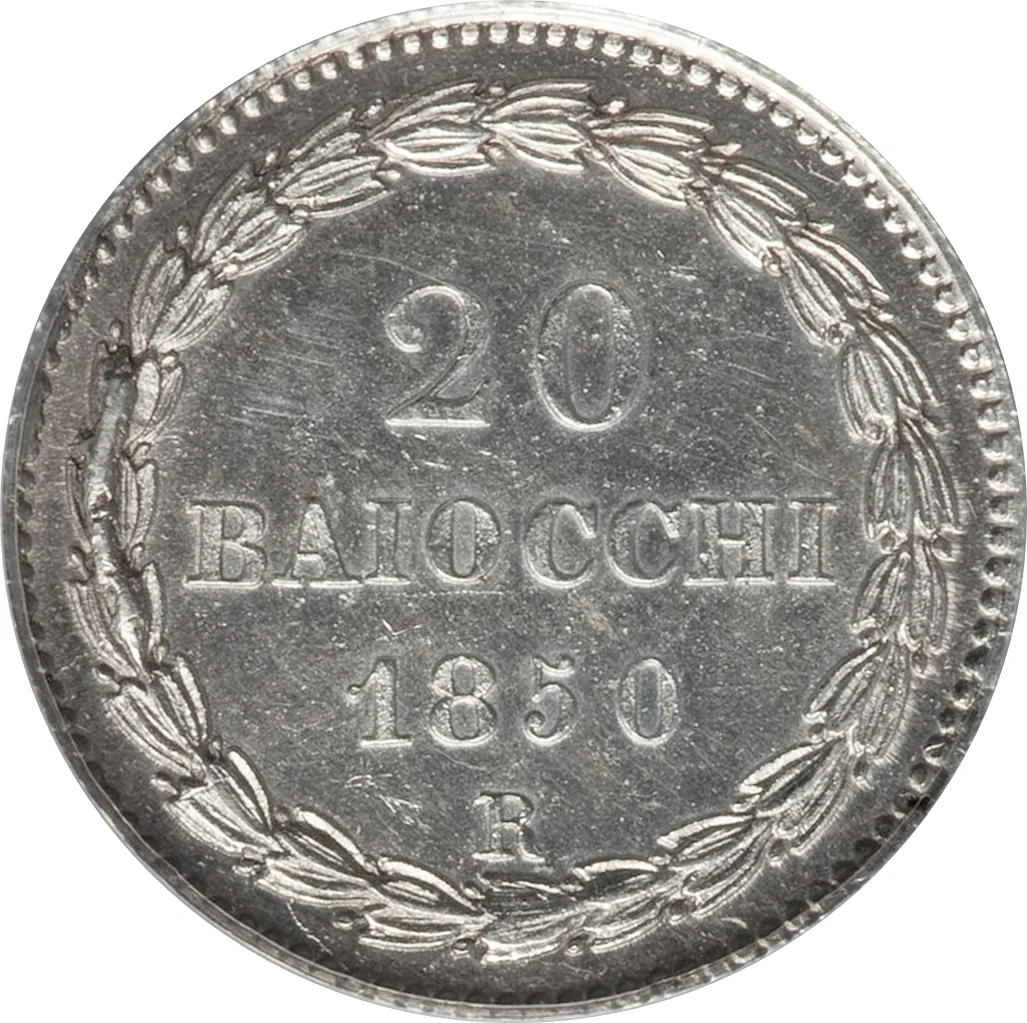
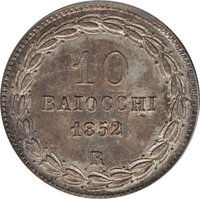
Reverse
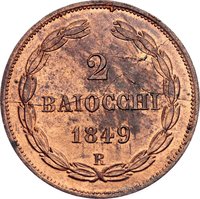
Description:
Date, value, and mintmark encircled by wreath.
Inscription:
20
BAIOCCHI
1830
R
BAIOCCHI
1830
R
Script: Latin
Engraver: Niccolò Cerbara
Edge
Reeded
Mintings
| Year | Mint Mark | Mintage | Quality | Collection |
|---|---|---|---|---|
| 1848 | — | — | ||
| 1848 | B | — | ||
| 1848 | R | 66,199 | ||
| 1849 | B | 21,758 | ||
| 1849 | R | 104,086 | ||
| 1850 | B | 6,940 | ||
| 1850 | R | 673,872 | ||
| 1851 | B | 154,606 | ||
| 1852 | B | 4,204 | ||
| 1852 | R | 10,000 | ||
| 1853 | R | 12,580 | ||
| 1854 | R | 1,915 | ||
| 1856 | R | 22,387 |
Historical background
In 1848, the Papal States, a central Italian polity under the temporal rule of the Pope, faced a severe and multifaceted currency crisis deeply intertwined with political revolution. The state's finances were chronically weak, relying heavily on debt and the circulation of multiple, often depreciated, coinage systems. Alongside the official Papal scudo, various regional coinages from other Italian states circulated, and the widespread use of debased low-denomination "biglione" (billon) coins created a chaotic and inflationary monetary environment. This fragile system was pushed to the brink by the extraordinary expenses of the revolutionary year, including the cost of fielding a military force to join the war against Austria in the north.
The political upheaval of 1848 was the catalyst for financial collapse. Following the election of the liberal Pope Pius IX and the initial granting of a constitution, the Papal government, under Minister Pellegrino Rossi and later the short-lived Roman Republic, was forced to issue massive amounts of paper money to cover its deficits, particularly the costs of war. This took the form of cedole, or treasury bonds, which began to circulate as a forced paper currency. Public confidence in this paper money evaporated rapidly as military setbacks occurred and the Pope fled to Gaeta in November 1848. The currency became virtually worthless, leading to a halt in commerce and a barter economy in many areas.
Thus, by the end of 1848, the monetary situation was one of complete disarray. The authority of the Papal mint was undermined, the scudo was effectively displaced by a mountain of depreciated paper, and the competing revolutionary government of the Roman Republic (proclaimed in early 1849) would attempt its own financial measures. The currency crisis was both a symptom and a cause of the state's disintegration, reflecting the loss of sovereign credibility and the immense economic cost of the revolution, which would only be "resolved" by the military restoration of papal authority in 1850 and a subsequent, drastic currency reform.
The political upheaval of 1848 was the catalyst for financial collapse. Following the election of the liberal Pope Pius IX and the initial granting of a constitution, the Papal government, under Minister Pellegrino Rossi and later the short-lived Roman Republic, was forced to issue massive amounts of paper money to cover its deficits, particularly the costs of war. This took the form of cedole, or treasury bonds, which began to circulate as a forced paper currency. Public confidence in this paper money evaporated rapidly as military setbacks occurred and the Pope fled to Gaeta in November 1848. The currency became virtually worthless, leading to a halt in commerce and a barter economy in many areas.
Thus, by the end of 1848, the monetary situation was one of complete disarray. The authority of the Papal mint was undermined, the scudo was effectively displaced by a mountain of depreciated paper, and the competing revolutionary government of the Roman Republic (proclaimed in early 1849) would attempt its own financial measures. The currency crisis was both a symptom and a cause of the state's disintegration, reflecting the loss of sovereign credibility and the immense economic cost of the revolution, which would only be "resolved" by the military restoration of papal authority in 1850 and a subsequent, drastic currency reform.
⭐ Rare