

5 baiocchi – Papal States
Add to wishlist
Vatican City
Context
Years: 1849–1850
Country: Vatican City
Issuer: Papal States
Ruler: Pius IX
Currency:
(1835—1866)
Demonetized: Yes
Total mintage: 12,512,160
Material
References
KM: #
Numista: #38349
Obverse
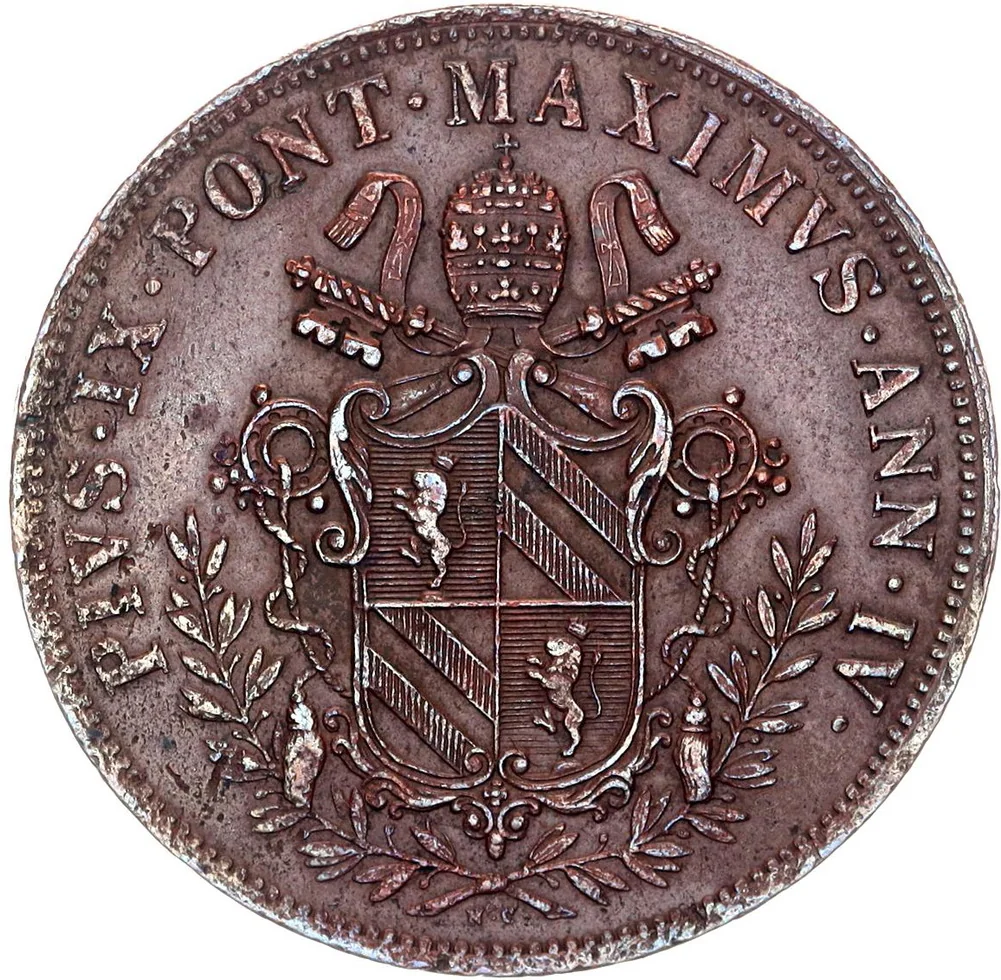
Description:
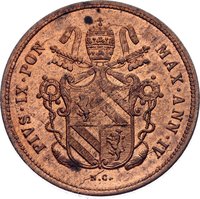
Papal arms. Engraver's initials beneath.
Inscription:
PIVS٠IX٠PONT٠MAXIMVS٠ANN٠IV٠
N. C.
N. C.
Translation:
Pius IX, Supreme Pontiff, Year 4.
Script: Latin
Language: Latin
Engraver: Niccolò Cerbara
Reverse
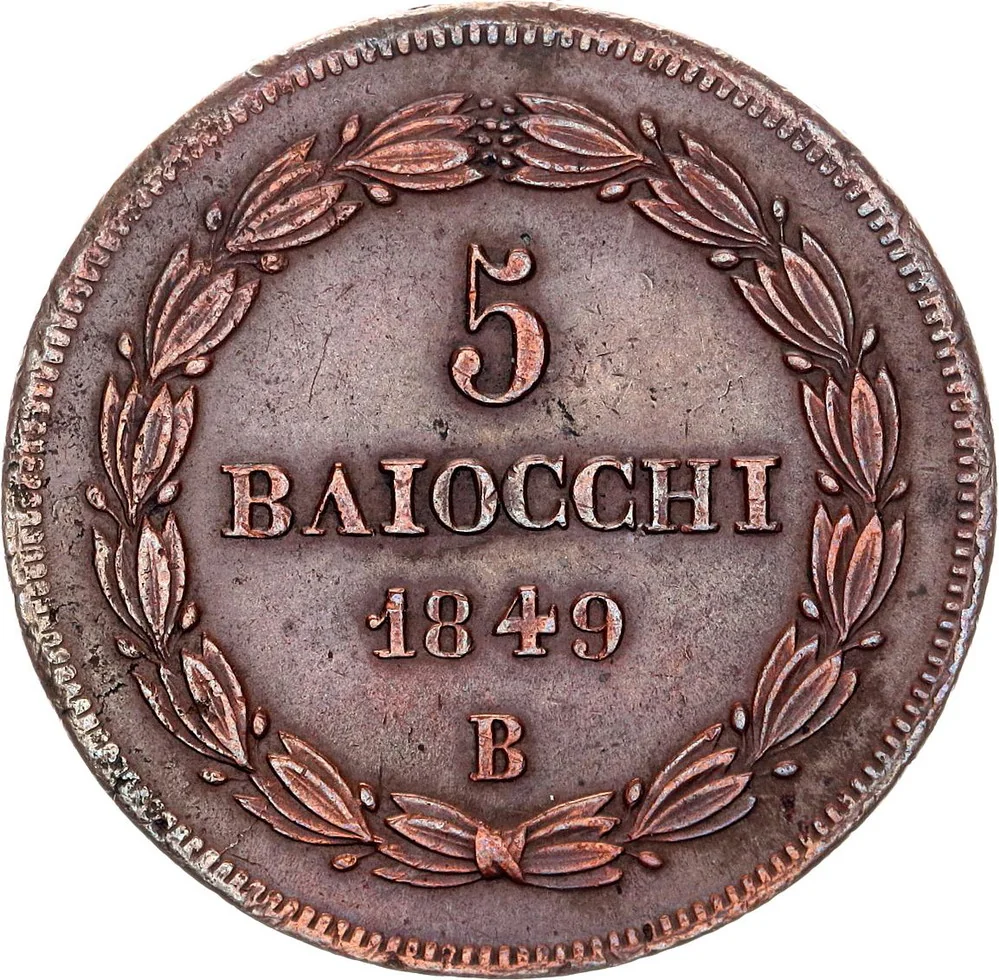
Description:
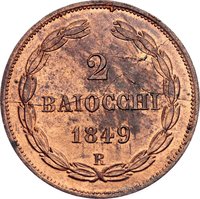
Value and date encircled
Inscription:
5
BAIOCCHI
1849
R
BAIOCCHI
1849
R
Script: Latin
Engraver: Niccolò Cerbara
Edge
Plain
Categories
| Symbols> Coat of Arms |
| Symbol> Wreath |
Mintings
Historical background
In 1849, the Papal States faced a severe monetary crisis, a direct consequence of the political upheaval of the Roman Republic. Following Pope Pius IX's flight to Gaeta in November 1848, the revolutionary government that took power in February 1849 inherited depleted coffers. To finance its defense against impending French and Austrian intervention, the Republic resorted to issuing a forced paper currency. This money, known as the "paper scudo" or "moneta di carta," was decreed as legal tender but was not backed by sufficient specie (gold or silver) in the treasury, leading to immediate depreciation and public distrust.
The situation was exacerbated by the existence of two competing currencies in circulation. Alongside the new republican paper scudi, older papal coins minted from silver, known as "scudi di moneta," continued to circulate. The public, understandably, hoarded the valuable papal silver coins and spent the rapidly depreciating paper, a classic example of Gresham's Law ("bad money drives out good"). This created a chaotic dual-system where prices skyrocketed, and the paper currency's value plummeted to a fraction of its face value, crippling daily commerce and causing significant hardship for the populace.
With the collapse of the Roman Republic in July 1849 and the Pope's restoration, the papal government was left with the formidable task of monetary stabilization. The restored authorities initially recognized the republican paper currency at a heavily discounted rate to prevent total economic collapse, but the process of withdrawing it from circulation and restoring confidence in the papal scudo was slow and painful. Thus, the currency situation of 1849 left a legacy of financial instability and debt that burdened the Papal States for years, highlighting the intimate link between political crisis and monetary disorder in this final phase of its existence.
The situation was exacerbated by the existence of two competing currencies in circulation. Alongside the new republican paper scudi, older papal coins minted from silver, known as "scudi di moneta," continued to circulate. The public, understandably, hoarded the valuable papal silver coins and spent the rapidly depreciating paper, a classic example of Gresham's Law ("bad money drives out good"). This created a chaotic dual-system where prices skyrocketed, and the paper currency's value plummeted to a fraction of its face value, crippling daily commerce and causing significant hardship for the populace.
With the collapse of the Roman Republic in July 1849 and the Pope's restoration, the papal government was left with the formidable task of monetary stabilization. The restored authorities initially recognized the republican paper currency at a heavily discounted rate to prevent total economic collapse, but the process of withdrawing it from circulation and restoring confidence in the papal scudo was slow and painful. Thus, the currency situation of 1849 left a legacy of financial instability and debt that burdened the Papal States for years, highlighting the intimate link between political crisis and monetary disorder in this final phase of its existence.
⭐ Rare