

20 pesos – Mexico
Add to wishlist
Circulating commemorative coins
Commemoration: Bicentennial of Mexico’s Military Academy
Mexico
Context
Material
Diameter: 30 mm
Weight: 12.67 g
Shape: Dodecagonal
Technique: Milled
Alignment: Coin alignment
flip
References
KM: #
Numista: #382137
Value
Exchange value: 20 MXN
Inflation-adjusted value: 21.98 MXN
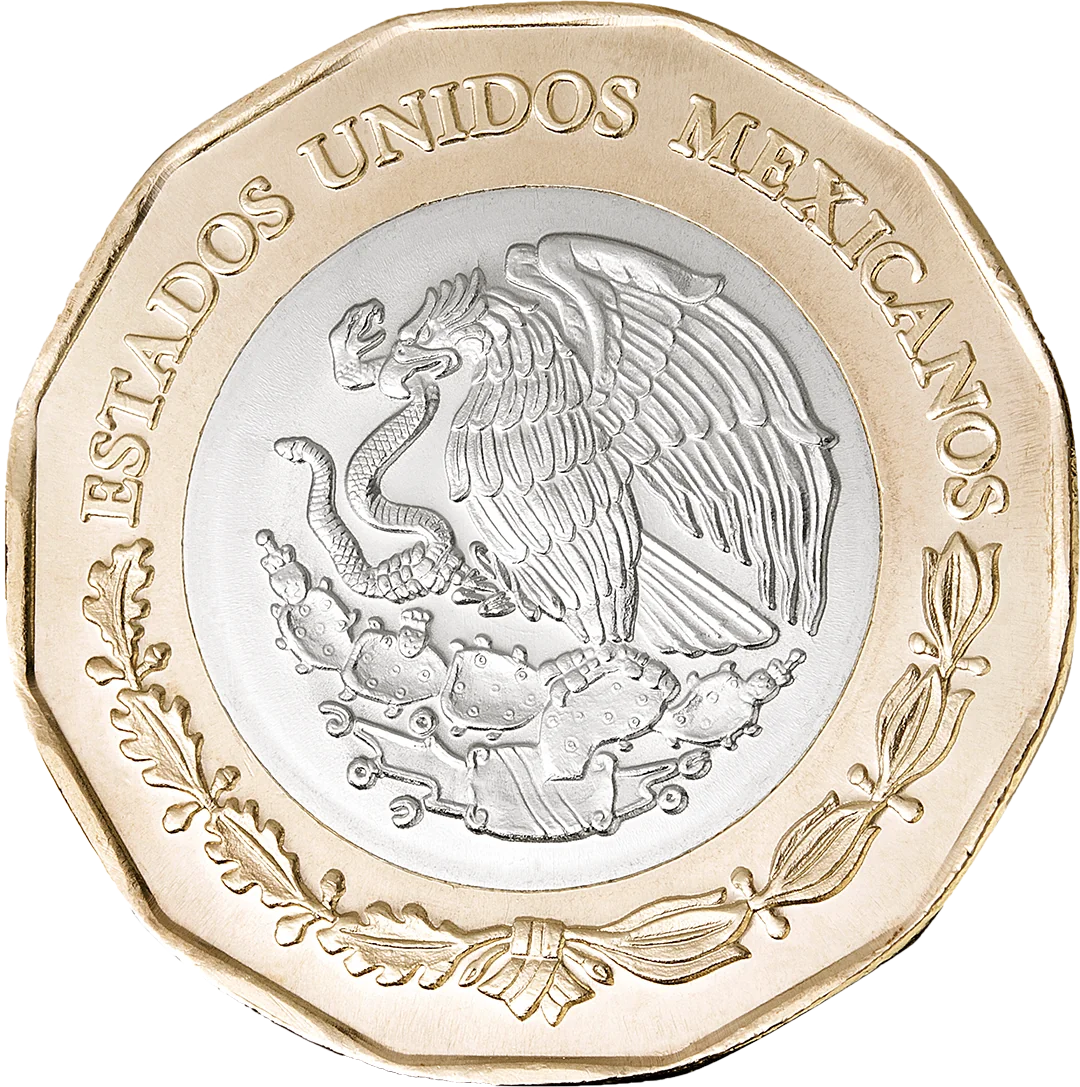
Obverse
Reverse
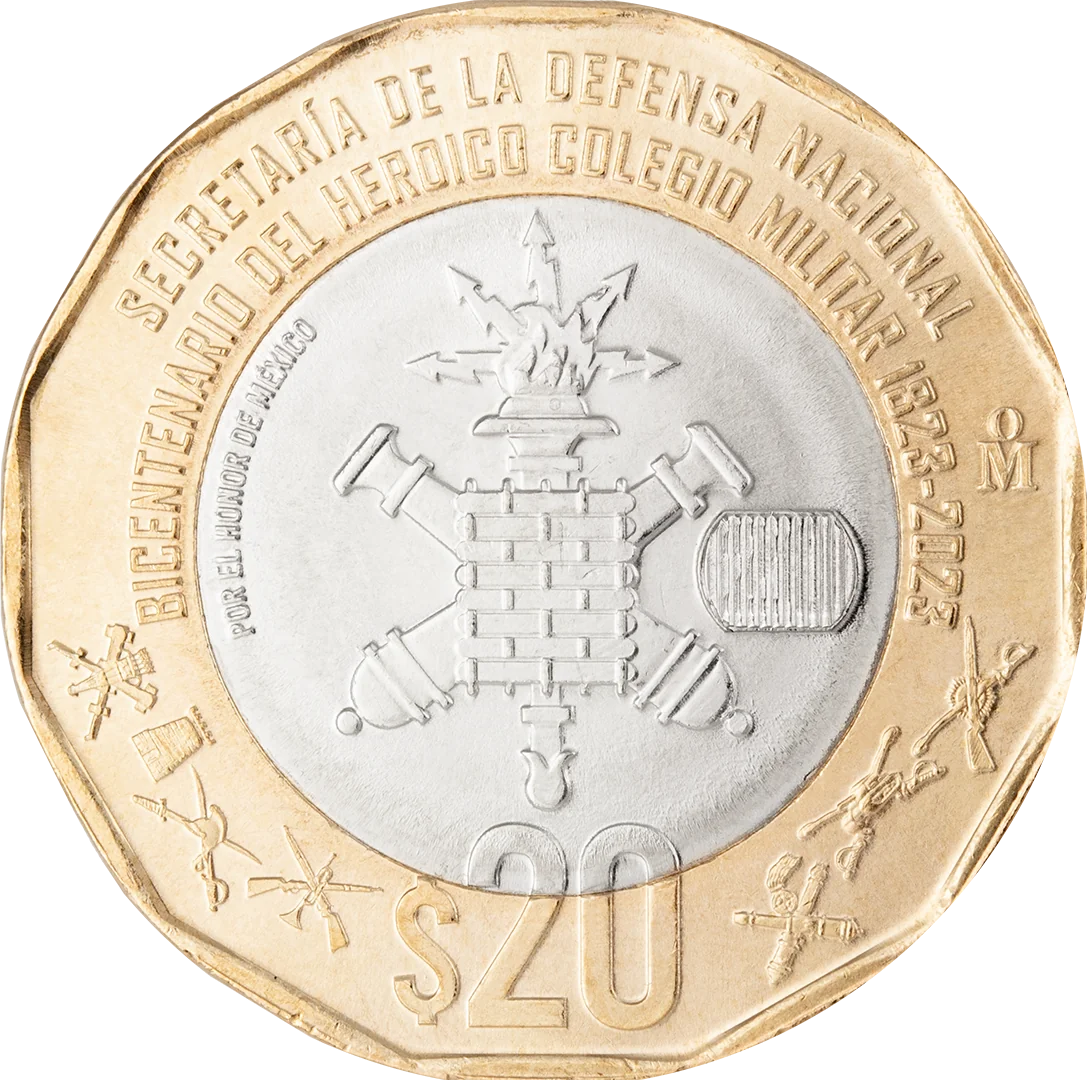
Description:
Mexican military academy coat of arms, value below, mintmark and microtext to the right.
Inscription:
SECRETARÍA DE LA DEFENSA NACIONAL
BICENTENARIO DEL HEROICO COLEGIO MILITAR 1823-2023
POR EL HONOR DE MÉXICO
Mo
20
$20
BICENTENARIO DEL HEROICO COLEGIO MILITAR 1823-2023
POR EL HONOR DE MÉXICO
Mo
20
$20
Translation:
Secretaría de la Defensa Nacional
Bicentennial of the Heroic Military College 1823-2023
For the Honor of Mexico
Mo
20
$20
Bicentennial of the Heroic Military College 1823-2023
For the Honor of Mexico
Mo
20
$20
Script: Latin
Language: Spanish
Edge
Interrupted milled
Categories
| Animal> Bird> Eagle |
| Building> Castle or fortification |
| Object> Firearms |
| Symbols> Coat of Arms |
| Symbol> Wreath |
Mints
| Name | Mark |
|---|---|
| Mexican Mint | (Mo) |
Mintings
| Year | Mint Mark | Mintage | Quality | Collection |
|---|---|---|---|---|
| 2023 | Mo | 4,994,775 |
Historical background
In 2023, the Mexican peso (MXN) defied broader global trends and emerged as one of the strongest performing currencies in the world against the US dollar. This strength was notable given the context of global monetary tightening, regional economic uncertainty, and persistent domestic inflation. Key drivers included high interest rates set by Banco de México (Banxico), which maintained its benchmark rate at a record 11.25% for much of the year to combat inflation, attracting substantial foreign capital into Mexican bonds. Furthermore, the phenomenon of "nearshoring"—where companies relocate supply chains closer to the US market—fueled optimism about long-term foreign direct investment, supporting the currency.
Despite the peso's external strength, domestic economic challenges persisted. Inflation, though gradually declining from its 2022 peak, remained stubbornly above Banxico's 3% target throughout the year, eroding purchasing power for households. This created a complex scenario where a strong currency helped lower import costs but also posed potential risks to export competitiveness. The government, led by President Andrés Manuel López Obrador, maintained a policy of fiscal discipline and avoided major spending shocks, which provided additional stability and investor confidence, even amid debates over controversial reforms in the energy and electoral sectors.
Looking forward, the currency's trajectory in late 2023 was closely tied to expectations for Banxico's monetary policy and the global economic outlook. While the peso benefited from its high yield and the nearshoring narrative, analysts cautioned that its valuation was becoming historically high, making it vulnerable to shifts in risk sentiment or changes in the interest rate differential with the United States. The overall situation presented a paradox of a robust currency coexisting with ongoing domestic economic pressures, setting a cautious stage for Mexico's entry into 2024.
Despite the peso's external strength, domestic economic challenges persisted. Inflation, though gradually declining from its 2022 peak, remained stubbornly above Banxico's 3% target throughout the year, eroding purchasing power for households. This created a complex scenario where a strong currency helped lower import costs but also posed potential risks to export competitiveness. The government, led by President Andrés Manuel López Obrador, maintained a policy of fiscal discipline and avoided major spending shocks, which provided additional stability and investor confidence, even amid debates over controversial reforms in the energy and electoral sectors.
Looking forward, the currency's trajectory in late 2023 was closely tied to expectations for Banxico's monetary policy and the global economic outlook. While the peso benefited from its high yield and the nearshoring narrative, analysts cautioned that its valuation was becoming historically high, making it vulnerable to shifts in risk sentiment or changes in the interest rate differential with the United States. The overall situation presented a paradox of a robust currency coexisting with ongoing domestic economic pressures, setting a cautious stage for Mexico's entry into 2024.
🌱 Fairly Common