

25 cents – Danish West Indies
Add to wishlist
United States
Context
Year: 1850
Country: United States
Issuer: Danish West Indies
Ruler: Frederick VII
Currency:
(1849—1905)
Demonetized: Yes
Material
Diameter: 24.3 mm
Weight: 6.68 g
Silver Weight:: 6.01 g
Thickness: 1.75 mm
Shape: Round
Composition: 90% Silver
Magnetic: No
Techniques: Milled, Counterstamped
Alignment: Coin alignment
flip
References
KM: #
Numista: #382134
Value
Bullion value: $15.36
Obverse
Description:
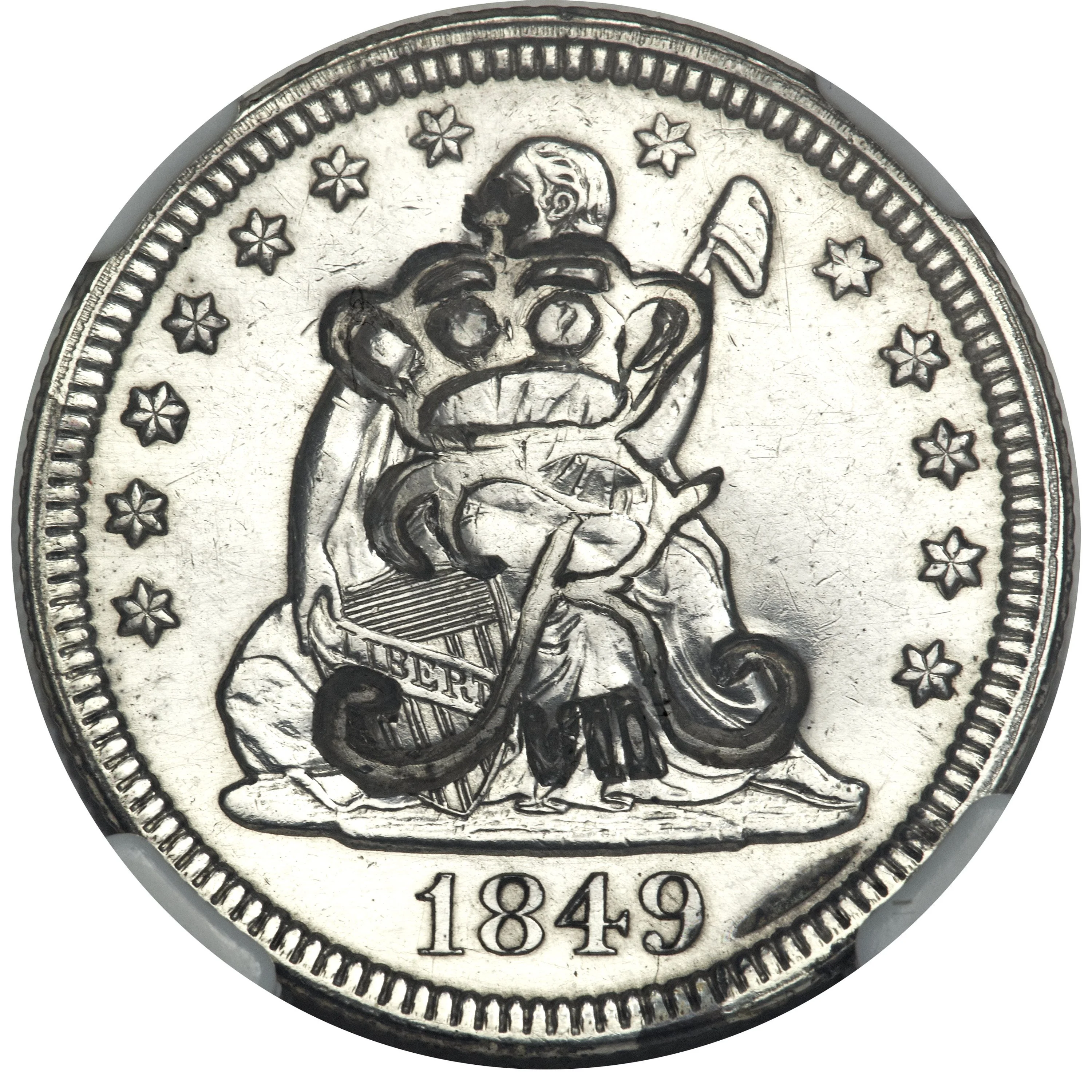
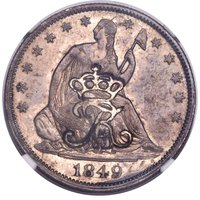
Seated Liberty with shield, cap on pole, 13 stars. Crowned FRVII monogram above.
Inscription:
FRVII
LIBERTY
1849
LIBERTY
1849
Translation:
FRVII
LIBERTY
1849
LIBERTY
1849
Script: Latin
Designer: Christian Gobrecht
Reverse
Description:
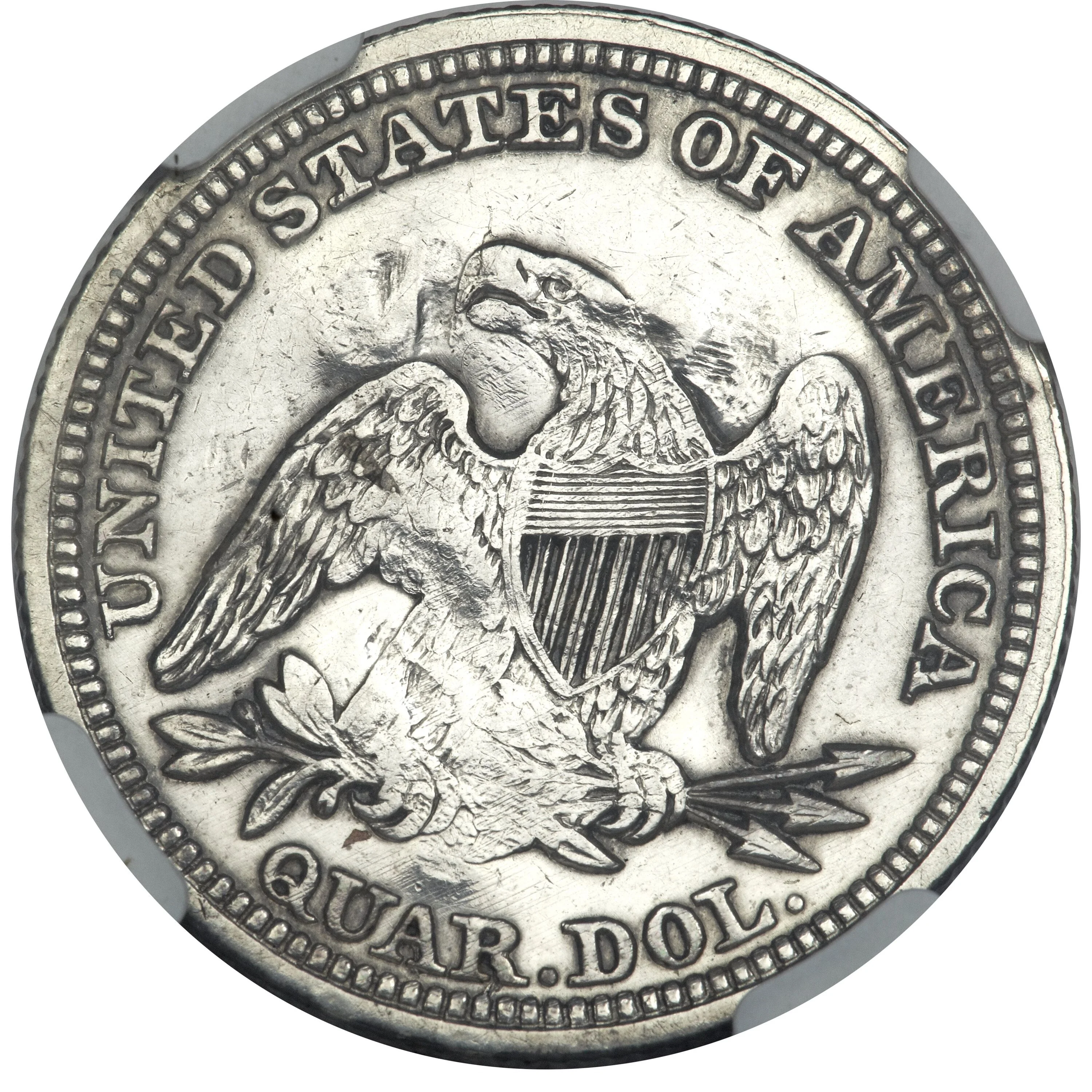
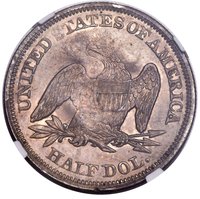
Eagle clutching arrows and an olive branch.
Inscription:
UNITED STATES OF AMERICA
QUAR. DOL.
QUAR. DOL.
Script: Latin
Designer: Christian Gobrecht
Edge
Reeded
Categories
| Animal> Bird> Eagle |
| Object> Armour |
| Symbol> Allegory |
| Symbols> Monogram |
| Symbol> Phrygian cap |
Mintings
| Year | Mint Mark | Mintage | Quality | Collection |
|---|---|---|---|---|
| 1850 | — | — |
Historical background
In 1850, the currency situation in the Danish West Indies (present-day U.S. Virgin Islands) was a complex and often chaotic system defined by its international port economy. The islands of St. Thomas, St. Croix, and St. John operated on a dual-currency system. Officially, the Danish rigsdaler was the colonial currency, divided into 96 skilling. However, in daily commercial life, especially in the bustling free port of Charlotte Amalie, a multitude of foreign coins circulated freely and were essential for trade. Spanish and Mexican silver dollars (pieces of eight), British sovereigns, and U.S. gold and silver coins were all common, their values fluctuating against each other and the rigsdaler based on weight and fineness.
This monetary pluralism was a direct result of the colony's role as a central trading hub in the Caribbean. The economy was not self-contained; it was deeply integrated into regional and Atlantic commerce, relying on the transit of goods and the provisioning of ships. Merchants and planters needed internationally recognized specie to settle accounts with foreign traders, making the Spanish dollar, a long-standing global benchmark, particularly dominant. The Danish authorities, recognizing they could not suppress this practice, periodically issued official exchange rate proclamations to fix the value of these foreign coins in skillings, attempting to bring some order to the market.
Consequently, the system was cumbersome and prone to confusion. Business transactions required constant calculation and conversion, while the government struggled with the practicalities of revenue collection in a consistent standard. For the enslaved majority of the population, who engaged in small-scale marketing of garden produce, access to coinage was limited, often dealing in the lowest denominations or barter. Thus, the currency landscape of 1850 reflected the colony's dual identity: a Danish political possession trying to administer a fundamentally international and mercantile economy through a fragile and improvised monetary framework.
This monetary pluralism was a direct result of the colony's role as a central trading hub in the Caribbean. The economy was not self-contained; it was deeply integrated into regional and Atlantic commerce, relying on the transit of goods and the provisioning of ships. Merchants and planters needed internationally recognized specie to settle accounts with foreign traders, making the Spanish dollar, a long-standing global benchmark, particularly dominant. The Danish authorities, recognizing they could not suppress this practice, periodically issued official exchange rate proclamations to fix the value of these foreign coins in skillings, attempting to bring some order to the market.
Consequently, the system was cumbersome and prone to confusion. Business transactions required constant calculation and conversion, while the government struggled with the practicalities of revenue collection in a consistent standard. For the enslaved majority of the population, who engaged in small-scale marketing of garden produce, access to coinage was limited, often dealing in the lowest denominations or barter. Thus, the currency landscape of 1850 reflected the colony's dual identity: a Danish political possession trying to administer a fundamentally international and mercantile economy through a fragile and improvised monetary framework.
✨ Legendary