

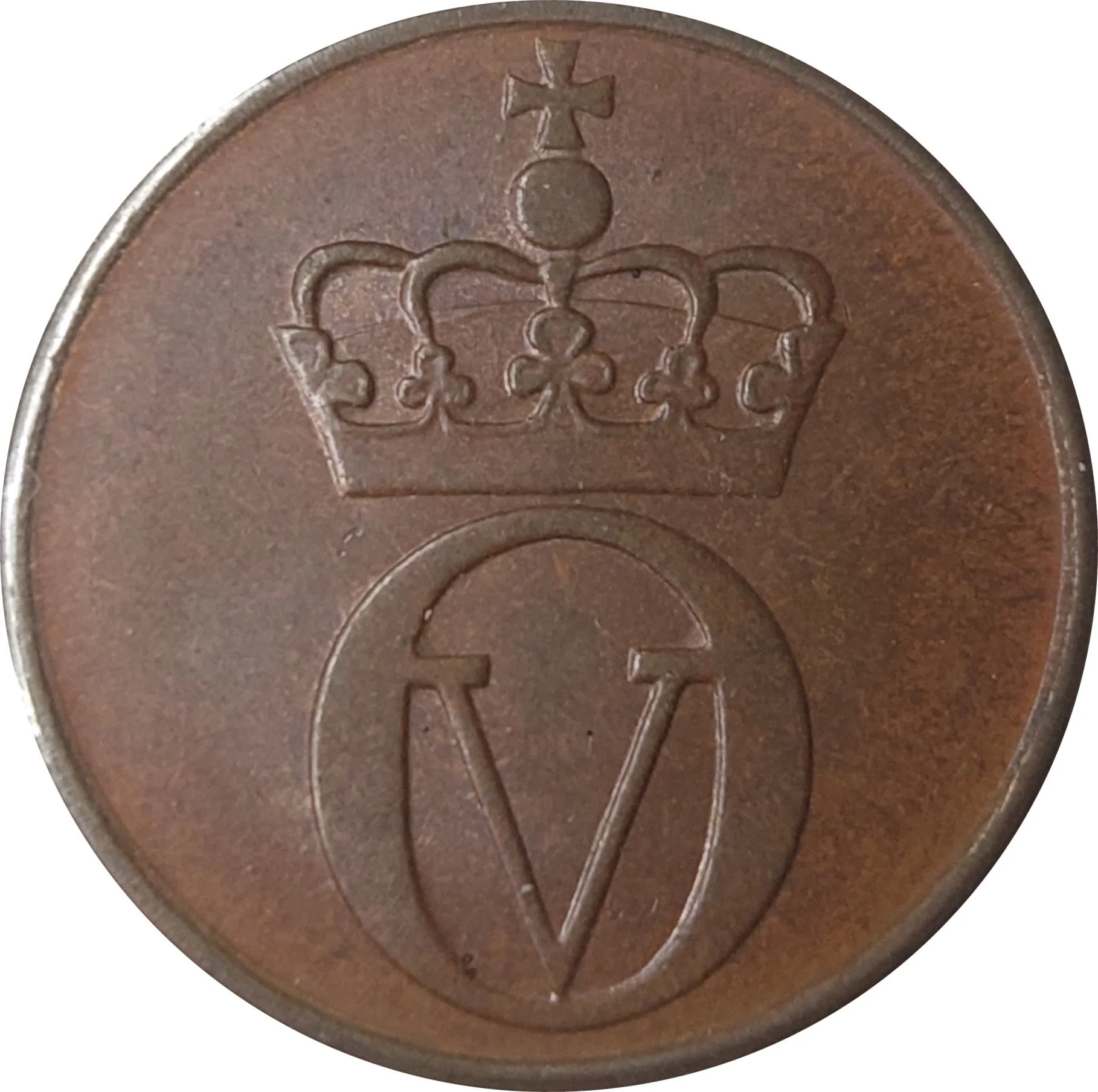
Obverse
Reverse
Description:
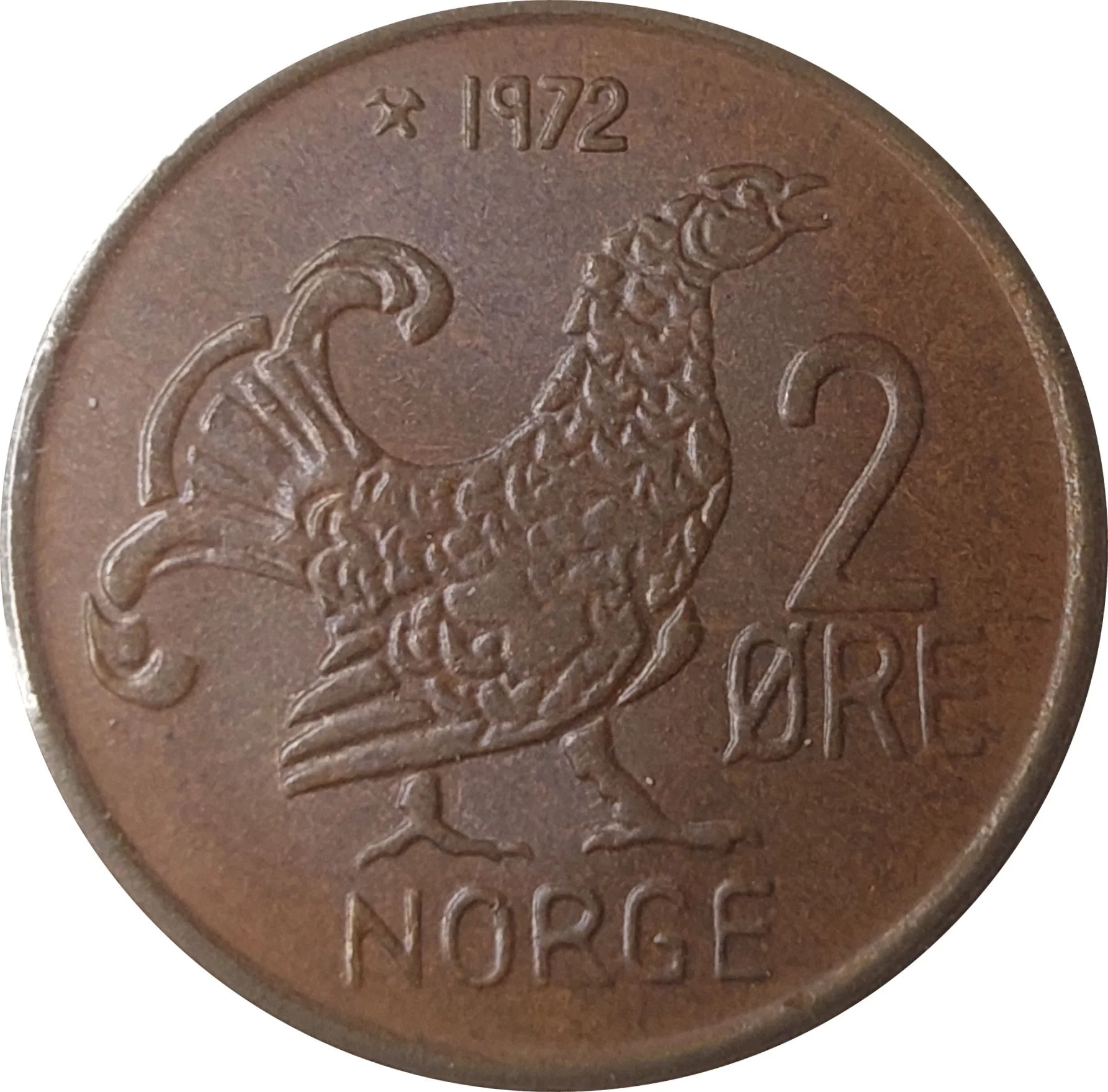
Black grouse facing right. Mintmark and date above, value to the right. Inscription below. Solid rim ring.
Inscription:
⚒ 1972
2
ØRE
NORGE
2
ØRE
NORGE
Translation:
2
ØRE
NORWAY
ØRE
NORWAY
Script: Latin
Language: Norwegian
Engraver: Per Palle Storm
Edge
Plain
Mints
| Name | Mark |
|---|---|
| Norwegian Mint | — |
Mintings
| Year | Mint Mark | Mintage | Quality | Collection |
|---|---|---|---|---|
| 1959 | — | 4,125,000 | ||
| 1960 | — | 200 | ||
| 1961 | — | 4,477,000 | ||
| 1962 | — | 6,205,000 | ||
| 1963 | — | 4,840,000 | ||
| 1964 | — | 7,250,000 | ||
| 1965 | — | 6,239,200 | ||
| 1966 | — | 10,483,600 | ||
| 1967 | — | 11,990,600 | ||
| 1968 | — | 3,467 | In sets | |
| 1969 | — | 305,100 | ||
| 1970 | — | 6,784,500 | ||
| 1970 | — | — | Proof | |
| 1971 | — | 15,455,500 | ||
| 1972 | — | 15,885,000 |
Historical background
In 1959, Norway's currency situation was defined by its membership in the Bretton Woods system, which pegged the Norwegian krone (NOK) to the US dollar at a fixed but adjustable rate. This arrangement, managed by the central bank (Norges Bank), provided stability for a nation heavily reliant on foreign trade, particularly for its growing export industries like shipping and emerging oil exploration. However, the system also required strict capital controls to prevent speculative flows and maintain the peg, limiting the free movement of money across borders.
The domestic economy was in a phase of robust post-war reconstruction and industrialization, fuelled by significant investment. This created persistent pressures on the krone, as strong import demand for machinery and goods often led to trade deficits. Consequently, monetary policy was primarily focused on defending the fixed exchange rate rather than targeting domestic inflation, which was kept in check through direct regulations on credit and interest rates set by the authorities.
Looking ahead, the stability of 1959 was somewhat deceptive. The fixed regime would come under increasing strain throughout the 1960s, leading to a devaluation in 1967. The situation in 1959 thus represents the tail end of a period of relative calm before the challenges of maintaining the Bretton Woods peg became overwhelming, ultimately paving the way for Norway's transition to a managed float in the early 1970s.
The domestic economy was in a phase of robust post-war reconstruction and industrialization, fuelled by significant investment. This created persistent pressures on the krone, as strong import demand for machinery and goods often led to trade deficits. Consequently, monetary policy was primarily focused on defending the fixed exchange rate rather than targeting domestic inflation, which was kept in check through direct regulations on credit and interest rates set by the authorities.
Looking ahead, the stability of 1959 was somewhat deceptive. The fixed regime would come under increasing strain throughout the 1960s, leading to a devaluation in 1967. The situation in 1959 thus represents the tail end of a period of relative calm before the challenges of maintaining the Bretton Woods peg became overwhelming, ultimately paving the way for Norway's transition to a managed float in the early 1970s.
🌱 Very Common