

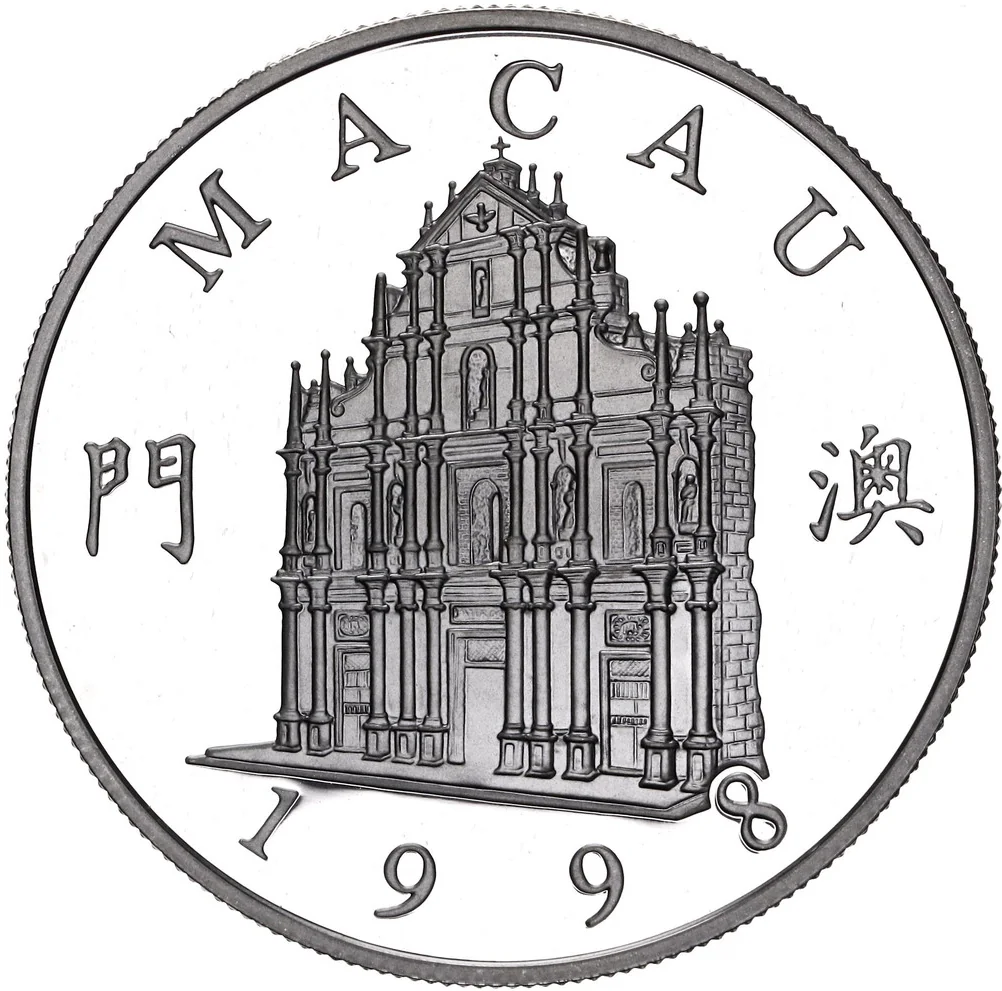
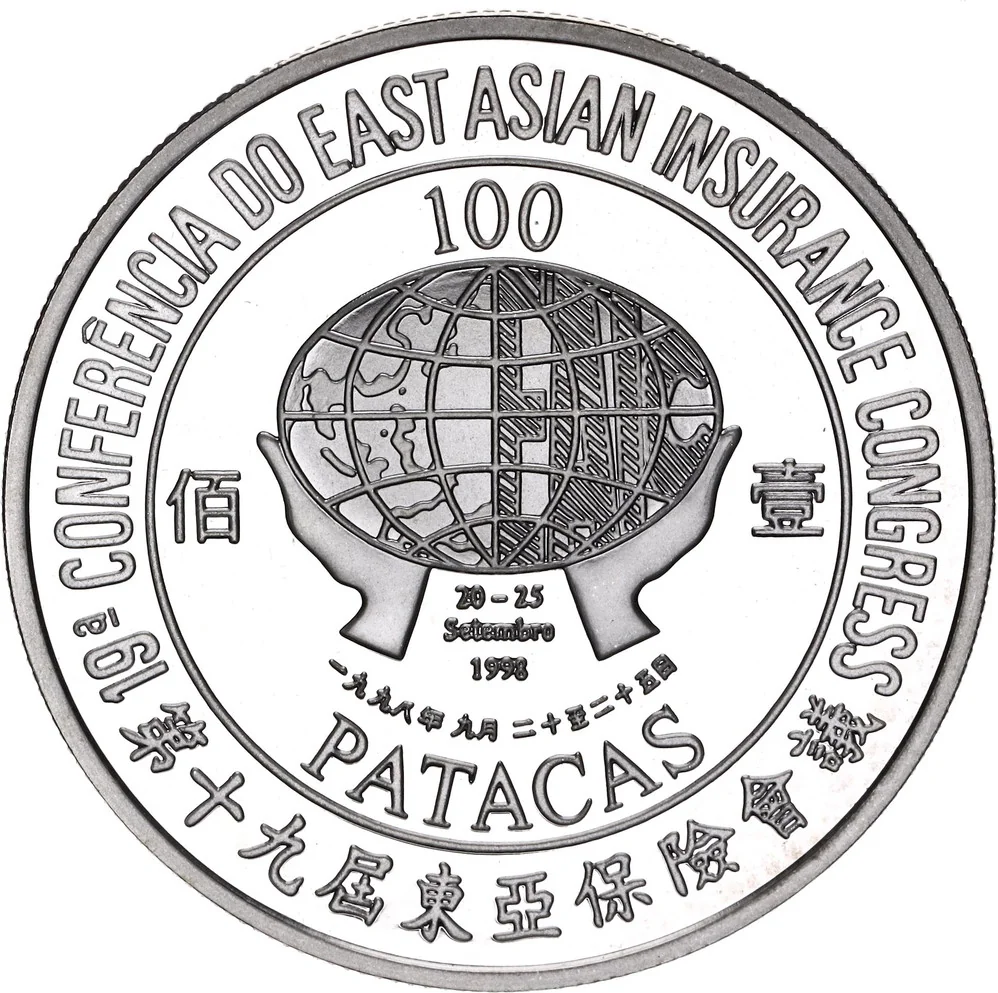
100 Patacas – Macau
Non-circulating coins
Commemoration: 19th East Asian Insurance Conference
China
Reverse
Inscription:
18ªCONFERÊNCIA DO EAST ASIA INSURANCE CONGRESS
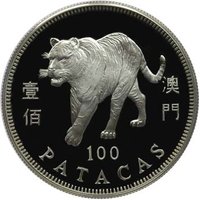
100 PATACAS
100 PATACAS
Translation:
Eighteenth Conference of the East Asia Insurance Congress
100 Patacas
100 Patacas
Languages: English, Portuguese
Edge
Locks
Mints
| Name | Mark |
|---|---|
| Royal Mint | — |
Mintings
| Year | Mint Mark | Mintage | Quality | Collection |
|---|---|---|---|---|
| 1998 | — | 3,000 | Proof |
Historical background
In 1998, Macau's currency situation was defined by its unique and stable dual-circulation system, operating under Portuguese administration just one year prior to its handover to China. The territory's official currency was the Macau Pataca (MOP), which was pegged to the Hong Kong Dollar (HKD) at an approximate fixed rate of 1.03 MOP to 1 HKD. This peg, in turn, linked the Pataca indirectly to the US Dollar due to Hong Kong's own dollar peg, providing crucial monetary stability. However, in daily practice, the Hong Kong Dollar was widely accepted and often preferred for larger transactions, especially in the tourism and gaming sectors, creating a de facto dual-currency economy.
This period was one of economic stress, as Macau, along with much of Asia, was weathering the aftermath of the 1997 Asian Financial Crisis. The crisis tested the resilience of the Pataca's peg, but the currency board system managed by the Autoridade Monetária e Cambial de Macau (Monetary and Foreign Exchange Authority of Macau) successfully maintained the fixed exchange rate. Confidence in the local currency was upheld, though economic growth stagnated and the crucial gaming industry faced challenges. The stability of the currency regime was a key priority for authorities during this turbulent time, ensuring no speculative attacks or capital flight disrupted the transition period.
The broader context was the impending sovereignty transfer on December 20, 1999. A key provision in the Sino-Portuguese Joint Declaration guaranteed that Macau's social and economic systems would remain unchanged for 50 years after the handover. This included the continuity of its separate currency and monetary policy. Therefore, the 1998 currency landscape was not only about managing contemporary economic challenges but also about reinforcing a system designed to persist post-handover, ensuring monetary autonomy from mainland China's Renminbi while maintaining strong, stabilizing links to the Hong Kong Dollar.
This period was one of economic stress, as Macau, along with much of Asia, was weathering the aftermath of the 1997 Asian Financial Crisis. The crisis tested the resilience of the Pataca's peg, but the currency board system managed by the Autoridade Monetária e Cambial de Macau (Monetary and Foreign Exchange Authority of Macau) successfully maintained the fixed exchange rate. Confidence in the local currency was upheld, though economic growth stagnated and the crucial gaming industry faced challenges. The stability of the currency regime was a key priority for authorities during this turbulent time, ensuring no speculative attacks or capital flight disrupted the transition period.
The broader context was the impending sovereignty transfer on December 20, 1999. A key provision in the Sino-Portuguese Joint Declaration guaranteed that Macau's social and economic systems would remain unchanged for 50 years after the handover. This included the continuity of its separate currency and monetary policy. Therefore, the 1998 currency landscape was not only about managing contemporary economic challenges but also about reinforcing a system designed to persist post-handover, ensuring monetary autonomy from mainland China's Renminbi while maintaining strong, stabilizing links to the Hong Kong Dollar.
💎 Extremely Rare