


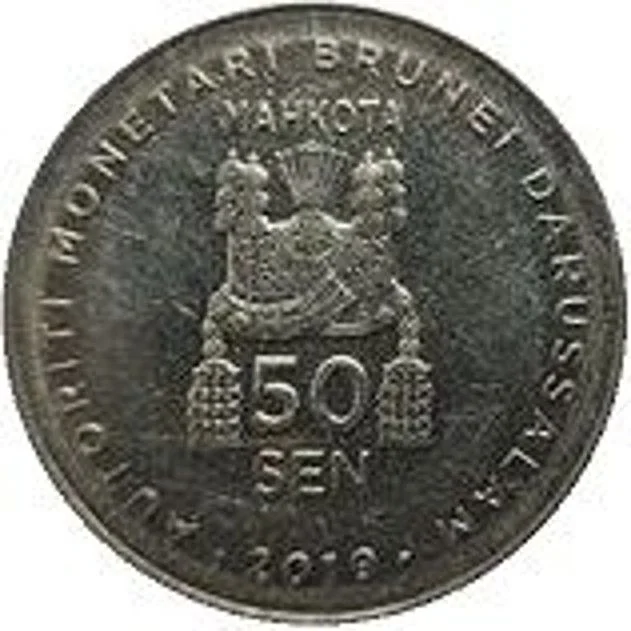
50 sen – Brunei
Add to wishlist
Brunei
Context
Material
Diameter: 27.76 mm
Weight: 9.5 g
Thickness: 2 mm
Shape: Round
Composition: Copper-nickel
Technique: Milled
Alignment: Medal alignment

flip
References
KM: #
Numista: #380220
Value
Exchange value: 0.50 BND
Obverse
Reverse
Edge
Reeded
Mintings
| Year | Mint Mark | Mintage | Quality | Collection |
|---|---|---|---|---|
| 2018 | — | — | ||
| 2019 | — | — | ||
| 2021 | — | — |
Historical background
In 2018, Brunei Darussalam's currency situation was characterized by stability and close integration with Singapore, underpinned by the longstanding Currency Interchangeability Agreement (CIA). This agreement, established in 1967, meant that the Brunei Dollar (BND) and the Singapore Dollar (SGD) were pegged at par and mutually accepted as customary tender in both countries. This arrangement provided significant economic stability for Brunei, anchoring its currency to Singapore's robust monetary policy and financial reputation, which helped control inflation and facilitate seamless cross-border trade and finance.
The year saw the Brunei Dollar maintaining its strength, trading within a narrow band against major currencies like the US Dollar, reflecting both the SGD peg and sustained high global oil and gas prices. As a hydrocarbon-dependent economy, Brunei's fiscal health and currency stability were directly supported by energy export revenues. The nation's substantial foreign exchange reserves, managed by the Brunei Currency and Monetary Board (BCMB), further bolstered confidence in the currency, ensuring full backing for the issued notes and coins.
However, this stability existed within a context of broader economic challenges. Brunei's economy was still navigating a prolonged period of modest growth following the 2014 oil price crash, emphasizing the need for economic diversification away from hydrocarbons. The currency peg, while a pillar of stability, also meant Brunei ceded independent monetary policy to Singapore's central bank. Consequently, in 2018, discussions on economic policy continued to focus less on currency reform and more on stimulating domestic sectors and foreign direct investment as part of the Wawasan Brunei 2035 vision, with the currency arrangement seen as a reliable foundation for that long-term transition.
The year saw the Brunei Dollar maintaining its strength, trading within a narrow band against major currencies like the US Dollar, reflecting both the SGD peg and sustained high global oil and gas prices. As a hydrocarbon-dependent economy, Brunei's fiscal health and currency stability were directly supported by energy export revenues. The nation's substantial foreign exchange reserves, managed by the Brunei Currency and Monetary Board (BCMB), further bolstered confidence in the currency, ensuring full backing for the issued notes and coins.
However, this stability existed within a context of broader economic challenges. Brunei's economy was still navigating a prolonged period of modest growth following the 2014 oil price crash, emphasizing the need for economic diversification away from hydrocarbons. The currency peg, while a pillar of stability, also meant Brunei ceded independent monetary policy to Singapore's central bank. Consequently, in 2018, discussions on economic policy continued to focus less on currency reform and more on stimulating domestic sectors and foreign direct investment as part of the Wawasan Brunei 2035 vision, with the currency arrangement seen as a reliable foundation for that long-term transition.


💎 Very Rare