

10 euro (Nicolaus Copernicus) – Malta
Add to wishlist
Non-circulating coins
Commemoration: 550th anniversary of the birth of Nicolaus Copernicus
Malta
Context
Material
References
KM: #
Numista: #379944
Value
Exchange value: 10 EUR
Bullion value: $151.08
Obverse
Description:
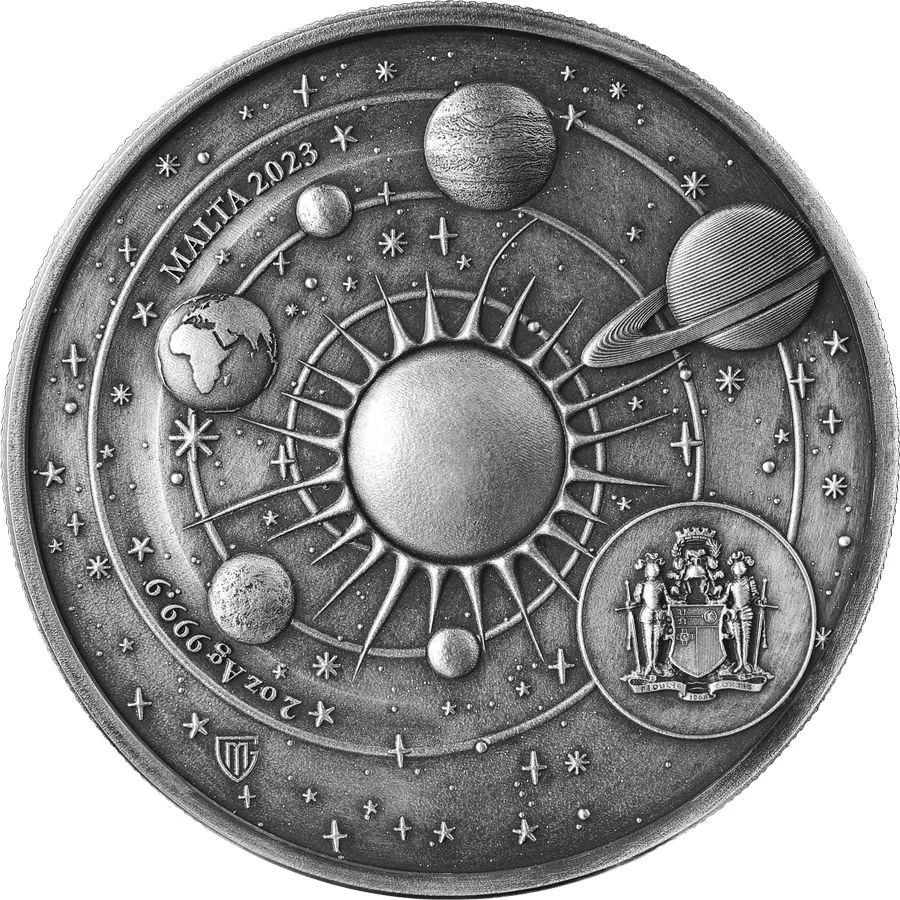
16th-century heliocentric solar system: Mercury, Venus, Earth, Mars, Jupiter, Saturn. Purity and mintmark lower left. Central Bank of Malta coat of arms lower right. Starry background.
Inscription:
MALTA 2023
2 oz Ag 999.9
GM
FIDUCIA 1968 FORTIS
2 oz Ag 999.9
GM
FIDUCIA 1968 FORTIS
Translation:
MALTA 2023
2 oz Silver 999.9
Grand Master
TRUST 1968 STRONG
2 oz Silver 999.9
Grand Master
TRUST 1968 STRONG
Script: Latin
Designer: Natalia Danysz
Reverse
Description:
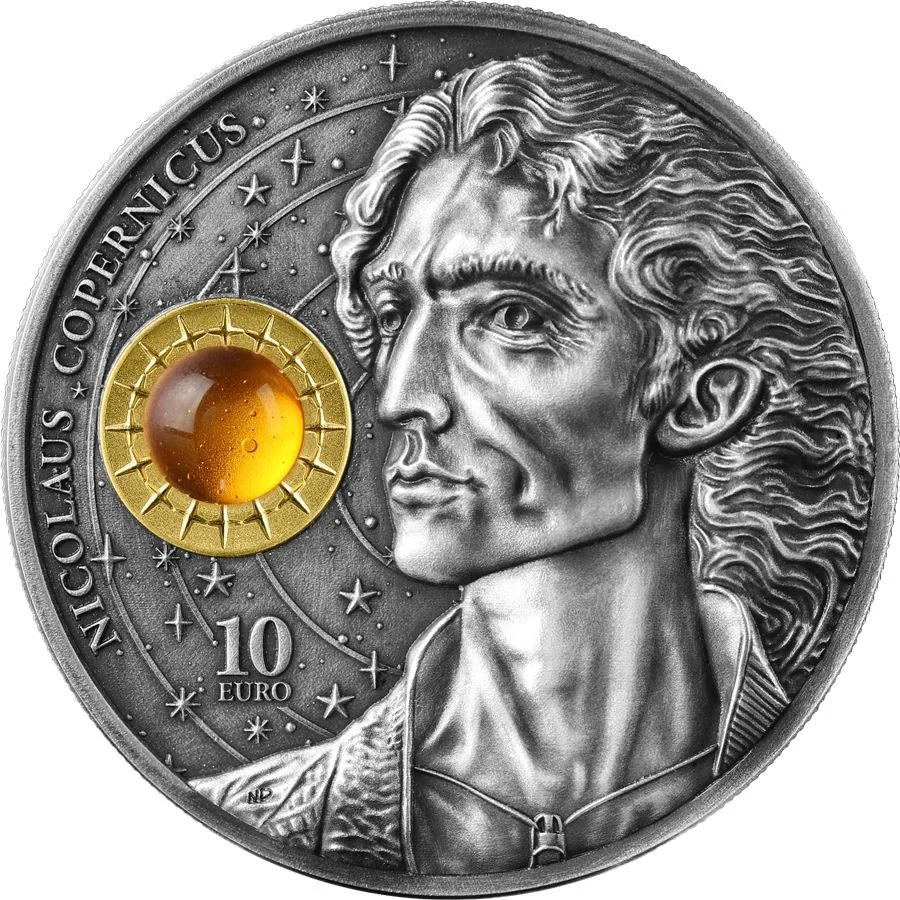
Bust of Copernicus facing left, with a plated amber sun beside him. Planetary orbits, stars, and planets in the left background. Denomination at lower left.
Inscription:
NICOLAUS COPERNICUS
10
EURO
ND
10
EURO
ND
Script: Latin
Designer: Natalia Danysz
Edge
Reeded
Categories
| Event> Birth anniversary |
| Person> Scientist |
| Map |
| Science> Natural phenomenon |
| Symbol> Globe |
| Space |
| Symbols> Coat of Arms |
| Symbol> Sun |
Mints
| Name | Mark |
|---|---|
| Germania Mint | GM |
Mintings
| Year | Mint Mark | Mintage | Quality | Collection |
|---|---|---|---|---|
| 2023 | GM | 1,473 |
Historical background
Malta's currency situation in 2023 remained firmly anchored within the Eurozone framework, having adopted the euro as its official currency in 2008. As a member of the Eurosystem, the country's monetary policy is set by the European Central Bank (ECB), with the Central Bank of Malta implementing these policies locally. The year was dominated by the ECB's continued efforts to combat high inflation across the bloc through a series of interest rate hikes, which directly influenced borrowing costs and economic activity on the islands. Malta's own inflation rate, while persistently high, generally remained slightly below the Eurozone average, partly cushioned by extensive government subsidies on energy and staple foods.
The Maltese economy demonstrated robust resilience in 2023, with strong GDP growth and a tight labour market. This economic performance supported the stability of the euro in Malta, though it also contributed to domestic price pressures. A key national concern was the high rate of inflation, which eroded purchasing power and became a primary economic challenge for households and businesses alike. The government's substantial subsidy schemes, while shielding consumers from the full brunt of energy price shocks, created significant fiscal pressure and debate about long-term sustainability.
Looking externally, the strength of the euro against other major currencies, particularly the US dollar, fluctuated based on the ECB's policy stance relative to the US Federal Reserve. For Malta, this impacted the cost of imports and the competitiveness of its vital tourism and export sectors. Domestically, there was ongoing discussion about the digital euro project and the evolution of fintech, but the physical euro remained unchallenged as the day-to-day currency. Overall, 2023 was a year of monetary policy tightening within a stable single currency framework, with Malta navigating the trade-offs between eurozone-wide anti-inflation measures and unique domestic economic conditions.
The Maltese economy demonstrated robust resilience in 2023, with strong GDP growth and a tight labour market. This economic performance supported the stability of the euro in Malta, though it also contributed to domestic price pressures. A key national concern was the high rate of inflation, which eroded purchasing power and became a primary economic challenge for households and businesses alike. The government's substantial subsidy schemes, while shielding consumers from the full brunt of energy price shocks, created significant fiscal pressure and debate about long-term sustainability.
Looking externally, the strength of the euro against other major currencies, particularly the US dollar, fluctuated based on the ECB's policy stance relative to the US Federal Reserve. For Malta, this impacted the cost of imports and the competitiveness of its vital tourism and export sectors. Domestically, there was ongoing discussion about the digital euro project and the evolution of fintech, but the physical euro remained unchallenged as the day-to-day currency. Overall, 2023 was a year of monetary policy tightening within a stable single currency framework, with Malta navigating the trade-offs between eurozone-wide anti-inflation measures and unique domestic economic conditions.
✨ Legendary