

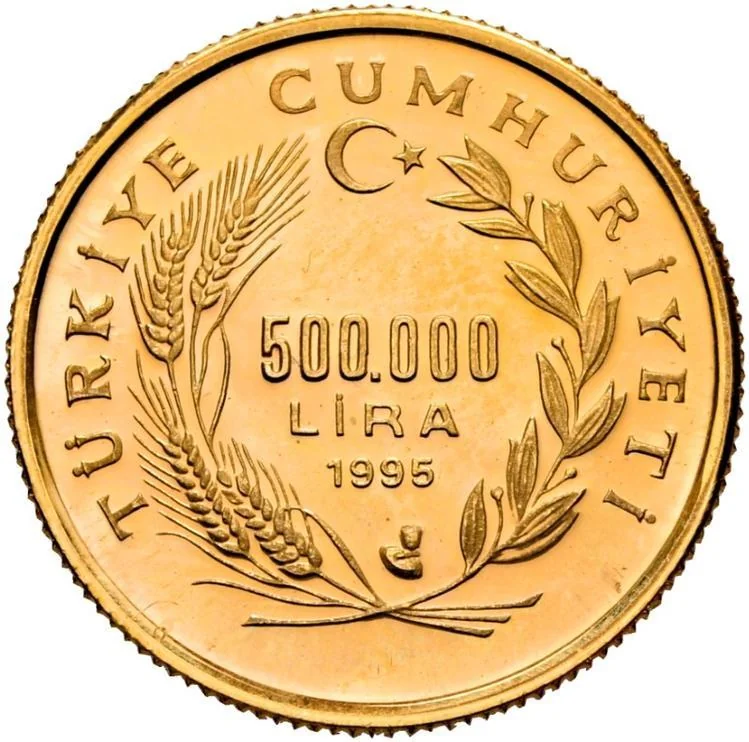
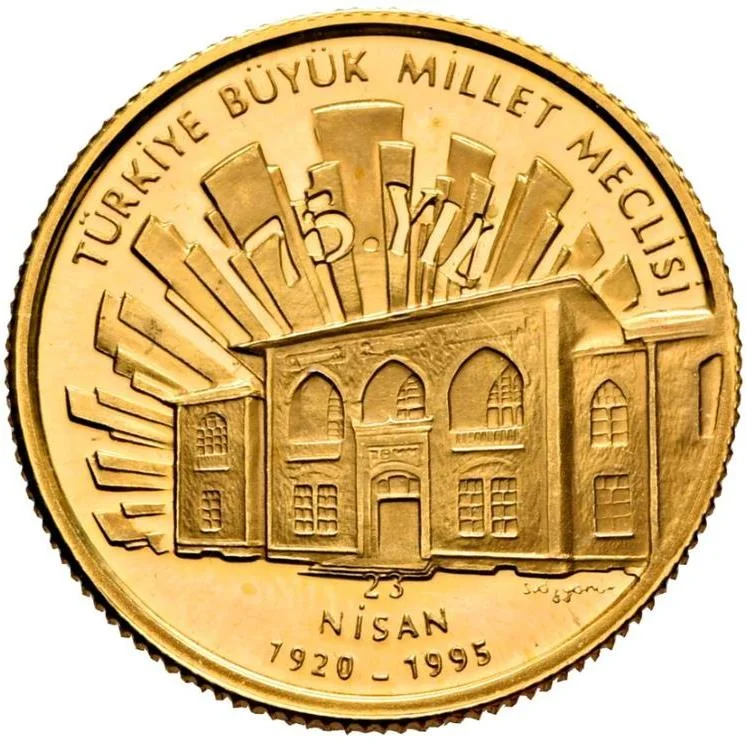
500000 Lira (Anniversary) – Turkey
Non-circulating coins
Commemoration: 75th Anniversary
Turkey
Context

Material
References
KM: #Click to copy to clipboard1034
Numista: #378050
Value
Exchange value: 500000 TRL
Bullion value: $1102.44
Inflation-adjusted value: 1050619190.00 TRL
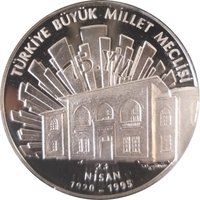
Obverse
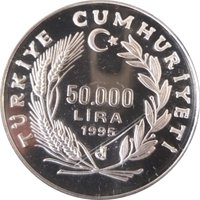
Reverse
Edge
Reeded
Categories
| Building> Governmental building |
Mints
| Name | Mark |
|---|---|
| Turkish State Mint | — |
Mintings
| Year | Mint Mark | Mintage | Quality | Collection |
|---|---|---|---|---|
| 1995 | — | 255 | Proof |
Historical background
In 1995, Turkey's currency situation was characterized by a fragile and volatile stability within a chronically high-inflation environment. The Turkish lira (TRL) was in the midst of a long-term depreciation trend, but the year itself saw a relative, government-engineered calm following a severe currency crisis in 1994. That preceding crisis had forced a major devaluation, with the lira losing over half its value against the U.S. dollar, and led to an International Monetary Fund (IMF) standby agreement. Under this strict stabilization program, the government committed to tight fiscal and monetary policies, which temporarily slowed the lira's freefall and brought monthly inflation down from its peak of over 20% in early 1994.
The central policy tool was a crawling peg exchange rate regime, where the Central Bank of the Republic of Turkey (CBRT) pre-announced a daily depreciation rate for the lira against a basket of currencies, primarily the dollar. This "exchange rate anchor" was intended to curb inflation expectations and provide predictability. Throughout 1995, this mechanism succeeded in preventing another sudden collapse, and the lira depreciated in a controlled manner, losing approximately 65% of its value against the dollar over the entire year—a significant but managed decline compared to the chaos of 1994.
However, this stability was superficial and costly. The high-inflation fundamentals remained largely unaddressed, with annual inflation still ending the year around 90%. The crawling peg required extremely high real interest rates to attract the necessary capital inflows, placing a heavy burden on the budget and the banking sector. Furthermore, the growing current account deficit and persistent political uncertainty ahead of elections signaled underlying vulnerabilities. Thus, 1995 proved to be a temporary respite, a period of managed decline that set the stage for the more severe crises that would follow later in the decade when the pressures on the pegged regime became unsustainable.
The central policy tool was a crawling peg exchange rate regime, where the Central Bank of the Republic of Turkey (CBRT) pre-announced a daily depreciation rate for the lira against a basket of currencies, primarily the dollar. This "exchange rate anchor" was intended to curb inflation expectations and provide predictability. Throughout 1995, this mechanism succeeded in preventing another sudden collapse, and the lira depreciated in a controlled manner, losing approximately 65% of its value against the dollar over the entire year—a significant but managed decline compared to the chaos of 1994.
However, this stability was superficial and costly. The high-inflation fundamentals remained largely unaddressed, with annual inflation still ending the year around 90%. The crawling peg required extremely high real interest rates to attract the necessary capital inflows, placing a heavy burden on the budget and the banking sector. Furthermore, the growing current account deficit and persistent political uncertainty ahead of elections signaled underlying vulnerabilities. Thus, 1995 proved to be a temporary respite, a period of managed decline that set the stage for the more severe crises that would follow later in the decade when the pressures on the pegged regime became unsustainable.

✨ Legendary