

1 sol – Peru
Add to wishlist
Non-circulating coins
Commemoration: Bicentennial of the Congress of the Republic
Peru
Context
Year: 2022
Issuer: Peru
Issuing organization: Central Reserve Bank of Peru
Period:
(since 1822)
Total mintage: 5,000
Material
References
KM: #
Numista: #376064
Value
Exchange value: 1 PEN
Bullion value: $77.56
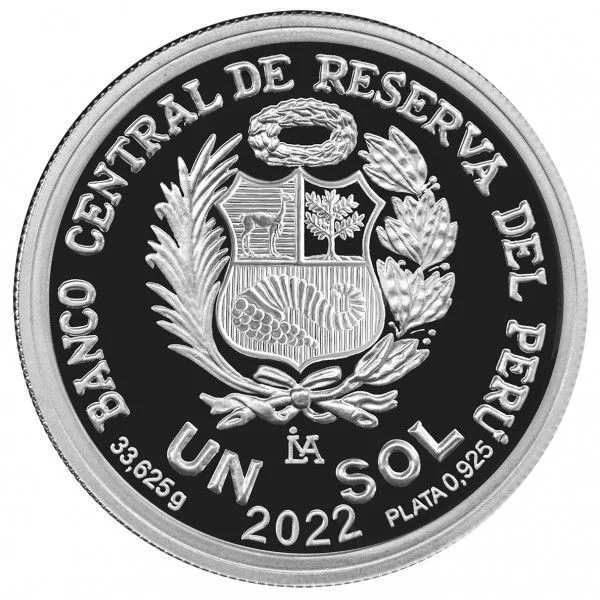
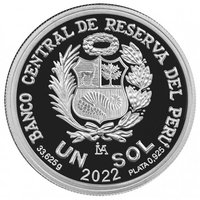
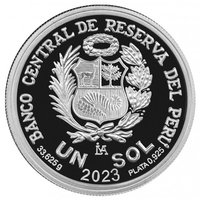
Obverse
Description:
Crest Date Value
Inscription:
BANCO CENTRAL DE RESERVA DEL PERÚ
UN SOL
33,625g 2022 PLATA 0,925
UN SOL
33,625g 2022 PLATA 0,925
Translation:
Central Reserve Bank of Peru
One Sol
33.625g 2022 Silver 0.925
One Sol
33.625g 2022 Silver 0.925
Script: Latin
Language: Spanish
Engraver: Eduardo Paredes Medina
Designer: Ernesto Gutiérrez Gamarra
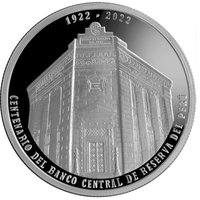
Reverse
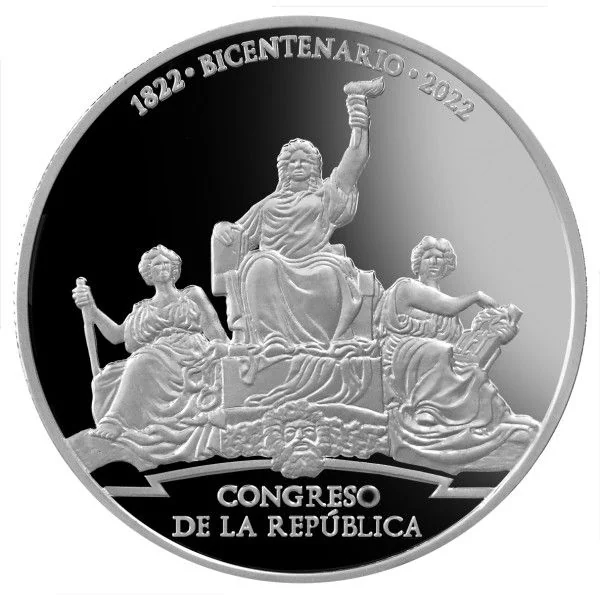
Description:
Constitutional allegory.
Inscription:
1822 BICENTENARIO 2022
CONGRESO DE LA REPÚBLICA
CONGRESO DE LA REPÚBLICA
Translation:
Bicentennial 1822 2022
Congress of the Republic
Congress of the Republic
Script: Latin
Language: Spanish
Engraver: Eduardo Paredes Medina
Designer: Ernesto Gutiérrez Gamarra
Edge
Reeded
Categories
| Event> Independence |
| Symbol> Allegory |
| Symbols> Coat of Arms |
Mints
| Name | Mark |
|---|---|
| Lima | (LIMA) |
Mintings
| Year | Mint Mark | Mintage | Quality | Collection |
|---|---|---|---|---|
| 2022 | LIMA | 5,000 | Proof |
Historical background
In 2022, Peru's currency, the sol (PEN), faced significant volatility and depreciation pressure, largely driven by intense political instability and global economic headwinds. The year began with the sol already weakened from 2021's political shocks, including the impeachment of President Pedro Castillo in December. His removal and subsequent protests created an environment of uncertainty, discouraging investment and capital inflows. This domestic turbulence was exacerbated by the global context of aggressive monetary tightening by the U.S. Federal Reserve, which strengthened the U.S. dollar and put pressure on emerging market currencies worldwide. Consequently, the sol depreciated to historic lows against the dollar, breaching the symbolic barrier of PEN 4.00 per USD and reaching around PEN 4.10 by mid-year.
In response, Peru's Central Bank (BCRP) pursued an assertive and orthodox policy to stabilize the currency and combat inflation, which peaked at 8.81% in June—a 26-year high. The BCRP raised its benchmark interest rate consistently throughout the year, from 2.75% at the end of 2021 to 7.50% by December 2022. It also actively intervened in the foreign exchange market, selling billions of dollars from its substantial international reserves to smooth volatility and support the sol. These measures were underpinned by Peru's traditionally strong macroeconomic fundamentals, including one of the lowest public debt levels in the region and high reserves, which provided a crucial buffer against the crisis.
Despite the pressures, the sol demonstrated a notable recovery in the latter half of 2022, closing the year around PEN 3.78 per USD. This rebound was attributed to the BCRP's credible policies, a weakening of the U.S. dollar globally in the final quarter, and strong copper prices—Peru being a major exporter—which improved the terms of trade. However, the year highlighted the Peruvian economy's vulnerability to political shocks, with currency stability being heavily contingent on calming the domestic political landscape, even amidst a relatively robust macroeconomic framework.
In response, Peru's Central Bank (BCRP) pursued an assertive and orthodox policy to stabilize the currency and combat inflation, which peaked at 8.81% in June—a 26-year high. The BCRP raised its benchmark interest rate consistently throughout the year, from 2.75% at the end of 2021 to 7.50% by December 2022. It also actively intervened in the foreign exchange market, selling billions of dollars from its substantial international reserves to smooth volatility and support the sol. These measures were underpinned by Peru's traditionally strong macroeconomic fundamentals, including one of the lowest public debt levels in the region and high reserves, which provided a crucial buffer against the crisis.
Despite the pressures, the sol demonstrated a notable recovery in the latter half of 2022, closing the year around PEN 3.78 per USD. This rebound was attributed to the BCRP's credible policies, a weakening of the U.S. dollar globally in the final quarter, and strong copper prices—Peru being a major exporter—which improved the terms of trade. However, the year highlighted the Peruvian economy's vulnerability to political shocks, with currency stability being heavily contingent on calming the domestic political landscape, even amidst a relatively robust macroeconomic framework.
💎 Extremely Rare