

5 Đồng – South Vietnam
Vietnam
Context
Year: 1971
Country: Vietnam 
Issuer: South Vietnam
Period:
(1967—1976)
Currency:
(1953—1975)
Demonetized: Yes
Total mintage: 15,000,000
Material
References
KM: #Click to copy to clipboard9a
Numista: #14214
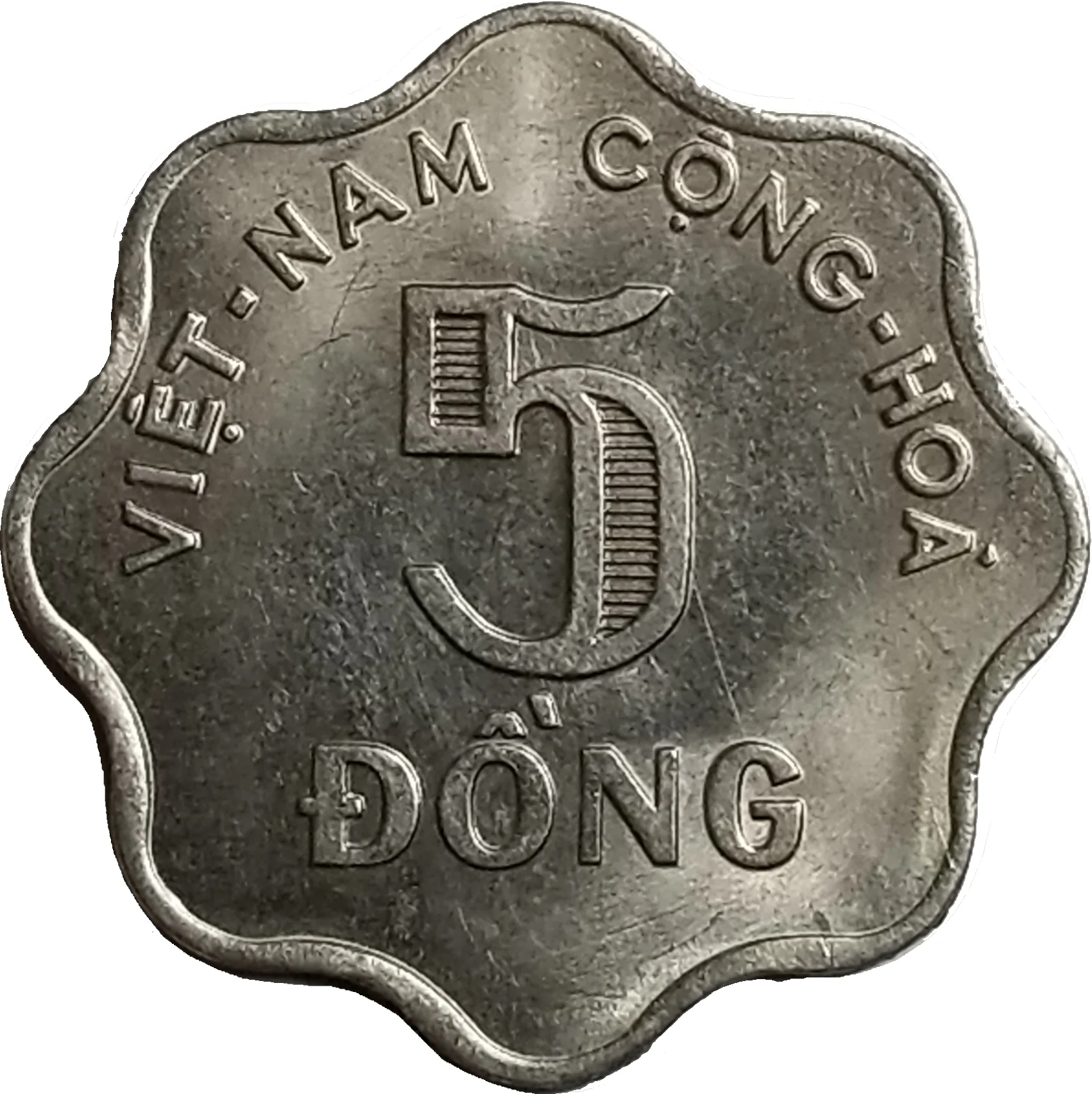
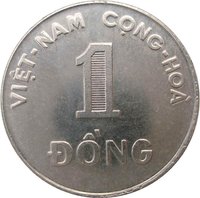
Obverse
Description:
Face value with encircling legend.
Inscription:
VIỆT-NAM CỘNG-HOÀ
5
ĐỒNG
5
ĐỒNG
Translation:
VIETNAM REPUBLIC
5
DONG
5
DONG
Script: Latin
Language: Vietnamese
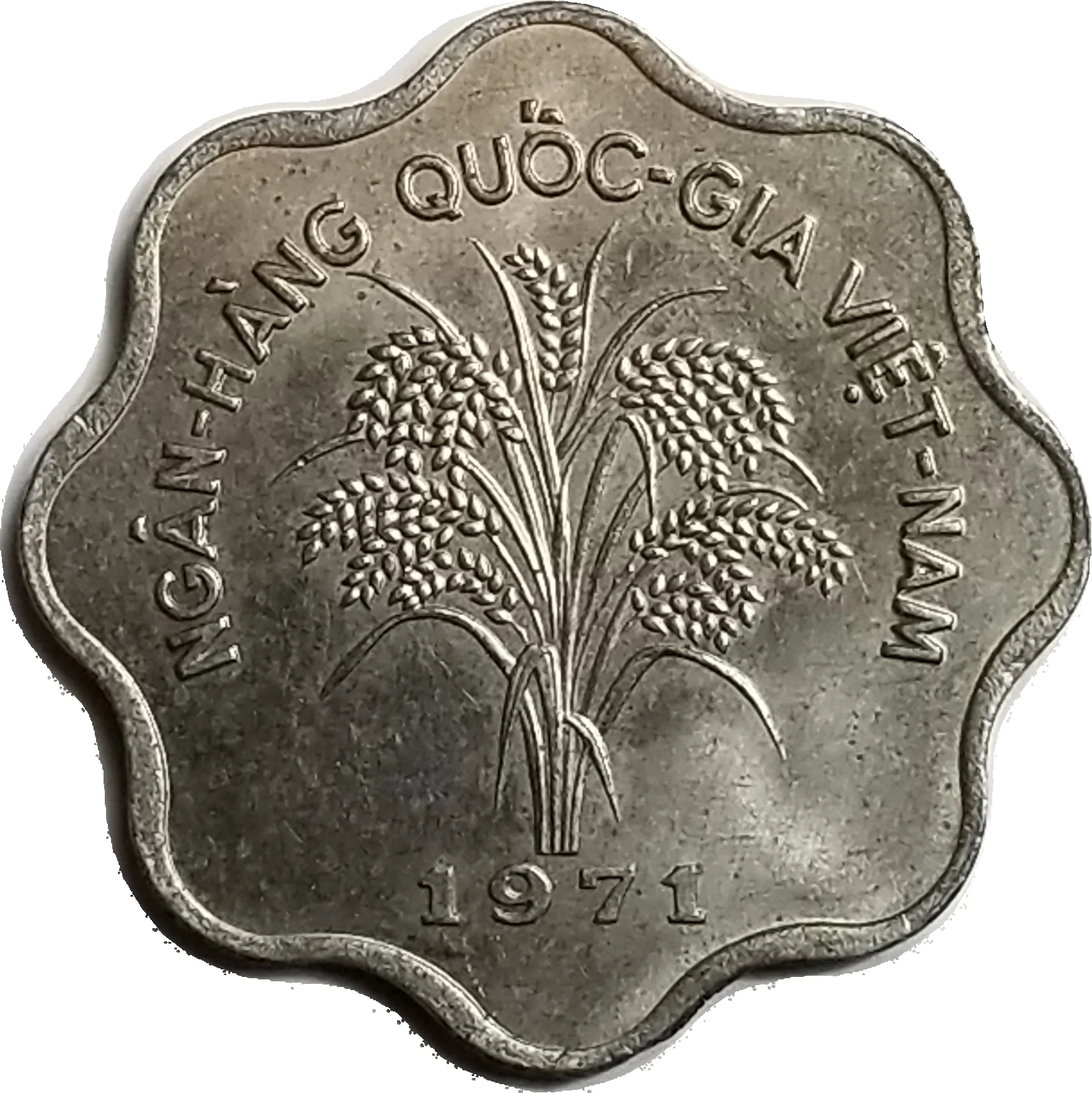
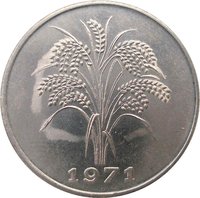
Reverse
Description:
Rice stalks with a date, encircled by legends.
Inscription:
NGÂN-HÀNG QUỐC-GIA VIỆT-NAM
1971
1971
Translation:
NATIONAL BANK OF VIETNAM
1971
1971
Script: Latin
Language: Vietnamese
Edge
Plain
Mints
| Name | Mark |
|---|---|
| Royal Mint | — |
Mintings
| Year | Mint Mark | Mintage | Quality | Collection |
|---|---|---|---|---|
| 1971 | — | 15,000,000 |
Historical background
By 1971, the currency situation in South Vietnam was a critical reflection of the war-torn economy's deep structural problems. The South Vietnamese piastre (đồng) was fundamentally an artificial currency, propped up by massive U.S. financial aid and a fixed, overvalued exchange rate pegged at 118 piastres to the U.S. dollar. This official rate bore little relation to economic reality, creating a vast and thriving black market where the dollar traded for nearly double the official rate. The economy was overwhelmingly dependent on imports, financed by American dollars, while domestic production was crippled by the war, leading to severe trade deficits and rampant inflation that eroded public confidence in the currency.
The primary mechanism for managing this system was the Commercial Import Program (CIP), a cornerstone of U.S. economic assistance. Under the CIP, the U.S. financed dollar grants for South Vietnamese merchants to import essential goods. These merchants then purchased the dollars with piastres from the South Vietnamese government, which theoretically soaked up excess local currency and stabilized prices. However, the program was plagued by corruption and inefficiency. Much of the imported goods were luxury items rather than essentials, benefiting a small urban elite and fueling a speculative economy centered on Saigon, while doing little to build productive capacity or reach the rural poor.
President Nguyen Van Thieu's government, under pressure from the U.S., attempted a drastic reform on October 15, 1971: a forced devaluation. The piastre was officially devalued by 25%, moving the peg to 275 đ to the dollar, and a "unified" floating rate was established. The intent was to curb the black market, reduce inflation, and make Vietnamese exports more competitive. The immediate result, however, was economic shock and public outcry, as prices soared and savings were dramatically eroded. While the black market narrowed temporarily, the devaluation failed to address the core issues of corruption, wartime disruption, and aid dependency, leaving the currency and the economy as fragile as ever as U.S. troop withdrawals accelerated.
The primary mechanism for managing this system was the Commercial Import Program (CIP), a cornerstone of U.S. economic assistance. Under the CIP, the U.S. financed dollar grants for South Vietnamese merchants to import essential goods. These merchants then purchased the dollars with piastres from the South Vietnamese government, which theoretically soaked up excess local currency and stabilized prices. However, the program was plagued by corruption and inefficiency. Much of the imported goods were luxury items rather than essentials, benefiting a small urban elite and fueling a speculative economy centered on Saigon, while doing little to build productive capacity or reach the rural poor.
President Nguyen Van Thieu's government, under pressure from the U.S., attempted a drastic reform on October 15, 1971: a forced devaluation. The piastre was officially devalued by 25%, moving the peg to 275 đ to the dollar, and a "unified" floating rate was established. The intent was to curb the black market, reduce inflation, and make Vietnamese exports more competitive. The immediate result, however, was economic shock and public outcry, as prices soared and savings were dramatically eroded. While the black market narrowed temporarily, the devaluation failed to address the core issues of corruption, wartime disruption, and aid dependency, leaving the currency and the economy as fragile as ever as U.S. troop withdrawals accelerated.
🌱 Common