

30 Euro (Slovene Olympic Medalist) – Slovenia
Non-circulating coins
Commemoration: 100th Anniversary of the 1st Slovene Olympic Medalist
Slovenia
Context
Material
References
KM: #Click to copy to clipboard110
Numista: #37423
Value
Exchange value: 30 EUR = $35.44
Bullion value: $40.00
Inflation-adjusted value: 41.44 EUR
Obverse
Description:
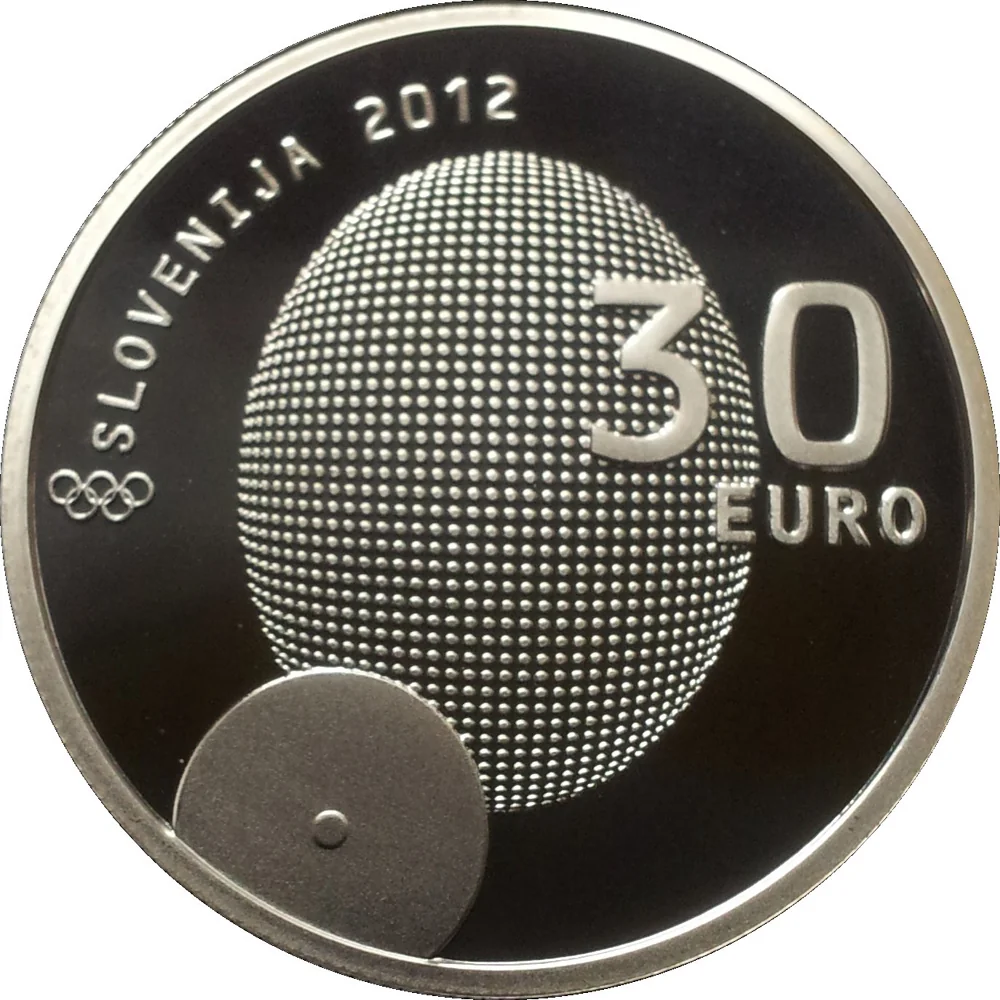
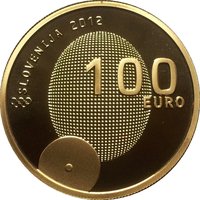
A saber mask motif, depicted with dots, is in the lower left circle of the coin, split by the edge. A small central dot is within this circle. Olympic rings are near the upper left edge, with "SLOVENIJA 2012" above. The upper right quarter features the value "30 EURO".
Inscription:
SLOVENIJA 2012
30 EURO
30 EURO
Script: Latin
Designer: Milan Drobnak
Reverse
Description:
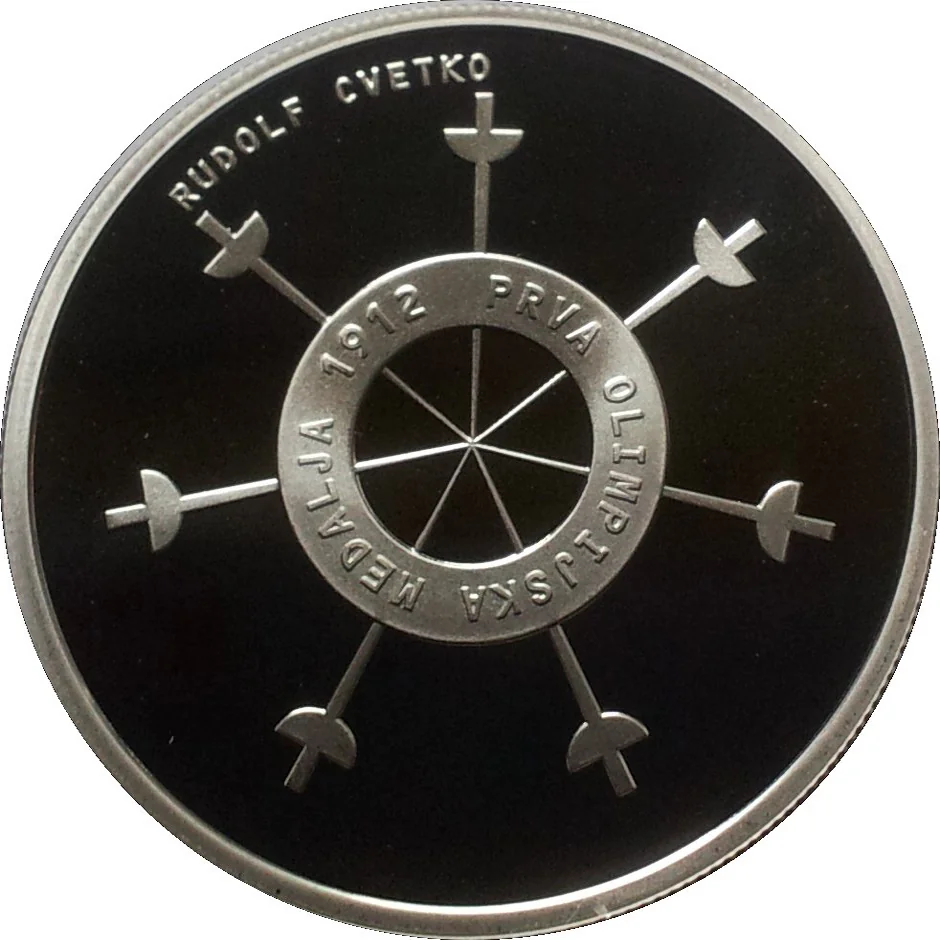
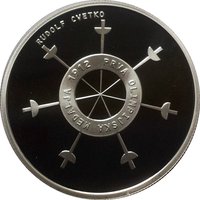
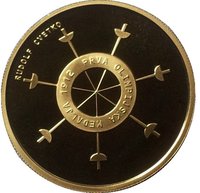
Seven sabers radiate from the coin's center, connected by a ring. Around it is "PRVA OLIMPIJSKA MEDALJA 1912". "RUDOLF CVETKO" is inscribed near the upper-left rim.
Inscription:
RUDOLF CVETKO
PRVA OLIMPIJSKA MEDALJA 1912
PRVA OLIMPIJSKA MEDALJA 1912
Script: Latin
Designer: Milan Drobnak
Edge
Mints
| Name | Mark |
|---|---|
| Kremnica | — |
Mintings
| Year | Mint Mark | Mintage | Quality | Collection |
|---|---|---|---|---|
| 2012 | — | 3,500 | Proof |
Historical background
In 2012, Slovenia was grappling with the severe aftershocks of the Eurozone debt crisis, which starkly exposed the vulnerabilities of its domestic banking sector and economy. As a member of the Eurozone since 2007, the country did not have an independent monetary policy or currency to devalue; its currency situation was defined by its use of the euro. This meant that unlike some neighboring non-euro countries, Slovenia could not use exchange rate adjustments as a tool to regain competitiveness. Instead, the burden of adjustment fell entirely on internal devaluation—a painful process of cutting wages, pensions, and public spending to reduce costs and deficits.
The core of the crisis was a deeply troubled banking system, burdened by a wave of non-performing loans stemming from a post-2008 collapse in construction and a corporate debt overhang, much of it held by state-owned banks. This domestic crisis triggered a loss of investor confidence, leading to a sharp spike in the country's borrowing costs on international bond markets in 2012. Fears mounted that Slovenia, following Cyprus, would become the sixth Eurozone country to require an international bailout. While the currency itself—the euro—remained stable, the economic context was one of severe strain, with the government struggling to finance itself and reassure markets of its solvency.
In response, the center-right government of Janez Janša, which took office in early 2012, implemented aggressive austerity measures and began drafting a comprehensive strategy to clean up the banking sector. These actions, including the establishment of a "bad bank" (the Bank Asset Management Company) in 2013, were crucial in stabilizing the situation by year's end and narrowly averting a formal international bailout. Thus, 2012 was a pivotal year where Slovenia's commitment to the euro was tested not by currency fluctuation, but by the immense pressure to restore fiscal and financial stability within the constraints of a shared monetary union.
The core of the crisis was a deeply troubled banking system, burdened by a wave of non-performing loans stemming from a post-2008 collapse in construction and a corporate debt overhang, much of it held by state-owned banks. This domestic crisis triggered a loss of investor confidence, leading to a sharp spike in the country's borrowing costs on international bond markets in 2012. Fears mounted that Slovenia, following Cyprus, would become the sixth Eurozone country to require an international bailout. While the currency itself—the euro—remained stable, the economic context was one of severe strain, with the government struggling to finance itself and reassure markets of its solvency.
In response, the center-right government of Janez Janša, which took office in early 2012, implemented aggressive austerity measures and began drafting a comprehensive strategy to clean up the banking sector. These actions, including the establishment of a "bad bank" (the Bank Asset Management Company) in 2013, were crucial in stabilizing the situation by year's end and narrowly averting a formal international bailout. Thus, 2012 was a pivotal year where Slovenia's commitment to the euro was tested not by currency fluctuation, but by the immense pressure to restore fiscal and financial stability within the constraints of a shared monetary union.
💎 Extremely Rare