

1 krone – Denmark
Add to wishlist
Denmark
Context
Years: 1992–2023
Issuer: Denmark
Ruler: Margrethe II
Currency:
(since 1873)
Total mintage: 328,811,113
Material
Diameter: 20.15 mm
Weight: 3.6 g
Thickness: 1.6 mm
Shape: Round with a round hole
Composition: Copper-nickel
Technique: Milled
Alignment: Medal alignment
flip
References
KM: #
Numista: #1417
Value
Exchange value: 1 DKK
Inflation-adjusted value: 1.89 DKK
Obverse
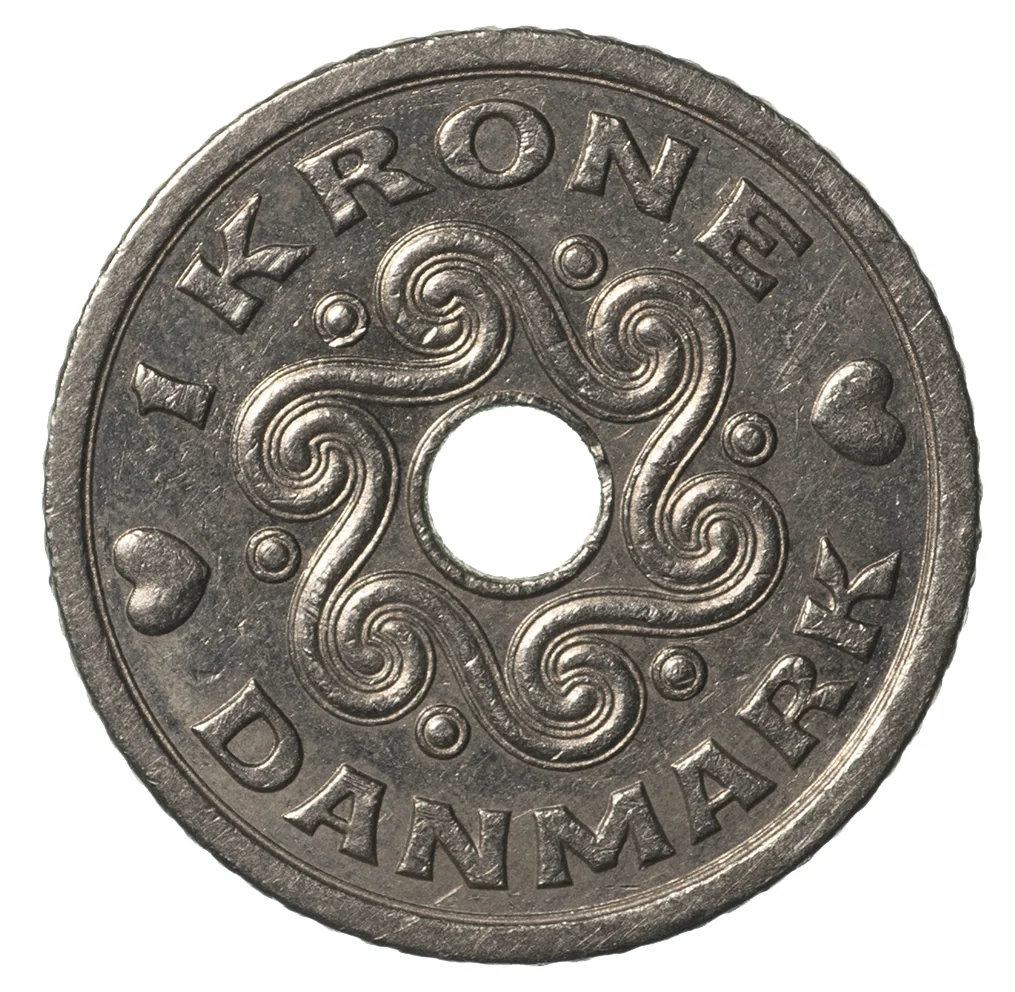
Description:
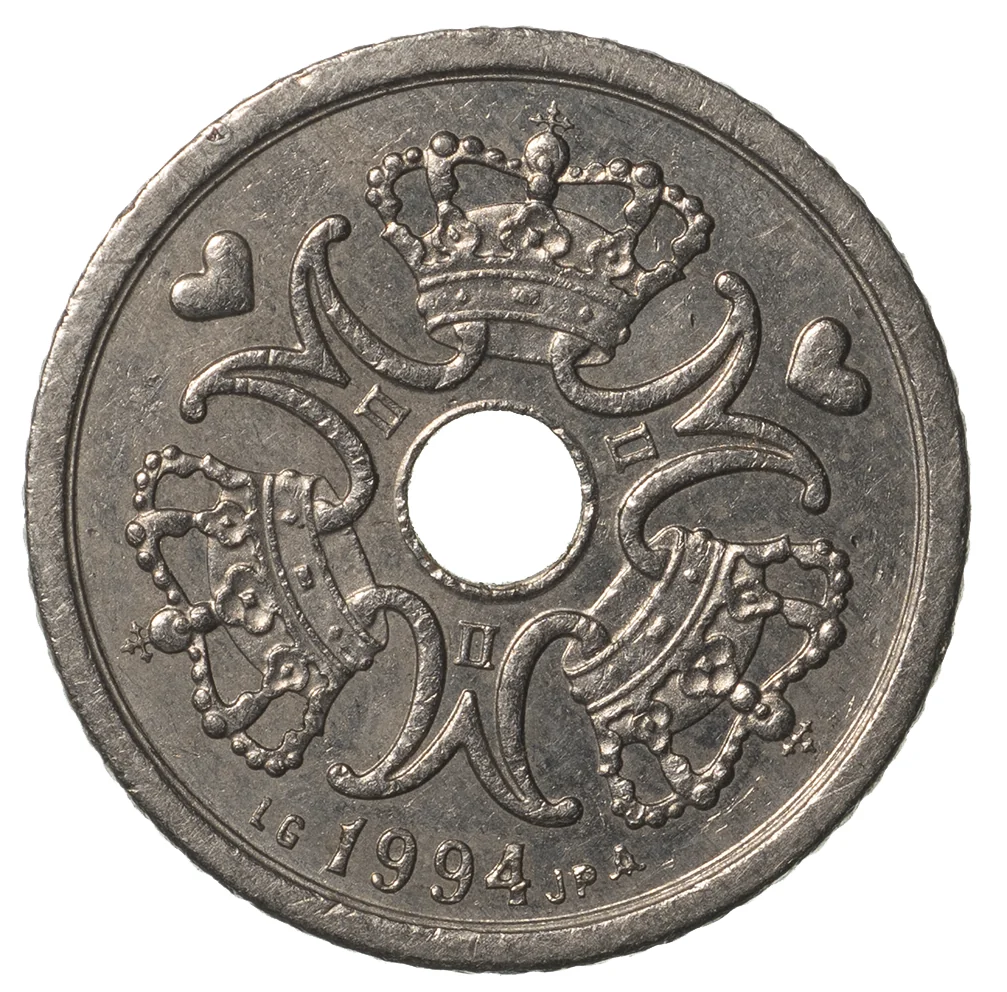
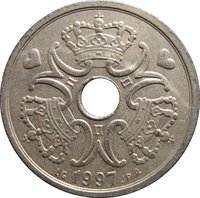
New royal monogram, repeated three times between crowns. Designer, medallist, and mint official signatures flank the year.
Inscription:
M II ♥ M II ♥ M II
LG 1992 JP A
LG 1992 JP A
Translation:
M II ♥ M II ♥ M II
LG 1992 JP A
LG 1992 JP A
Script: Latin
Engraver: Jan Petersen
Designer: Johan Alkjaer
Reverse
Edge
Reeded
Mints
| Name | Mark |
|---|---|
| Mint of Finland | — |
| Royal Danish Mint | — |
Mintings
| Year | Mint Mark | Mintage | Quality | Collection |
|---|---|---|---|---|
| 1992 | LG;JP;A | 81,621,000 | ||
| 1993 | LG;JP;A | 15,844,000 | ||
| 1994 | LG;JP;A | 23,658,000 | ||
| 1995 | LG;JP;A | 34,966,000 | ||
| 1996 | LG;JP;A | 10,081,000 | ||
| 1997 | LG;JP;A | 10,121,807 | ||
| 1998 | LG;JP;A | 13,100,000 | ||
| 1999 | LG;JP;A | 6,479,000 | ||
| 2000 | LG;JP;A | 21,500,000 | ||
| 2001 | LG;JP;A | 14,640,000 | ||
| 2002 | — | 9,000,000 | ||
| 2003 | — | 5,231,000 | ||
| 2004 | — | 3,000 | Proof | |
| 2004 | — | 16,139,596 | ||
| 2005 | — | 16,757,000 | ||
| 2005 | — | 2,650 | Proof | |
| 2006 | — | 21,026,000 | ||
| 2006 | — | 1,800 | Proof | |
| 2007 | — | 1,400 | Proof | |
| 2007 | — | 11,729,000 | ||
| 2008 | — | 13,339,000 | ||
| 2008 | — | 1,000 | Proof | |
| 2009 | — | 1,050 | Proof | |
| 2009 | — | 624,000 | In sets | |
| 2010 | — | 1,010 | Proof | |
| 2010 | — | 26,000 | In sets | |
| 2011 | — | 21,000 | In sets | |
| 2011 | — | 1,000 | Proof | |
| 2012 | — | 1,000 | Proof | |
| 2012 | — | 17,000 | In sets | |
| 2013 | — | 765,800 | ||
| 2013 | — | 1,200 | Proof | |
| 2014 | JS;HW | — | Proof | |
| 2014 | JS;HW | 2,106,000 | ||
| 2015 | JS;HW | — | ||
| 2015 | JS;HW | 800 | Proof | |
| 2016 | LGS;HW | — | ||
| 2016 | LGS;HW | 800 | Proof | |
| 2017 | — | — | ||
| 2017 | — | 800 | Proof | |
| 2018 | — | 800 | Proof | |
| 2018 | — | — | ||
| 2019 | — | — | ||
| 2019 | — | 600 | Proof | |
| 2020 | — | — | ||
| 2020 | — | — | Proof | |
| 2021 | ♥︎ | — | Proof | |
| 2021 | ♥︎ | — | ||
| 2022 | ♥︎ | — | ||
| 2022 | ♥︎ | — | Proof | |
| 2023 | ♥︎ | — | ||
| 2023 | ♥︎ | — | Proof |
Historical background
In 1992, Denmark found itself at the epicenter of a European currency crisis. As a member of the European Exchange Rate Mechanism (ERM), the forint was pegged to a narrow band within the Deutsche Mark, a system designed to limit exchange rate fluctuations ahead of the planned Economic and Monetary Union (EMU). This arrangement required Denmark to maintain high interest rates to defend the krone's value, aligning its monetary policy closely with the powerful German Bundesbank, which had raised rates aggressively to combat inflation following reunification.
The situation became untenable in September 1992. Financial markets, led by major speculators, launched a concerted attack on several ERM currencies, believing their parities were unsustainable given differing national economic conditions. The pressure on the Danish krone was immense, as investors doubted Denmark's willingness to endure a recession to maintain the peg. Despite the Danish central bank's desperate efforts—including raising its key lending rate to 500% in a single day—capital flight continued, forcing a severe political choice.
The crisis culminated with the Danish government's decision to hold a referendum on the Maastricht Treaty in June 1992, which resulted in a narrow "no" vote. This rejection, occurring amidst the financial turmoil, sent shockwaves through Europe and intensified the speculative pressure. While Denmark ultimately remained in the ERM (albeit with a temporarily widened fluctuation band), the 1992 crisis profoundly shaped its European policy, leading to the Edinburgh Agreement opt-outs and its subsequent decision to stay outside the Eurozone, preserving the krone as its national currency.
The situation became untenable in September 1992. Financial markets, led by major speculators, launched a concerted attack on several ERM currencies, believing their parities were unsustainable given differing national economic conditions. The pressure on the Danish krone was immense, as investors doubted Denmark's willingness to endure a recession to maintain the peg. Despite the Danish central bank's desperate efforts—including raising its key lending rate to 500% in a single day—capital flight continued, forcing a severe political choice.
The crisis culminated with the Danish government's decision to hold a referendum on the Maastricht Treaty in June 1992, which resulted in a narrow "no" vote. This rejection, occurring amidst the financial turmoil, sent shockwaves through Europe and intensified the speculative pressure. While Denmark ultimately remained in the ERM (albeit with a temporarily widened fluctuation band), the 1992 crisis profoundly shaped its European policy, leading to the Edinburgh Agreement opt-outs and its subsequent decision to stay outside the Eurozone, preserving the krone as its national currency.
🌱 Very Common