

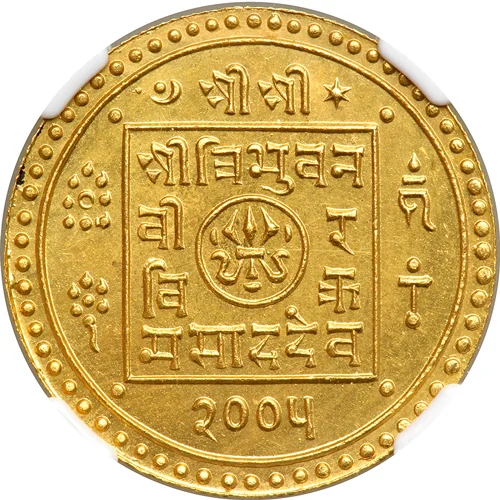
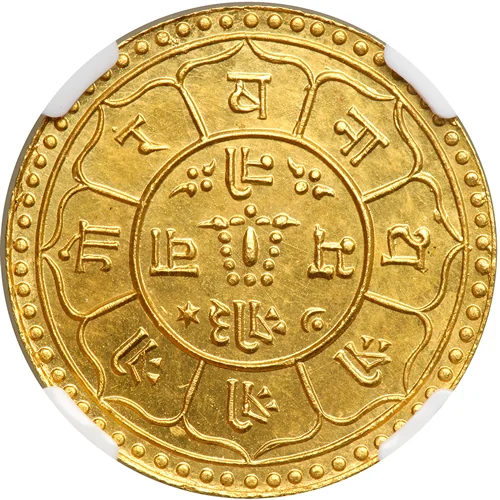
2 Tolas – Nepal
Nepal
Context
Year: 1948
Vikram Samvat Year: 2005
Issuer: Nepal 
Ruler: Tribhuvan Bir Bikram Shah
Currency:
Demonetized: Yes
Material
References
KM: #Click to copy to clipboard728
Numista: #37041
Value
Bullion value: $3868.15
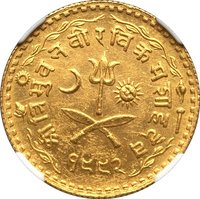
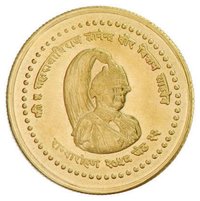
Obverse
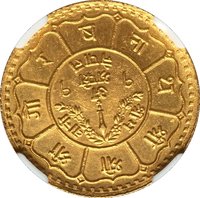
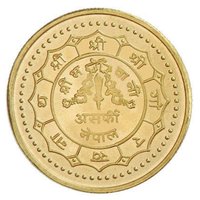
Reverse
Edge
Mintings
| Year | Mint Mark | Mintage | Quality | Collection |
|---|---|---|---|---|
| 1948 | — | — |
Historical background
In 1948, Nepal’s currency situation was defined by its complex relationship with British India and the legacy of the Rana regime's isolationist policies. The primary circulating currency was the Indian Rupee, which held legal tender status and dominated trade and finance. Alongside it, Nepal’s own silver Mohar and copper coins circulated, but they were largely confined to local, small-scale transactions and were often undervalued against the Indian currency. This created a dual-system that reflected Nepal’s economic dependence on India, as the Nepalese Rupee, first minted in 1932, had yet to establish itself as a strong, independent national currency.
The year is particularly notable for the 1948 devaluation of the Nepalese Rupee. Following India's independence in 1947 and its subsequent devaluation of the Indian Rupee against sterling in 1948, Nepal was compelled to follow suit to maintain parity and prevent economic disruption. The Nepalese Rupee was officially devalued by approximately 30.7%, changing its peg from 1 Nepalese Rupee = 1.28 Indian Rupees to a 1:1 ratio. This move was not a sovereign monetary decision but a reactive one, underscoring how Nepal's currency was effectively a satellite of the Indian monetary system.
This period highlighted the urgent need for monetary reform and central banking, which would become a key focus in the coming decade. The 1948 devaluation exposed the vulnerabilities of a system without a central bank or independent monetary policy. It set the stage for the eventual establishment of the Nepal Rastra Bank in 1956, which would take control of issuing currency and formally end the circulation of Indian rupees within Nepal, marking the beginning of a truly national monetary system.
The year is particularly notable for the 1948 devaluation of the Nepalese Rupee. Following India's independence in 1947 and its subsequent devaluation of the Indian Rupee against sterling in 1948, Nepal was compelled to follow suit to maintain parity and prevent economic disruption. The Nepalese Rupee was officially devalued by approximately 30.7%, changing its peg from 1 Nepalese Rupee = 1.28 Indian Rupees to a 1:1 ratio. This move was not a sovereign monetary decision but a reactive one, underscoring how Nepal's currency was effectively a satellite of the Indian monetary system.
This period highlighted the urgent need for monetary reform and central banking, which would become a key focus in the coming decade. The 1948 devaluation exposed the vulnerabilities of a system without a central bank or independent monetary policy. It set the stage for the eventual establishment of the Nepal Rastra Bank in 1956, which would take control of issuing currency and formally end the circulation of Indian rupees within Nepal, marking the beginning of a truly national monetary system.
✨ Legendary