

1 Pound – Gibraltar
Non-circulating coins
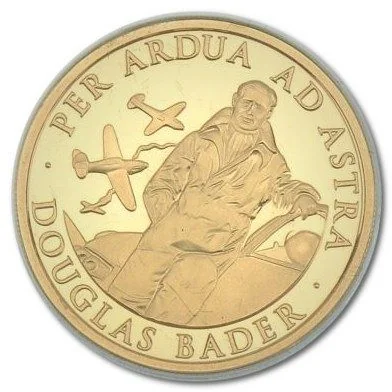
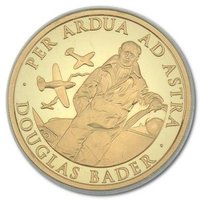
Commemoration: Douglas Bader
United Kingdom
Context
Year: 2016
Country: United Kingdom 
Issuer: Gibraltar 
Ruler: Elizabeth II
Currency:
(since 1971)
Total mintage: 242
Material
References
KM: #Click to copy to clipboard1552a
Numista: #369925
Value
Exchange value: 1 GIP
Bullion value: $2903.99
Inflation-adjusted value: 1.42 GIP
Obverse
Description:
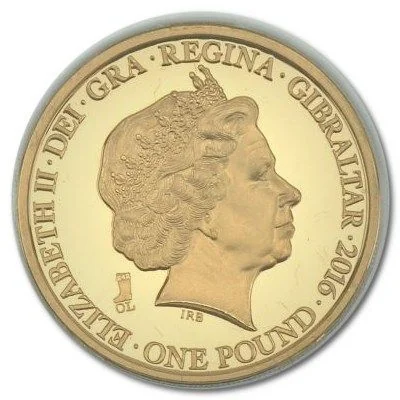
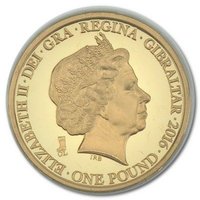
Queen Elizabeth II in profile, wearing the "Girls of Great Britain and Ireland" Tiara. Legend and date surround the portrait, with the denomination below and the Operation Leg privy mark to the left.
Inscription:
ELIZABETH II · DEI · GRA · REGINA · GIBRALTAR · 2016
OL IRB
· ONE POUND ·
OL IRB
· ONE POUND ·
Script: Latin
Designer: Ian Rank-Broadley
Reverse
Edge
Reeded
Categories
| Person> Military leader |
| Transportation> Aircraft |
| History> War |
Mintings
| Year | Mint Mark | Mintage | Quality | Collection |
|---|---|---|---|---|
| 2016 | — | 242 | Proof |
Historical background
In 2016, Gibraltar's currency situation remained defined by its longstanding and practical dual-currency system, with both Pound Sterling (GIP) and the euro in widespread daily use. While the Gibraltar government issues its own banknotes (Gibraltar pounds, pegged at par with the UK pound), the territory's economic life is heavily influenced by its border with Spain. Consequently, most retail businesses, especially those catering to the large influx of Spanish workers and tourists, readily accepted euros, though often at exchange rates less favourable than official banks. The Gibraltar pound itself, while legal tender only in Gibraltar, was freely interchangeable with the Bank of England pound, which also circulated widely.
This monetary environment existed under the significant shadow of the Brexit referendum held in June 2016. The UK's vote to leave the European Union introduced profound uncertainty for Gibraltar, which had overwhelmingly voted to remain (96%). Key concerns immediately emerged regarding the future fluidity of the border with Spain, which underpinned the daily cross-border movement of people and the convenience of the dual-currency economy. There were fears that a "hard Brexit" could disrupt the economic symbiosis with the neighbouring Spanish region of Campo de Gibraltar, potentially affecting the practical utility of the euro in the territory.
Despite this political upheaval, the formal currency framework was stable. The Gibraltar pound's peg to sterling was unwavering, and there were no discussions about abandoning it. The core issue was not the currency itself, but the potential for Brexit to alter the underlying economic and geographic realities that made the flexible use of two currencies so advantageous. Therefore, 2016 was a year of monetary continuity in practice but deep apprehension about the future, with the currency situation serving as a barometer for wider economic relations pending the outcome of UK-EU negotiations.
This monetary environment existed under the significant shadow of the Brexit referendum held in June 2016. The UK's vote to leave the European Union introduced profound uncertainty for Gibraltar, which had overwhelmingly voted to remain (96%). Key concerns immediately emerged regarding the future fluidity of the border with Spain, which underpinned the daily cross-border movement of people and the convenience of the dual-currency economy. There were fears that a "hard Brexit" could disrupt the economic symbiosis with the neighbouring Spanish region of Campo de Gibraltar, potentially affecting the practical utility of the euro in the territory.
Despite this political upheaval, the formal currency framework was stable. The Gibraltar pound's peg to sterling was unwavering, and there were no discussions about abandoning it. The core issue was not the currency itself, but the potential for Brexit to alter the underlying economic and geographic realities that made the flexible use of two currencies so advantageous. Therefore, 2016 was a year of monetary continuity in practice but deep apprehension about the future, with the currency situation serving as a barometer for wider economic relations pending the outcome of UK-EU negotiations.

✨ Legendary