

1000 Lire – Vatican City
Non-circulating coins
Commemoration: Sollecitudo Rei Socialis encyclical
Vatican City
Context
Year: 1988
Issuer: Vatican City 
Ruler: John Paul II
Currency:
(1929—2001)
Demonetization: 1 March 2002
Total mintage: 80,000
Material
References
KM: #Click to copy to clipboard212
Numista: #14146
Value
Exchange value: 1000 VAL
Bullion value: $34.89
Obverse
Description:
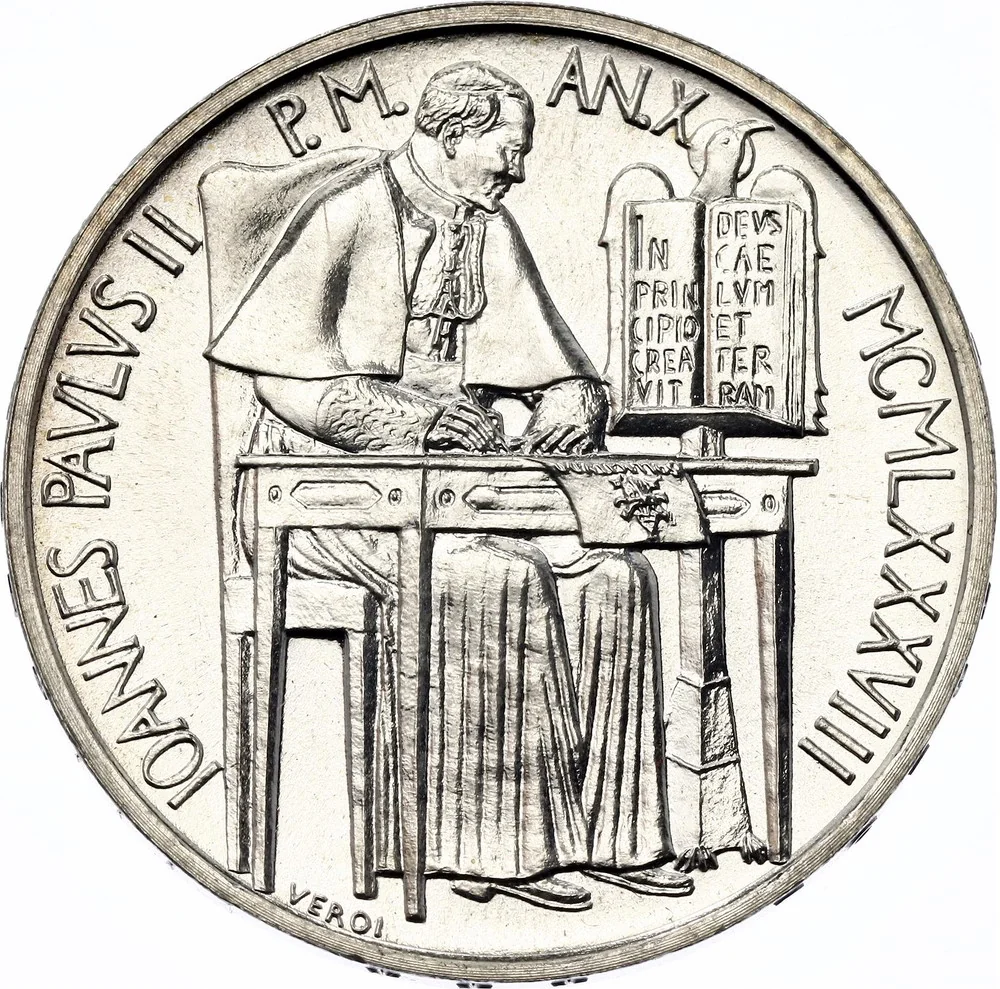
Pope John Paul II signs the Encyclical, gazing at the Tables of the Law. A nimbate dove, symbolizing the Holy Spirit, supports them on a pedestal.
Inscription:
IOANNES PAVLVS II P.M. AN.X·MCMLXXXVIII
Translation:
JOHN PAUL II PONTIFF MAXIMUS YEAR 10 1988
Script: Latin
Language: Latin
Engraver: Guido Veroi
Reverse
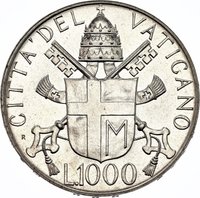
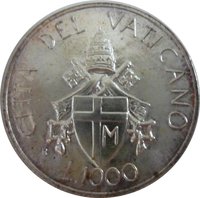
Description:
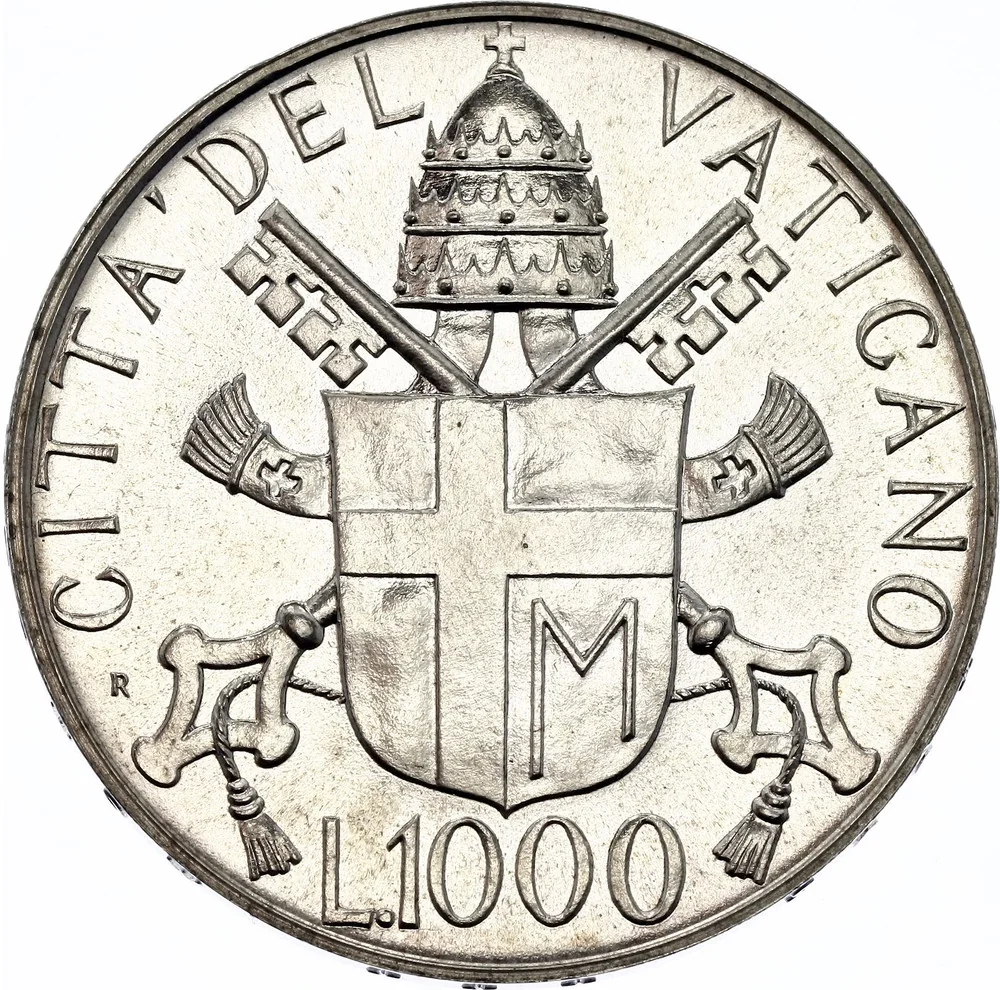
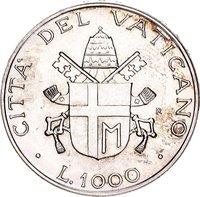
Heraldic emblem
Inscription:
CITTA' DEL VATICANO
R L.1000
R L.1000
Translation:
Vatican City
L. 1000
L. 1000
Script: Latin
Language: Italian
Engraver: Guido Veroi
Edge
Embossed script
Legend:
TOTVS TVVS +++ MCMLXXXVIII +++
Translation:
Totally Yours +++ 1988 +++
Language: Latin
Categories
| Person> Religious figure |
| Religion> Religious objects |
| Symbols> Coat of Arms |
Mints
| Name | Mark |
|---|---|
| Rome | R |
Mintings
| Year | Mint Mark | Mintage | Quality | Collection |
|---|---|---|---|---|
| 1988 | R | 80,000 |
Historical background
In 1988, Vatican City's currency situation was defined by its unique status as an independent state with a tiny, non-productive economy. While the Italian Lira was the de facto everyday currency used for all transactions within its walls, the Vatican possessed the sovereign right to issue its own coinage. This right, granted by the Lateran Treaty of 1929, allowed for the minting of Vatican Lira coins, which had legal tender status within the city-state and, crucially, were interchangeable at par with the Italian Lira throughout Italy. This arrangement was central to the Vatican's fiscal independence and symbolic sovereignty.
The year 1988 fell within a significant transitional period for the Vatican's monetary authority. The 1984 revision of the Lateran Concordat had redefined the terms, limiting the Vatican's coin-minting rights. The new agreement stipulated that Vatican coinage was to be primarily commemorative and numismatic in nature, with strict annual ceilings on face-value volume set in negotiation with the Italian government. This was a move away from a fully functional parallel currency and toward a system where the coins' value was increasingly derived from their collectability rather than their nominal monetary role.
Consequently, by 1988, the economic reality was a dual-system dependency. The Italian Lira circulated for all practical purposes, while the issuance of Vatican Lira coinage served three main functions: as a source of revenue for the Holy See (through the sale of premium-priced collector sets), as a tool for promoting the Pope's image and Catholic themes worldwide, and as a continued, though diminished, symbol of statehood. This setup would remain in place until the introduction of the Euro in 2002, when the Vatican negotiated a special agreement to issue limited Euro coins under similar restrictive terms.
The year 1988 fell within a significant transitional period for the Vatican's monetary authority. The 1984 revision of the Lateran Concordat had redefined the terms, limiting the Vatican's coin-minting rights. The new agreement stipulated that Vatican coinage was to be primarily commemorative and numismatic in nature, with strict annual ceilings on face-value volume set in negotiation with the Italian government. This was a move away from a fully functional parallel currency and toward a system where the coins' value was increasingly derived from their collectability rather than their nominal monetary role.
Consequently, by 1988, the economic reality was a dual-system dependency. The Italian Lira circulated for all practical purposes, while the issuance of Vatican Lira coinage served three main functions: as a source of revenue for the Holy See (through the sale of premium-priced collector sets), as a tool for promoting the Pope's image and Catholic themes worldwide, and as a continued, though diminished, symbol of statehood. This setup would remain in place until the introduction of the Euro in 2002, when the Vatican negotiated a special agreement to issue limited Euro coins under similar restrictive terms.
🌟 Limited