

10 kroner – Denmark
Add to wishlist
Denmark
Context
Year: 2023
Issuer: Denmark
Issuing organization: National Bank of Denmark
Ruler: Margrethe II
Currency:
(since 1873)
Material
Diameter: 23.35 mm
Weight: 7 g
Shape: Round
Composition: Aluminium bronze
Magnetic: No
Technique: Milled
Alignment: Medal alignment
flip
References
KM: #
Numista: #368747
Value
Exchange value: 10 DKK
Inflation-adjusted value: 10.50 DKK
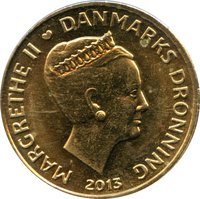
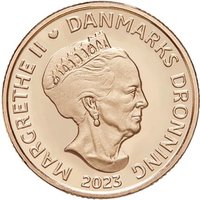
Obverse
Description:
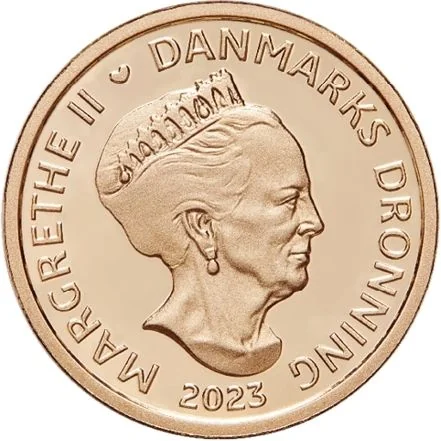
Queen Margrethe II's sixth portrait, facing right.
Inscription:
MARGRETHE II ♥︎ DANMARKS DRONNING 2023
Translation:
Margrethe II ♥ Queen of Denmark 2023
Script: Latin
Designer: Eva Hjorth
Reverse
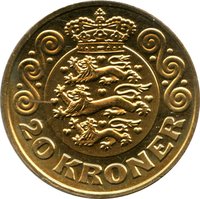
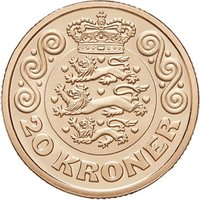
Description:
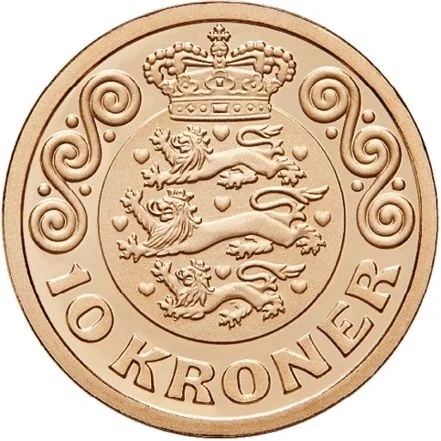
Danish crowned coat of arms on a disc, with ornamental decorations and the value below.
Inscription:
10 KRONER
Script: Latin
Edge
Plain
Categories
| Person> Monarch |
| Symbols> Coat of Arms |
Mints
| Name | Mark |
|---|---|
| Mint of Finland | — |
Mintings
| Year | Mint Mark | Mintage | Quality | Collection |
|---|---|---|---|---|
| 2023 | ♥︎ | — | ||
| 2023 | ♥︎ | — | Proof |
Historical background
In 2023, Denmark maintained its long-standing and stable currency framework, with the Danish krone (DKK) continuing its peg to the euro through the European Exchange Rate Mechanism (ERM II). This policy, managed by the independent Danish central bank (Danmarks Nationalbank), is a cornerstone of the nation's economic strategy, ensuring low inflation and exchange rate stability for its open, trade-dependent economy. The fixed exchange rate is maintained at a central rate of 7.46038 kroner per euro, with a very narrow permitted fluctuation band of ±2.25%, though in practice the bank intervenes to keep movements much tighter, typically within ±0.5%.
The year was characterized by Danmarks Nationalbank actively shadowing the monetary policy of the European Central Bank (ECB) to maintain the peg's credibility, even as Denmark is not a member of the Eurozone. As the ECB raised interest rates aggressively throughout 2022 and into 2023 to combat inflation, the Danish central bank followed suit with parallel rate hikes. This was necessary to prevent capital outflows and downward pressure on the krone, which at times required significant foreign currency interventions. Despite these global pressures, the peg remained robust and unquestioned, with Denmark's AAA credit rating and substantial foreign exchange reserves providing a strong buffer.
Domestically, the currency situation was largely a non-issue for everyday economic activity, as stability is taken for granted. However, the alignment with ECB policy meant that Danish businesses and households also faced higher borrowing costs, contributing to a cooling housing market and moderated economic growth. Looking ahead, the debate on potentially adopting the euro remained dormant, as the existing arrangement provided all the benefits of eurozone stability without formal political integration, a balance that continued to enjoy broad political and public support in Denmark throughout 2023.
The year was characterized by Danmarks Nationalbank actively shadowing the monetary policy of the European Central Bank (ECB) to maintain the peg's credibility, even as Denmark is not a member of the Eurozone. As the ECB raised interest rates aggressively throughout 2022 and into 2023 to combat inflation, the Danish central bank followed suit with parallel rate hikes. This was necessary to prevent capital outflows and downward pressure on the krone, which at times required significant foreign currency interventions. Despite these global pressures, the peg remained robust and unquestioned, with Denmark's AAA credit rating and substantial foreign exchange reserves providing a strong buffer.
Domestically, the currency situation was largely a non-issue for everyday economic activity, as stability is taken for granted. However, the alignment with ECB policy meant that Danish businesses and households also faced higher borrowing costs, contributing to a cooling housing market and moderated economic growth. Looking ahead, the debate on potentially adopting the euro remained dormant, as the existing arrangement provided all the benefits of eurozone stability without formal political integration, a balance that continued to enjoy broad political and public support in Denmark throughout 2023.
💎 Very Rare