

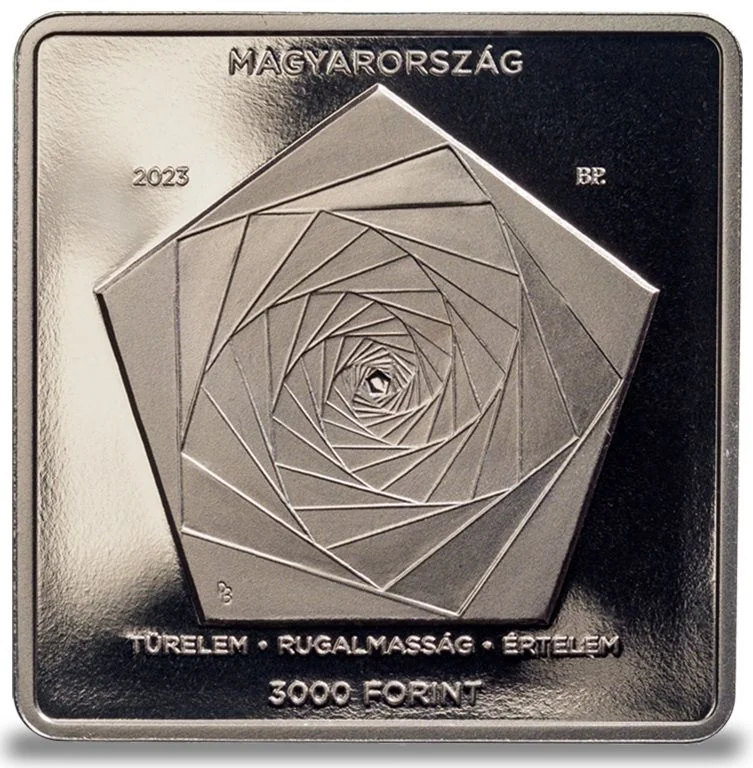
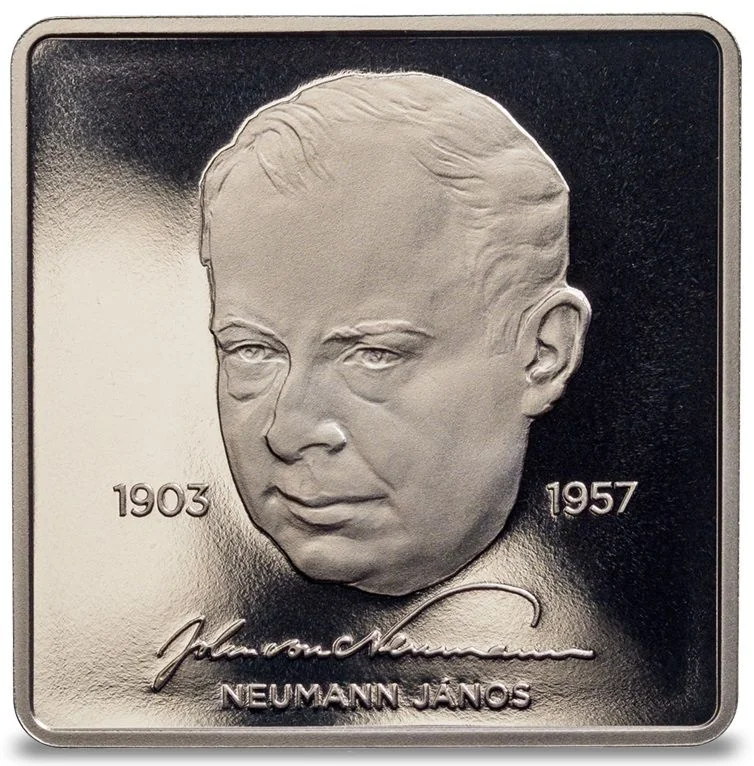
3000 forint – Hungary
Add to wishlist
Non-circulating coins
Commemoration: 13th. series - Neumann János
Hungary
Context
Year: 2023
Issuer: Hungary
Issuing organization: Magyar Pénzverő
Period:
(since 1989)
Currency:
(since 1946)
Total mintage: 11,000
Material
Weight: 14 g
Shape: Square with rounded corners
Technique: Milled
Alignment: Medal alignment
flip
References
Numista: #368743
Value
Exchange value: 3000 HUF
Inflation-adjusted value: 3750.36 HUF
Obverse
Inscription:
MAGYARORSZÁG
2023 BP.
Türelem * Rugalmasság * Értelem
3000 FORINT
2023 BP.
Türelem * Rugalmasság * Értelem
3000 FORINT
Translation:
HUNGARY
2023 BP.
Patience * Flexibility * Intellect
3000 FORINT
2023 BP.
Patience * Flexibility * Intellect
3000 FORINT
Script: Latin
Language: Hungarian
Designer: Pelcz Balázs
Reverse
Description:
John von Neumann's signature
Inscription:
1903 - 1957
NEUMANN JÁNOS
NEUMANN JÁNOS
Translation:
1903 - 1957
John Neumann
John Neumann
Scripts: Latin, Latin (cursive)
Language: Hungarian
Designer: Pelcz Balázs
Edge
Plain
Categories
| Event> Birth anniversary |
| Person> Scientist |
Mints
| Name | Mark |
|---|---|
| Hungarian mint | BP. |
Historical background
In 2023, Hungary's currency, the forint (HUF), navigated a year of significant pressure and gradual stabilization. The primary challenges stemmed from a prolonged period of high inflation, which peaked at over 25% in early 2023—the highest in the European Union—and a wide interest rate differential with major currencies. These factors, combined with concerns over the pace of European Union fund disbursements and the country's twin deficits (budget and current account), led to notable volatility. The forint repeatedly tested and, at times, breached the psychologically sensitive 400-per-euro level in the first half of the year, reflecting investor unease.
The National Bank of Hungary (MNB) played a central role in managing the situation through a unique dual monetary policy. To combat inflation and support the currency, the MNB maintained the EU's highest base interest rate at 13% for most of the year. Alongside this, it employed a series of targeted liquidity tools, effectively creating a "soft peg" or interest rate corridor to provide stability. This strategy, alongside a gradual improvement in the country's risk assessment as EU funds began to flow after agreements with the European Commission, helped the forint recover ground in the latter part of 2023, strengthening to around 375-380 against the euro by year-end.
Overall, 2023 was a transition year for the Hungarian forint, moving from extreme vulnerability to a more stable, though still fragile, position. The currency's fortunes remained tightly linked to the inflation outlook, the MNB's policy decisions, and the broader access to EU reconstruction funds. While the aggressive monetary policy succeeded in averting a deeper crisis and bolstering the forint, it came at the cost of constrained economic growth, setting the stage for a cautious shift towards rate cuts only as inflation showed clear signs of sustained deceleration towards the very end of the year.
The National Bank of Hungary (MNB) played a central role in managing the situation through a unique dual monetary policy. To combat inflation and support the currency, the MNB maintained the EU's highest base interest rate at 13% for most of the year. Alongside this, it employed a series of targeted liquidity tools, effectively creating a "soft peg" or interest rate corridor to provide stability. This strategy, alongside a gradual improvement in the country's risk assessment as EU funds began to flow after agreements with the European Commission, helped the forint recover ground in the latter part of 2023, strengthening to around 375-380 against the euro by year-end.
Overall, 2023 was a transition year for the Hungarian forint, moving from extreme vulnerability to a more stable, though still fragile, position. The currency's fortunes remained tightly linked to the inflation outlook, the MNB's policy decisions, and the broader access to EU reconstruction funds. While the aggressive monetary policy succeeded in averting a deeper crisis and bolstering the forint, it came at the cost of constrained economic growth, setting the stage for a cautious shift towards rate cuts only as inflation showed clear signs of sustained deceleration towards the very end of the year.

💎 Very Rare