

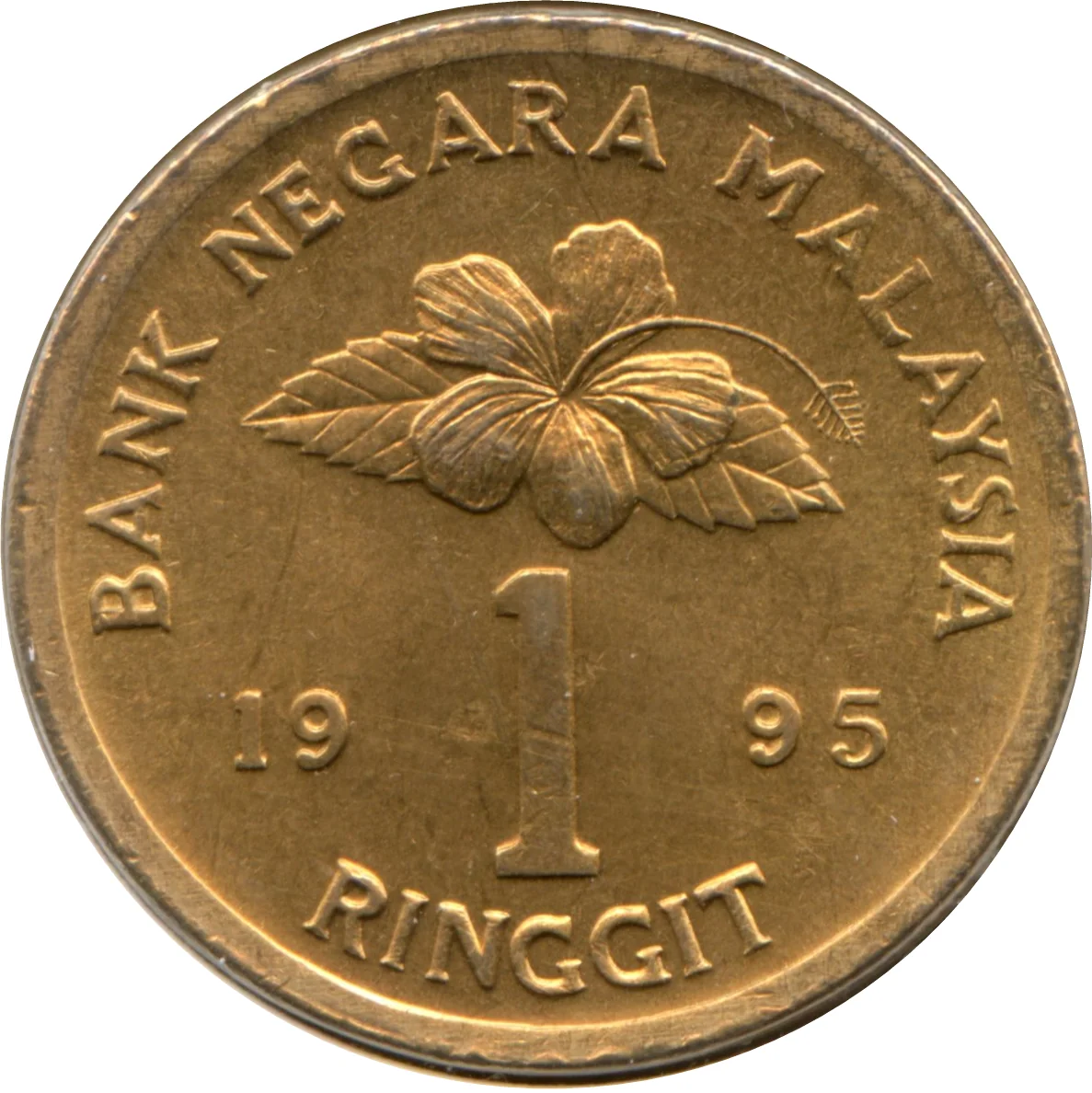
Obverse
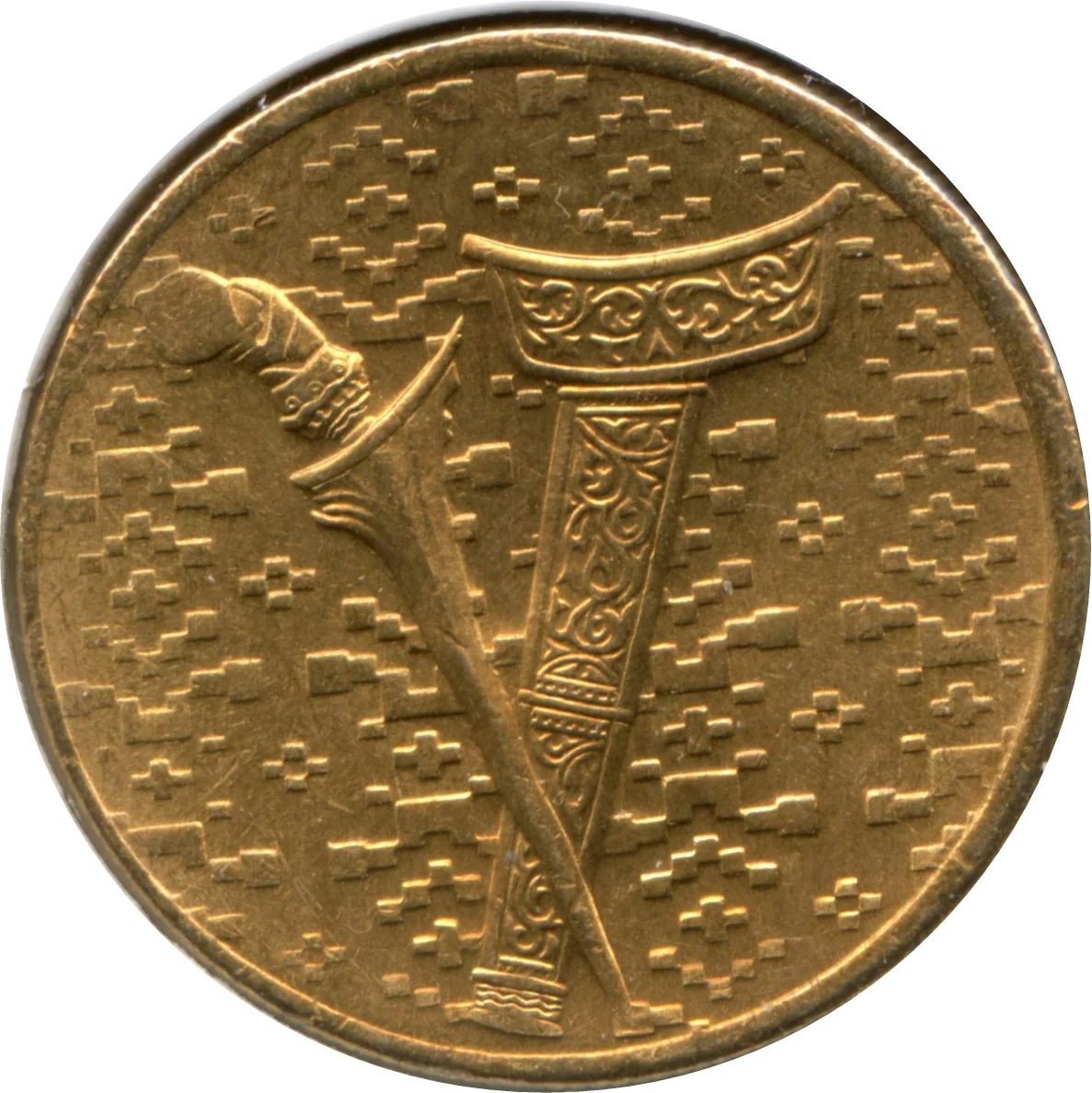
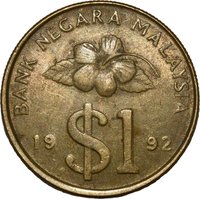
Reverse
Description:
Dagger with sheath
Edge
Reeded
Categories
| Plants> Flower |
| Object> Cold weapons |
Mints
| Name | Mark |
|---|---|
| Shah Alam | — |
Mintings
| Year | Mint Mark | Mintage | Quality | Collection |
|---|---|---|---|---|
| 1993 | — | 178,893,810 | ||
| 1994 | — | 36,899,026 | ||
| 1995 | — | 132,172,580 | ||
| 1996 | — | 59,460,000 | ||
| 1997 | — | 41,842,514 | ||
| 1998 | — | 607,756,026 |
Historical background
In 1993, Malaysia's currency situation was dominated by the country's rapid economic growth and its evolving relationship with global financial markets. The economy was in the midst of a sustained boom, averaging over 8% annual GDP growth, driven by industrialization, foreign direct investment, and exports. This strong fundamental performance bolstered the Malaysian Ringgit (MYR), which was pegged to a undisclosed basket of currencies of its major trading partners rather than a single currency like the US Dollar. The peg provided stability for trade and investment, but the ringgit's value was still influenced by market forces within a managed float.
A key development of the period was Malaysia's active encouragement of the internationalization of the Ringgit. In 1993, Bank Negara Malaysia (the central bank) lifted restrictions on the use of the Ringgit in foreign trade, allowing its use for invoicing and settlement of international transactions, particularly within the region. This move was aimed at promoting Kuala Lumpur as a financial centre and reducing reliance on the US Dollar. Concurrently, the offshore market for Ringgit deposits and loans (known as the "Ringgit Deposit Market" in Singapore) grew significantly, facilitated by interest rate differentials that made borrowing in Ringgit attractive.
However, this liberalization also introduced new vulnerabilities. The large and growing offshore Ringgit market began to complicate domestic monetary policy, as cross-border flows could undermine Bank Negara's control over domestic liquidity and interest rates. While not yet in crisis, the seeds of future tension were being sown. The massive inflows of foreign capital chasing high returns contributed to asset inflation and set the stage for the volatility that would culminate in the 1997 Asian Financial Crisis, during which the offshore market would become a channel for speculative attacks against the Ringgit.
A key development of the period was Malaysia's active encouragement of the internationalization of the Ringgit. In 1993, Bank Negara Malaysia (the central bank) lifted restrictions on the use of the Ringgit in foreign trade, allowing its use for invoicing and settlement of international transactions, particularly within the region. This move was aimed at promoting Kuala Lumpur as a financial centre and reducing reliance on the US Dollar. Concurrently, the offshore market for Ringgit deposits and loans (known as the "Ringgit Deposit Market" in Singapore) grew significantly, facilitated by interest rate differentials that made borrowing in Ringgit attractive.
However, this liberalization also introduced new vulnerabilities. The large and growing offshore Ringgit market began to complicate domestic monetary policy, as cross-border flows could undermine Bank Negara's control over domestic liquidity and interest rates. While not yet in crisis, the seeds of future tension were being sown. The massive inflows of foreign capital chasing high returns contributed to asset inflation and set the stage for the volatility that would culminate in the 1997 Asian Financial Crisis, during which the offshore market would become a channel for speculative attacks against the Ringgit.

🌱 Very Common