

5 Cents – United States
United States
Context
Years: 1883–1913
Issuer: United States 
Period:
(since 1776)
Currency:
(since 1785)
Total mintage: 596,067,893
Material
Diameter: 21.2 mm
Weight: 5 g
Thickness: 1.95 mm
Shape: Round
Composition: Copper-nickel
Technique: Milled
Alignment: Coin alignment
flip
References
KM: #Click to copy to clipboard112
Numista: #3683
Value
Exchange value: 0.05 USD = $0.05
Obverse
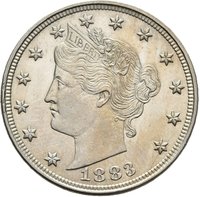
Description:
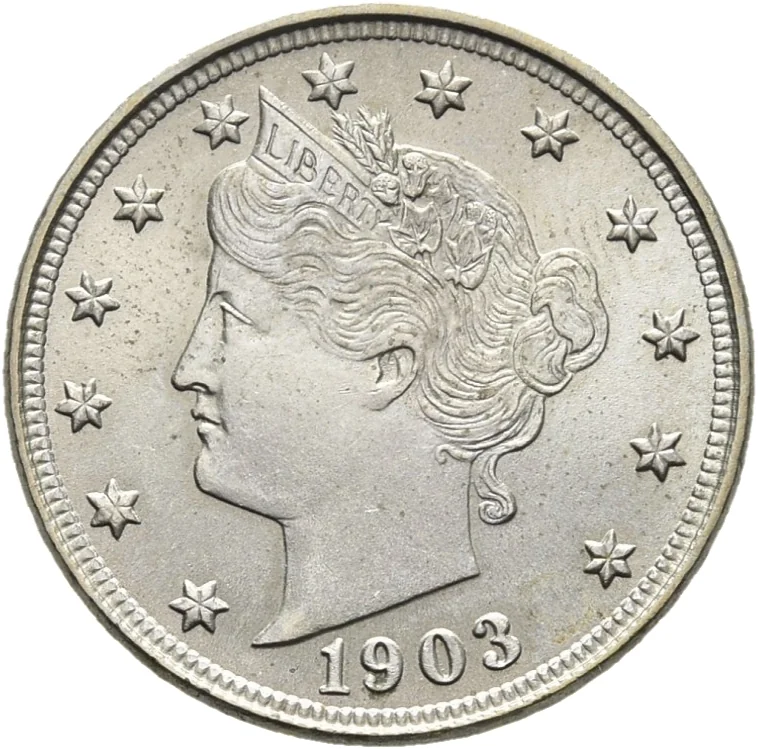
Liberty's head encircled by 13 stars for the original colonies.
Inscription:
* * * * * * * * * * * * *
LIBERTY
1912
LIBERTY
1912
Script: Latin
Engraver: Charles Edward Barber
Reverse
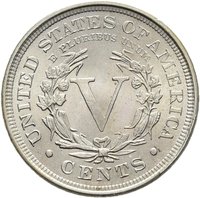
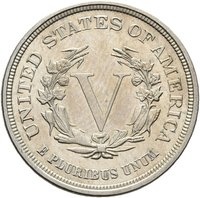
Description:
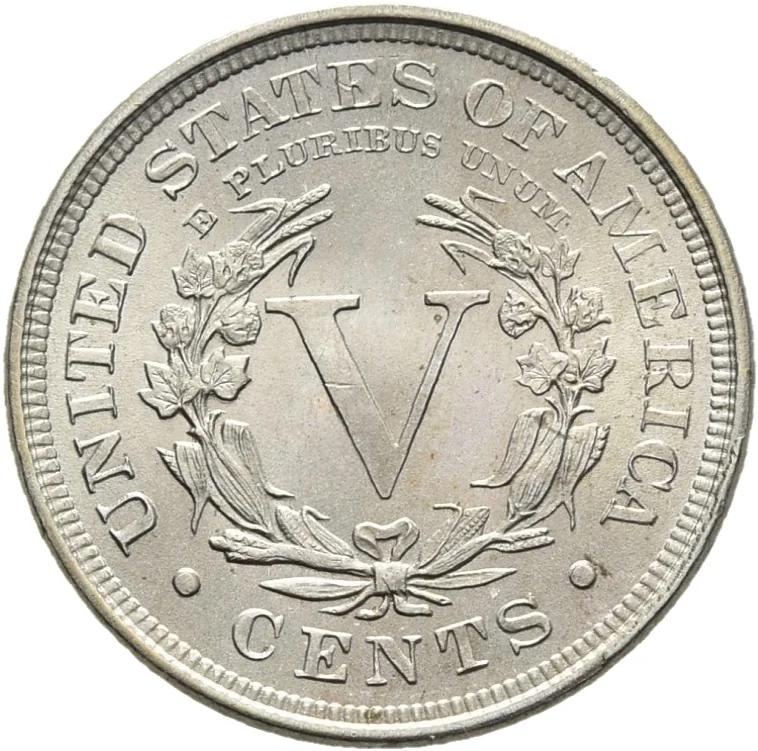
V with laurel wreath
Inscription:
UNITED STATES OF AMERICA
E PLURIBUS UNUM
V
·CENTS·
E PLURIBUS UNUM
V
·CENTS·
Translation:
UNITED STATES OF AMERICA
OUT OF MANY, ONE
FIVE CENTS
OUT OF MANY, ONE
FIVE CENTS
Script: Latin
Engraver: Charles Edward Barber
Edge
Plain
Mints
| Name | Mark |
|---|---|
| United States Mint of Philadelphia | — |
| United States Mint of Denver | D |
| United States Mint of San Francisco | S |
Mintings
| Year | Mint Mark | Mintage | Quality | Collection |
|---|---|---|---|---|
| 1883 | — | 16,026,200 | ||
| 1883 | — | 6,783 | Proof | |
| 1884 | — | 3,942 | Proof | |
| 1884 | — | 11,270,000 | ||
| 1885 | — | 1,472,700 | ||
| 1885 | — | 3,790 | Proof | |
| 1886 | — | 3,326,000 | ||
| 1886 | — | 4,290 | Proof | |
| 1887 | — | 15,260,692 | ||
| 1887 | — | 2,960 | Proof | |
| 1888 | — | 4,582 | Proof | |
| 1888 | — | 10,167,901 | ||
| 1889 | — | 3,336 | Proof | |
| 1889 | — | 15,878,025 | ||
| 1890 | — | 16,256,532 | ||
| 1890 | — | 2,740 | Proof | |
| 1891 | — | 16,832,000 | ||
| 1891 | — | 2,350 | Proof | |
| 1892 | — | 11,696,897 | ||
| 1892 | — | 2,745 | Proof | |
| 1893 | — | 13,368,000 | ||
| 1893 | — | 2,195 | Proof | |
| 1894 | — | 5,410,500 | ||
| 1894 | — | 2,632 | Proof | |
| 1895 | — | 2,062 | Proof | |
| 1895 | — | 9,977,822 | ||
| 1896 | — | 8,841,058 | ||
| 1896 | — | 1,862 | Proof | |
| 1897 | — | 20,426,797 | ||
| 1897 | — | 1,938 | Proof | |
| 1898 | — | 12,530,292 | ||
| 1898 | — | 1,795 | Proof | |
| 1899 | — | 26,027,000 | ||
| 1899 | — | 2,031 | Proof | |
| 1900 | — | 27,253,733 | ||
| 1900 | — | 2,262 | Proof | |
| 1901 | — | 26,478,228 | ||
| 1901 | — | 1,985 | Proof | |
| 1902 | — | 2,018 | Proof | |
| 1902 | — | 31,487,561 | ||
| 1903 | — | 28,004,935 | ||
| 1903 | — | 1,790 | Proof | |
| 1904 | — | 21,403,167 | ||
| 1904 | — | 1,817 | Proof | |
| 1905 | — | 29,825,124 | ||
| 1905 | — | 2,152 | Proof | |
| 1906 | — | 1,725 | Proof | |
| 1906 | — | 38,612,000 | ||
| 1907 | — | 1,475 | Proof | |
| 1907 | — | 39,213,325 | ||
| 1908 | — | 22,684,557 | ||
| 1908 | — | 1,620 | Proof | |
| 1909 | — | 11,585,763 | ||
| 1909 | — | 4,763 | Proof | |
| 1910 | — | 2,405 | Proof | |
| 1910 | — | 30,166,948 | ||
| 1911 | — | 39,557,639 | ||
| 1911 | — | 1,733 | Proof | |
| 1912 | D | 8,474,000 | ||
| 1912 | S | 238,000 | ||
| 1912 | — | 26,234,569 | ||
| 1912 | — | 2,145 | Proof | |
| 1913 | — | 5 |
Historical background
In 1883, the United States was in the midst of a long and contentious debate over its monetary system, often called the "Battle of the Standards." The core conflict pitted advocates for a currency backed solely by gold ("gold bugs") against those who wanted to retain or expand the use of silver ("silverites"). This struggle was deeply sectional and class-based, with Eastern bankers and industrialists favoring the stability of the gold standard, while farmers, miners, and debtors in the South and West championed the free coinage of silver to increase the money supply, cause inflation, and ease the repayment of loans with cheaper dollars.
The legal framework was defined by the Coinage Act of 1873, which demonetized silver and put the nation on a de facto gold standard, a move silver proponents bitterly denounced as the "Crime of '73." In response to political pressure, a compromise was reached with the Bland-Allison Act of 1878, which required the Treasury to purchase and coin a limited amount of silver each month. By 1883, this act was in full effect, but it satisfied neither side. The Treasury's purchases were too small to significantly raise prices as the silverites hoped, yet the constant injection of silver dollars—which often sat in bank vaults—complicated the gold-backed system favored by Eastern financiers.
Thus, the currency situation in 1883 was one of uneasy and complex duality. The country operated on a gold standard for international trade and to maintain credibility with foreign investors, while simultaneously circulating a growing, but limited, supply of silver currency domestically. This period of relative calm was deceptive, as the underlying tensions between the metallic standards remained unresolved. The debate would intensify dramatically in the following decade, culminating in the political earthquake of the 1896 presidential election, where William Jennings Bryan would famously condemn the gold standard in his "Cross of Gold" speech.
The legal framework was defined by the Coinage Act of 1873, which demonetized silver and put the nation on a de facto gold standard, a move silver proponents bitterly denounced as the "Crime of '73." In response to political pressure, a compromise was reached with the Bland-Allison Act of 1878, which required the Treasury to purchase and coin a limited amount of silver each month. By 1883, this act was in full effect, but it satisfied neither side. The Treasury's purchases were too small to significantly raise prices as the silverites hoped, yet the constant injection of silver dollars—which often sat in bank vaults—complicated the gold-backed system favored by Eastern financiers.
Thus, the currency situation in 1883 was one of uneasy and complex duality. The country operated on a gold standard for international trade and to maintain credibility with foreign investors, while simultaneously circulating a growing, but limited, supply of silver currency domestically. This period of relative calm was deceptive, as the underlying tensions between the metallic standards remained unresolved. The debate would intensify dramatically in the following decade, culminating in the political earthquake of the 1896 presidential election, where William Jennings Bryan would famously condemn the gold standard in his "Cross of Gold" speech.
🌱 Very Common