

500 lire – Vatican City
Add to wishlist
Circulating commemorative coins
Commemoration: Lay Missions in the World
Vatican City
Context
Year: 1989
Issuer: Vatican City
Ruler: John Paul II
Currency:
(1929—2001)
Demonetization: 1 March 2002
Total mintage: 60,000
Material
References
KM: #
Numista: #14133
Value
Exchange value: 500 VAL
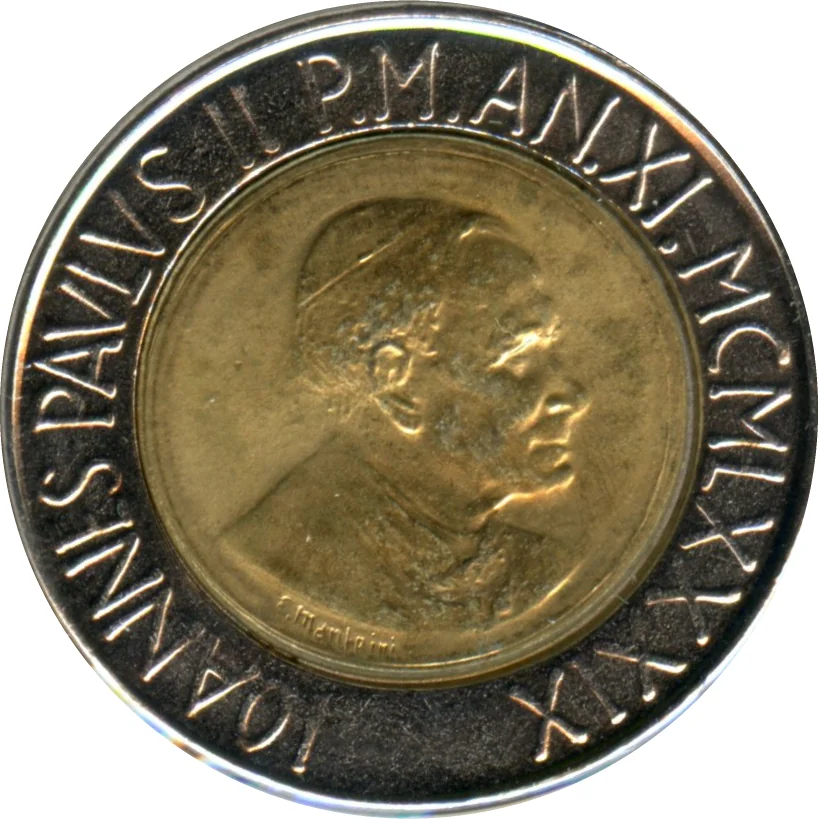
Obverse
Description:
Get in. Let's go.
Inscription:
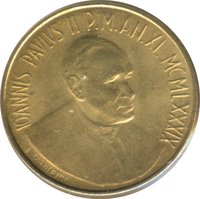
IONNES PAVLVS II P.M.AN.XI.MCMLXXXIX
Translation:
John Paul II, Supreme Pontiff, in the 11th Year, 1989.
Script: Latin
Language: Latin
Engraver: Enrico Manfrini
Reverse
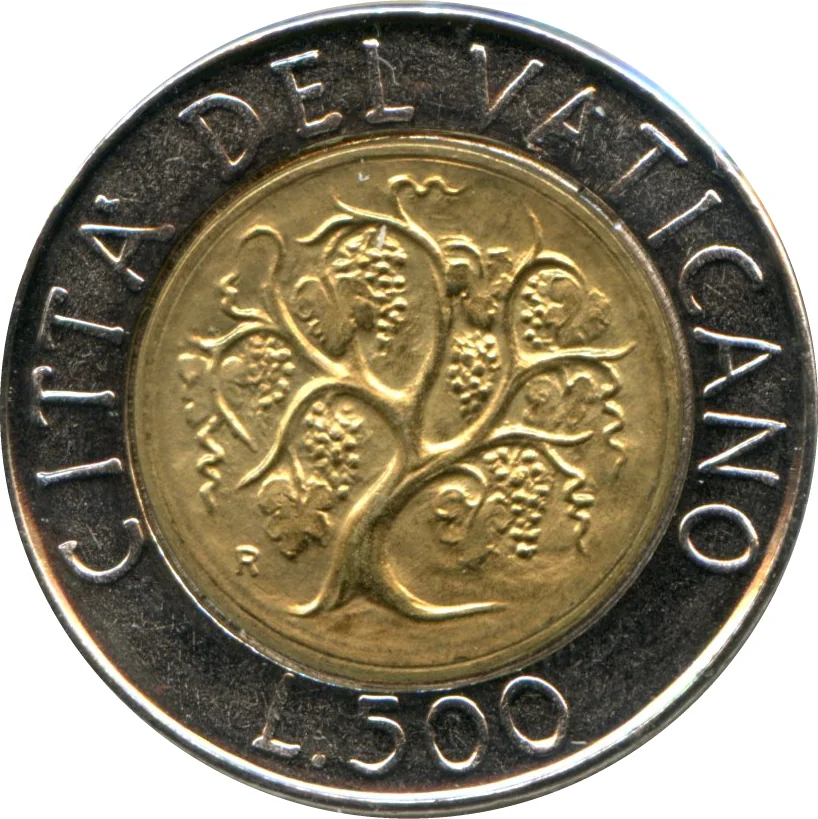
Description:
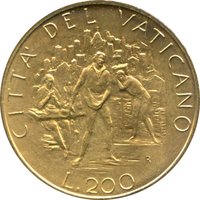
Grapevine: Cultivating sustenance from the earth.
Inscription:
CITTA' DEL VATICANO
R L.500
R L.500
Translation:
Vatican City
500 Lire
500 Lire
Script: Latin
Language: Italian
Engraver: Enrico Manfrini
Edge
Segmented reeding
Categories
| Person> Religious figure |
| Plant> Fruit |
| Religion> Religious objects |
Mints
| Name | Mark |
|---|---|
| Rome | R |
Mintings
| Year | Mint Mark | Mintage | Quality | Collection |
|---|---|---|---|---|
| 1989 | R | 60,000 |
Historical background
In 1989, Vatican City’s currency situation was defined by its unique status as an independent city-state with a deeply integrated economic relationship with Italy. While it issued its own distinct coinage—the Vatican lira—these coins were legally part of the Italian lira system due to the terms of the 1929 Lateran Treaty. The Vatican lira was pegged at a 1:1 ratio with the Italian lira and circulated interchangeably throughout Italy. This arrangement meant Vatican City, despite its sovereignty, did not have a fully independent monetary policy and was effectively within the Italian currency zone.
The year 1989 fell within a period of significant numismatic activity for the Vatican. The Institute for the Works of Religion (the Vatican Bank) managed finances, but the issuing of coins and stamps was a crucial source of revenue. Coins from this era often carried the effigy of Pope John Paul II and were minted in limited quantities, making them highly sought after by collectors worldwide. This collector demand, rather than domestic economic need, primarily drove the production and value of Vatican coinage.
Importantly, this system was on the cusp of major change. As a member of the European Monetary System, Italy was moving toward greater economic integration, a process that would culminate in the adoption of the euro a decade later. Vatican City, through its agreements with Italy, was already preparing for this shift. Thus, the currency situation in 1989 represented the final phase of a long-standing lira-based system, soon to be eclipsed by the coming of European economic and monetary union.
The year 1989 fell within a period of significant numismatic activity for the Vatican. The Institute for the Works of Religion (the Vatican Bank) managed finances, but the issuing of coins and stamps was a crucial source of revenue. Coins from this era often carried the effigy of Pope John Paul II and were minted in limited quantities, making them highly sought after by collectors worldwide. This collector demand, rather than domestic economic need, primarily drove the production and value of Vatican coinage.
Importantly, this system was on the cusp of major change. As a member of the European Monetary System, Italy was moving toward greater economic integration, a process that would culminate in the adoption of the euro a decade later. Vatican City, through its agreements with Italy, was already preparing for this shift. Thus, the currency situation in 1989 represented the final phase of a long-standing lira-based system, soon to be eclipsed by the coming of European economic and monetary union.
🌱 Common