

5 euro – Lithuania
Add to wishlist
Non-circulating coins
Commemoration: Coin dedicated to the role of the Lithuanian Catholic Church in unarmed resistance
Lithuania
Context
Material

References
KM: #
Numista: #366645
Value
Exchange value: 5 EUR
Bullion value: $28.00
Inflation-adjusted value: 5.53 EUR
Obverse
Description:
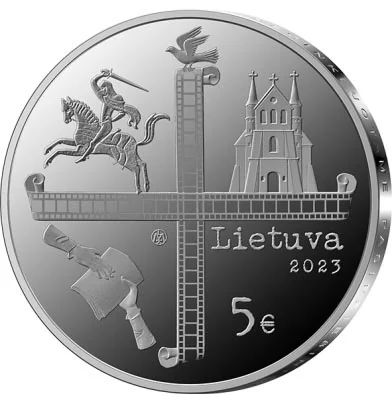
The obverse depicts a cross formed from microfilms, reflecting the distribution of the Chronicle of the Catholic Church in Lithuania. Within the cross's quadrants are the Vytis symbol, Simnas church (the Chronicle's origin), and a scene of the publication being handed on. It includes the inscriptions LIETUVA, 2023, €5, and the mintmark. A dove carrying the microfilm cross at the top symbolizes the Holy Spirit inspiring courage and the Chronicle's spread.
Inscription:
Lietuva
2023
5€
LMK
2023
5€
LMK
Translation:
Lithuania
2023
5€
Lithuanian Mint
2023
5€
Lithuanian Mint
Script: Latin
Languages: English, Lithuanian
Designer: Rūta Ona Čigriejūtė
Reverse
Description:
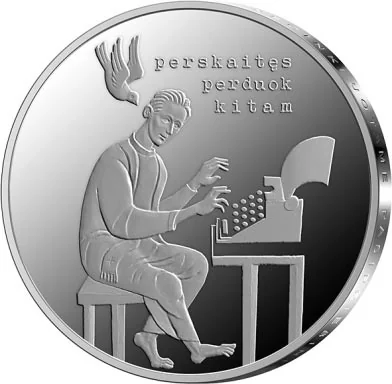
The reverse depicts an evangelist as a medieval scribe, typing words inspired by the Holy Spirit. The dove symbolizes inspiration, his stole his calling, his bare feet his poverty, and the typewriter his modern era. The inscription reads: “Pass on after reading.”
Inscription:
Perskaitęs perduok kitam
Translation:
Having read, pass to another.
Script: Latin
Language: Lithuanian
Designer: Rūta Ona Čigriejūtė
Edge
Smooth with inscriptions
Legend:
LIETUVOS KATALIKŲ BAŽNYČIOS VAIDMUO NEGINKLUOTAME PASIPRIEŠINIME
Translation:
The Role of the Lithuanian Catholic Church in the Non-Armed Resistance
Language: Lithuanian
Mints
| Name | Mark |
|---|---|
| Lithuanian Mint | (LMK) |
Mintings
| Year | Mint Mark | Mintage | Quality | Collection |
|---|---|---|---|---|
| 2023 | LMK | 2,750 | Proof |
Historical background
In 2023, Lithuania's currency situation was firmly anchored within the Eurozone, having adopted the euro on January 1, 2015. As a result, the country no longer had an independent monetary policy or a national currency (the former litas), with the European Central Bank (ECB) setting interest rates and overseeing price stability for the entire bloc. Lithuania's economic performance and currency stability were therefore directly tied to the euro's strength and the ECB's policy decisions, particularly its efforts to combat high inflation through a series of interest rate hikes throughout 2022 and 2023.
The primary domestic focus regarding currency was not on exchange rates but on inflation, which remained a significant economic challenge. While inflation in Lithuania peaked in 2022 and began to moderate in 2023, it consistently remained among the highest in the Eurozone. This was driven by persistent factors like elevated energy prices, strong wage growth, and robust domestic demand. Consequently, the real effective exchange rate—a measure of price competitiveness—was a point of attention, as high inflation risked making Lithuanian goods and services relatively more expensive.
Financially, 2023 was a landmark year as Lithuania solidified its position as a leading European hub for fintech, particularly with the widespread use of electronic money (e-money) institutions. The Bank of Lithuania reported that the total value of payments handled by Lithuanian-licensed e-money institutions surpassed that of traditional banks. This digital finance boom, while separate from the physical euro currency, represented a dynamic and growing segment of the nation's financial landscape, operating within the secure framework of the single currency.
The primary domestic focus regarding currency was not on exchange rates but on inflation, which remained a significant economic challenge. While inflation in Lithuania peaked in 2022 and began to moderate in 2023, it consistently remained among the highest in the Eurozone. This was driven by persistent factors like elevated energy prices, strong wage growth, and robust domestic demand. Consequently, the real effective exchange rate—a measure of price competitiveness—was a point of attention, as high inflation risked making Lithuanian goods and services relatively more expensive.
Financially, 2023 was a landmark year as Lithuania solidified its position as a leading European hub for fintech, particularly with the widespread use of electronic money (e-money) institutions. The Bank of Lithuania reported that the total value of payments handled by Lithuanian-licensed e-money institutions surpassed that of traditional banks. This digital finance boom, while separate from the physical euro currency, represented a dynamic and growing segment of the nation's financial landscape, operating within the secure framework of the single currency.
💎 Extremely Rare