

100 lire – Vatican City
Add to wishlist
Circulating commemorative coins
Commemoration: Encyclical Redemptoris Missio: The missions in the World
Vatican City
Context
Year: 1991
Issuer: Vatican City
Ruler: John Paul II
Currency:
(1929—2001)
Demonetization: 1 March 2002
Total mintage: 48,000
Material
References
KM: #
Numista: #14122
Value
Exchange value: 100 VAL
Obverse
Description:
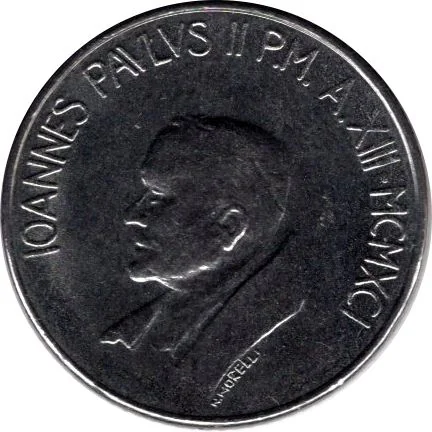
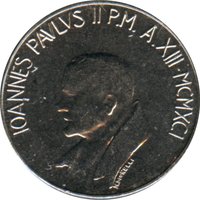
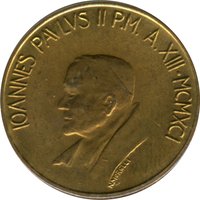
Bust left, dated pontificate year 13 and Gregorian year 1991 in Roman numerals.
Inscription:
IOANNES PAVLVS II P.M. A. XIII - MCMXCI
N.MORELLI
N.MORELLI
Translation:
JOHN PAUL II SUPREME PONTIFF YEAR 13 - 1991
N. MORELLI
N. MORELLI
Script: Latin
Language: Latin
Engraver: Nicola Morelli
Reverse
Description:
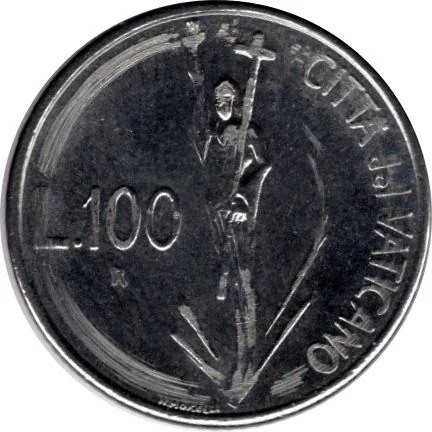
Resurrected Jesus, right arm raised, left hand holding a cross. Denomination and mint mark at left.
Inscription:
CITTÁ del VATICANO
L.100
R
N.MORELLI
L.100
R
N.MORELLI
Translation:
Vatican City
L.100
R
N. Morelli
L.100
R
N. Morelli
Script: Latin
Language: Italian
Engraver: Nicola Morelli
Edge
Reeded
Categories
| Person> Religious figure |
| Religion> Religious objects |
| Symbol> Cross |
Mints
| Name | Mark |
|---|---|
| Rome | R |
Mintings
| Year | Mint Mark | Mintage | Quality | Collection |
|---|---|---|---|---|
| 1991 | R | 48,000 |
Historical background
In 1991, the currency situation in Vatican City was defined by its unique status as a sovereign entity without an independent monetary policy. As established by the 1929 Lateran Treaty, the Vatican was part of the Italian lira monetary zone. Consequently, the Italian lira was the official legal tender for all everyday transactions within the city-state's walls. The Vatican did, however, exercise a limited sovereign right to mint its own coinage—distinct lira coins featuring the likeness of the reigning Pope—but these were issued in limited quantities, primarily for collectors and symbolic purposes, and circulated at par with Italian coins.
This arrangement was underpinned by a specific financial agreement with Italy, renewed in 1991, which allowed the Vatican Bank (IOR) to operate and granted the state the right to issue coinage up to a fixed annual value. Crucially, the Vatican's coinage was minted by the Italian State Mint (Istituto Poligrafico e Zecca dello Stato), further cementing the operational dependency on Italy. For higher-value transactions and its complex finances, the Vatican relied on a mixture of Italian banknotes and international banking instruments, lacking the authority to print its own paper currency.
Therefore, the background of 1991 shows a microstate entirely integrated into a larger neighbor's monetary system on the eve of European integration. This year was a quiet but significant prelude to a major shift, as the European Monetary Union, established by the Maastricht Treaty later that year, would eventually lead to the replacement of the lira with the euro. The Vatican would subsequently negotiate a new monetary convention with Italy in 2000, allowing it to adopt the euro as its official currency while retaining the right to issue its own euro coins.
This arrangement was underpinned by a specific financial agreement with Italy, renewed in 1991, which allowed the Vatican Bank (IOR) to operate and granted the state the right to issue coinage up to a fixed annual value. Crucially, the Vatican's coinage was minted by the Italian State Mint (Istituto Poligrafico e Zecca dello Stato), further cementing the operational dependency on Italy. For higher-value transactions and its complex finances, the Vatican relied on a mixture of Italian banknotes and international banking instruments, lacking the authority to print its own paper currency.
Therefore, the background of 1991 shows a microstate entirely integrated into a larger neighbor's monetary system on the eve of European integration. This year was a quiet but significant prelude to a major shift, as the European Monetary Union, established by the Maastricht Treaty later that year, would eventually lead to the replacement of the lira with the euro. The Vatican would subsequently negotiate a new monetary convention with Italy in 2000, allowing it to adopt the euro as its official currency while retaining the right to issue its own euro coins.
🌱 Common