

50 lire – Vatican City
Add to wishlist
Circulating commemorative coins
Commemoration: The Whole Family
Vatican City
Context
Year: 1982
Issuer: Vatican City
Ruler: John Paul II
Currency:
(1929—2001)
Demonetization: 1 March 2002
Total mintage: 287,000
Material
References
KM: #
Numista: #14116
Value
Exchange value: 50 VAL
Obverse
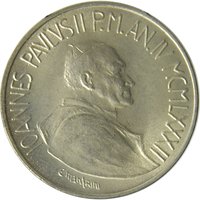
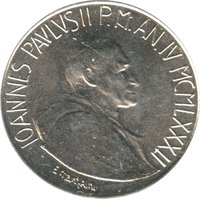
Description:
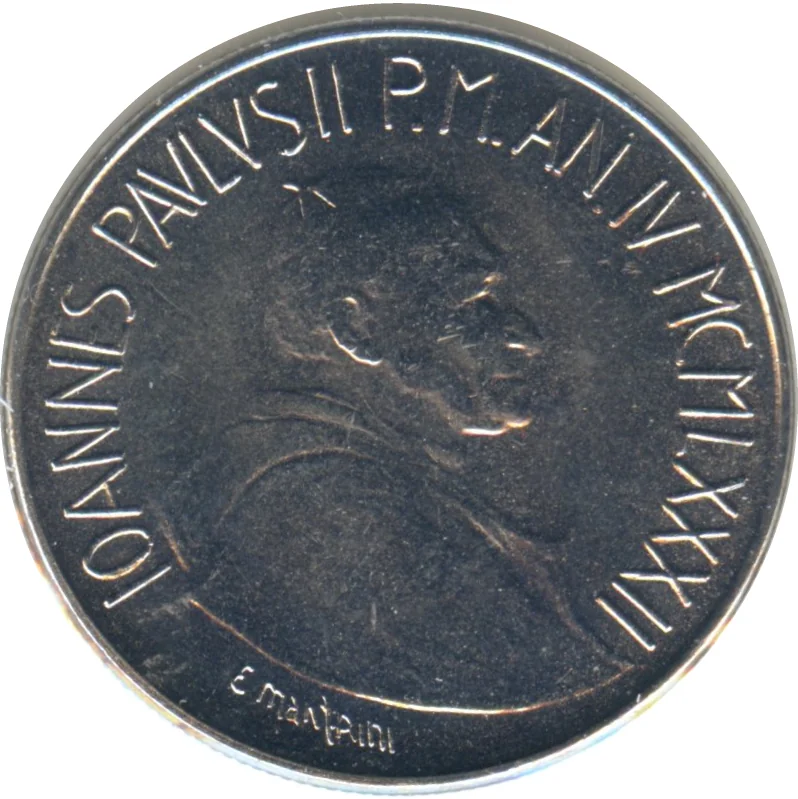
John Paul II in profile.
Inscription:
IOANNES PAVLVS II P.M.AN.IV MCMLXXXII
E MANFRINI
E MANFRINI
Translation:
John Paul II, Supreme Pontiff, Year Four, 1982.
From the Manfrin(i) collection.
From the Manfrin(i) collection.
Script: Latin
Engraver: Enrico Manfrini
Reverse
Description:
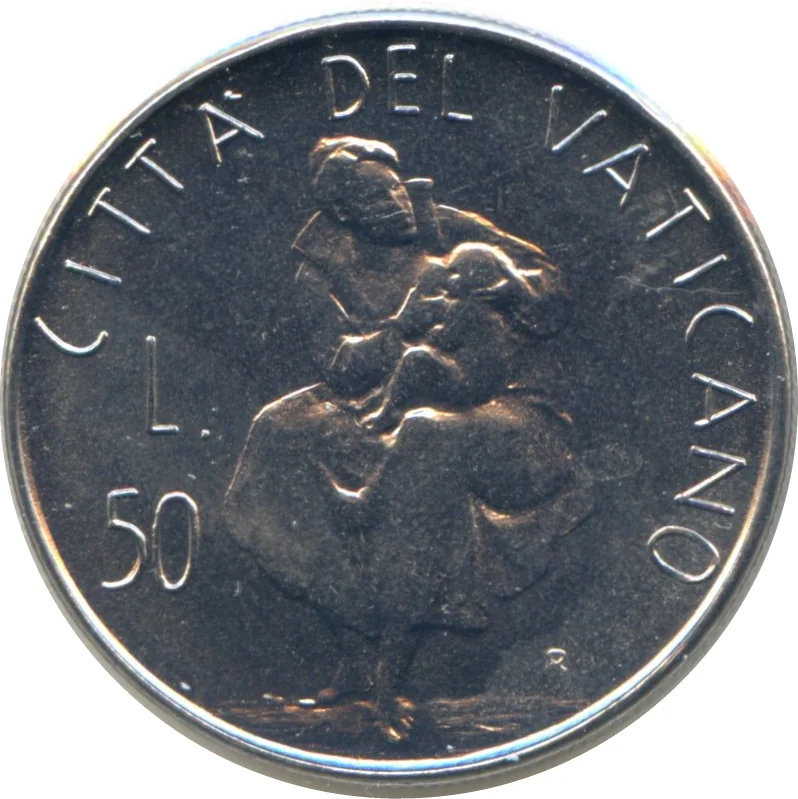
Nursing mother
Inscription:
CITTA' DEL VATICANO
L. 50
R
L. 50
R
Translation:
Vatican City
50 Lire
50 Lire
Script: Latin
Language: Italian
Engraver: Enrico Manfrini
Edge
Reeded
Categories
| Person> Religious figure |
| Religion> Religious objects |
Mints
| Name | Mark |
|---|---|
| Rome | R |
Mintings
| Year | Mint Mark | Mintage | Quality | Collection |
|---|---|---|---|---|
| 1982 | R | 287,000 |
Historical background
In 1982, Vatican City's currency situation was defined by its unique status as an independent city-state with deep economic and institutional ties to Italy. Since the signing of the Lateran Treaty in 1929, the Vatican had been integrated into the Italian monetary system. The Italian Lira was the official legal tender, and the Holy See was granted the right to issue its own coinage (in lire) for circulation within its territory and as collectibles. These Vatican lire coins, minted by the Italian State Mint, were legal tender in both Vatican City and Italy, though they primarily served a commemorative and symbolic role for collectors and pilgrims rather than everyday commerce.
This monetary arrangement existed within a period of significant economic and political turmoil in Italy, which directly impacted the Vatican. The early 1980s were marked by high inflation, lira instability, and the aftermath of the collapse of the Banco Ambrosiano in 1982, in which the Vatican's own bank, the Institute for the Works of Religion (IOR), was a major shareholder. The scandal created a severe financial crisis for the Holy See, leading to a reported deficit and intense scrutiny of its financial dealings. This context of economic pressure and scandal overshadowed the day-to-day currency mechanics.
Consequently, while the physical currency—Italian and Vatican lire—functioned normally in 1982, the broader financial standing of the Vatican was under severe strain. The focus was not on a change in circulating currency but on stabilizing its institutions and managing a reputational crisis. The fundamental monetary relationship with Italy remained unchanged, a stability that contrasted sharply with the turbulent financial and diplomatic challenges the Holy See was navigating at the time.
This monetary arrangement existed within a period of significant economic and political turmoil in Italy, which directly impacted the Vatican. The early 1980s were marked by high inflation, lira instability, and the aftermath of the collapse of the Banco Ambrosiano in 1982, in which the Vatican's own bank, the Institute for the Works of Religion (IOR), was a major shareholder. The scandal created a severe financial crisis for the Holy See, leading to a reported deficit and intense scrutiny of its financial dealings. This context of economic pressure and scandal overshadowed the day-to-day currency mechanics.
Consequently, while the physical currency—Italian and Vatican lire—functioned normally in 1982, the broader financial standing of the Vatican was under severe strain. The focus was not on a change in circulating currency but on stabilizing its institutions and managing a reputational crisis. The fundamental monetary relationship with Italy remained unchanged, a stability that contrasted sharply with the turbulent financial and diplomatic challenges the Holy See was navigating at the time.
🌱 Common