

2 Pesos (first oil well in Argentina) – Argentina
Non-circulating coins
Commemoration: 100th anniversary of the first oil well in Argentina
Argentina
Context
Material
References
KM: #Click to copy to clipboard145.2
Numista: #365285
Value
Exchange value: 2 ARS
Obverse
Description:
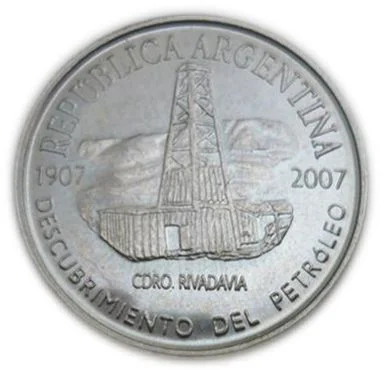
The central imprint features the first oil extraction tower, dated between "1907" and "2007", with the legend "CDRO. RIVADAVIA". The upper arch reads "REPÚBLICA ARGENTINA" and the lower arch reads "DESCUBRIMIENTO DEL PETROLEO".
Inscription:
REPUBLICA ARGENTINA
1907 2007
CDRO RIVADAVIA
DESCUBRIMIENTO DEL PETROLEO
1907 2007
CDRO RIVADAVIA
DESCUBRIMIENTO DEL PETROLEO
Translation:
ARGENTINE REPUBLIC
1907 2007
CDRO RIVADAVIA
DISCOVERY OF OIL
1907 2007
CDRO RIVADAVIA
DISCOVERY OF OIL
Script: Latin
Language: Spanish
Engraver: Carlos Pedro Rodríguez Dufour
Reverse
Description:
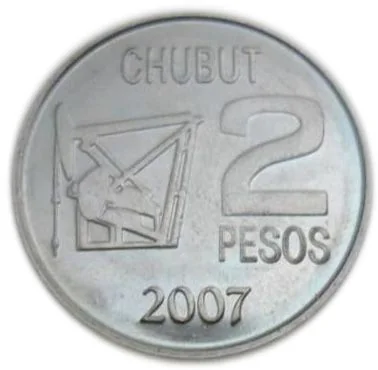
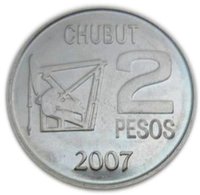
Left: a punching machine. Right: the value "2 PESOS". Above: "CHUBUT". Below: the year "2007".
Inscription:
CHUBUT
2
PESOS
2007
2
PESOS
2007
Script: Latin
Engraver: Carlos Pedro Rodríguez Dufour
Edge
Plain
Categories
| Industry |
Mints
| Name | Mark |
|---|---|
| Buenos Aires | — |
Mintings
| Year | Mint Mark | Mintage | Quality | Collection |
|---|---|---|---|---|
| 2007 | — | 5,000 |
Historical background
By 2007, Argentina was in the midst of a sustained period of economic growth and relative currency stability following the catastrophic 2001-2002 crisis. Under the administrations of Néstor Kirchner and then his wife Cristina Fernández de Kirchner, who took office in December 2007, the official exchange rate of the peso was tightly managed by the Central Bank. It was maintained at approximately 3 pesos to the US dollar, a policy aimed at promoting export competitiveness and controlling inflation. This stability, however, was largely artificial, sustained through heavy intervention in the foreign exchange market using reserves accumulated from a booming soy and commodity export sector.
Beneath this official stability, significant distortions were emerging. Annual inflation, officially reported at around 8-10%, was widely distrusted by both the public and independent economists, who estimated the true rate to be significantly higher. This perception gap, combined with a growing fiscal deficit and expansive monetary policy, fueled a strong demand for US dollars as a store of value. Consequently, a parallel foreign exchange market, known as the "blue dollar," began to solidify, trading at a modest but persistent premium to the official rate. This premium signaled underlying market pressures and a lack of confidence in the peso's long-term value.
The government's response to these pressures was a system of capital controls and import restrictions, which became more entrenched as the decade progressed. While these measures succeeded in maintaining the official peg in the short term, they created a complex web of financial repression. The growing gap between the official and parallel rates discouraged foreign investment, encouraged capital flight, and set the stage for the severe currency crises that would erupt in the following years. Thus, 2007 represented a calm before the storm, where the foundations of future instability were being laid under a facade of controlled exchange rates.
Beneath this official stability, significant distortions were emerging. Annual inflation, officially reported at around 8-10%, was widely distrusted by both the public and independent economists, who estimated the true rate to be significantly higher. This perception gap, combined with a growing fiscal deficit and expansive monetary policy, fueled a strong demand for US dollars as a store of value. Consequently, a parallel foreign exchange market, known as the "blue dollar," began to solidify, trading at a modest but persistent premium to the official rate. This premium signaled underlying market pressures and a lack of confidence in the peso's long-term value.
The government's response to these pressures was a system of capital controls and import restrictions, which became more entrenched as the decade progressed. While these measures succeeded in maintaining the official peg in the short term, they created a complex web of financial repression. The growing gap between the official and parallel rates discouraged foreign investment, encouraged capital flight, and set the stage for the severe currency crises that would erupt in the following years. Thus, 2007 represented a calm before the storm, where the foundations of future instability were being laid under a facade of controlled exchange rates.
⭐ Rare