

80 réis – Brazil
Add to wishlist
Brazil
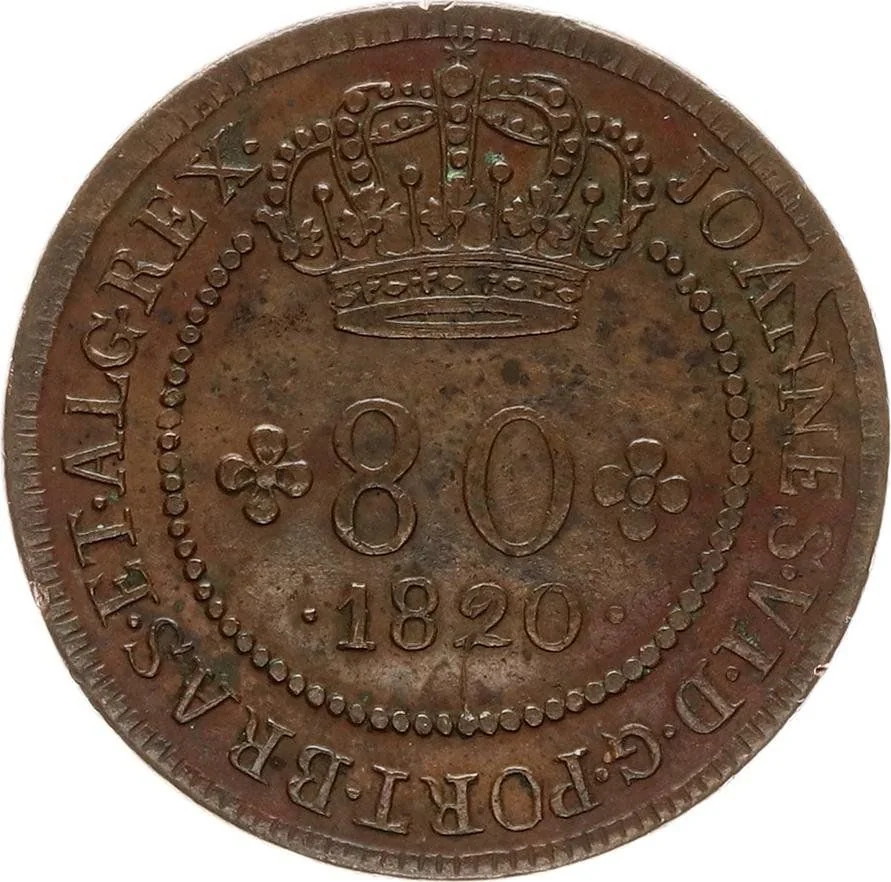
Obverse
Description:
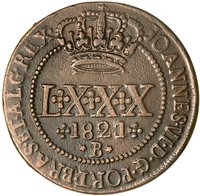
Crowned coin
Inscription:
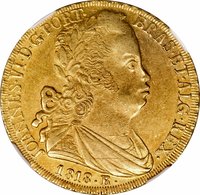
JOANNES VI DG PORT BRAS ET ALG REX
80
1820
80
1820
Translation:
John VI, by the Grace of God, King of Portugal, Brazil, and the Algarves
Script: Latin
Languages: Latin, Portuguese
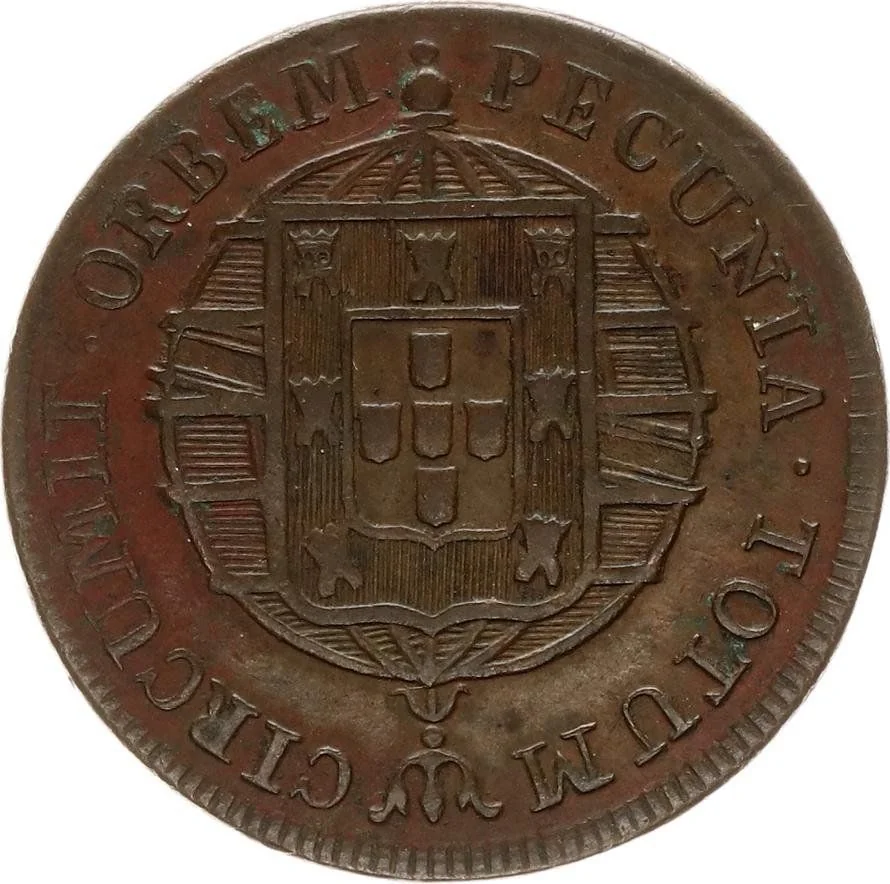
Reverse
Edge
Mints
| Name | Mark |
|---|---|
| Casa da Moeda do Brasil | — |
Mintings
| Year | Mint Mark | Mintage | Quality | Collection |
|---|---|---|---|---|
| 1820 | — | — |
Historical background
In 1820, Brazil's currency situation was a complex legacy of its colonial past, characterized by chronic scarcity, multiple circulating media, and significant inflationary pressures. As the seat of the Portuguese Empire since 1808, Brazil had seen its economy strained by the costs of maintaining the royal court, ongoing military conflicts, and expanded administrative functions. The primary official currency was the réis (plural: réis), a low-denomination copper and silver-based system inherited from Portugal. However, the supply of minted coinage was utterly insufficient for the growing economy, leading to a severe shortage of circulating specie.
To fill this void, a chaotic mix of alternative currencies circulated alongside official coin. These included worn and clipped foreign coins (particularly Spanish American pesos), locally issued copper tokens known as sinetes, and a substantial volume of paper money. The latter consisted primarily of vales reais (royal treasury notes), first issued in 1808, which functioned as inconvertible government debt. Their value was not backed by precious metal but by the promise of future tax revenue, leading to rapid depreciation. Furthermore, private banks and commercial houses issued their own promissory notes, adding to the monetary confusion and making transactions across the vast territory difficult and unreliable.
This unstable monetary environment was a significant factor in the political ferment of the period. The year 1820 itself was pivotal, as the Liberal Revolution in Portugal demanded the return of King João VI and the re-subordination of Brazil to Lisbon, triggering Brazil's own path to independence in 1822. The currency chaos directly undermined economic confidence, fueled price inflation that hurt the poor and the military, and highlighted the fiscal weaknesses of the Rio de Janeiro government. Thus, in 1820, Brazil's currency was not just an economic tool but a symbol of the transitional and fragile state of a colony on the brink of becoming an empire, burdened with the financial disorder it would need to solve as a nascent nation.
To fill this void, a chaotic mix of alternative currencies circulated alongside official coin. These included worn and clipped foreign coins (particularly Spanish American pesos), locally issued copper tokens known as sinetes, and a substantial volume of paper money. The latter consisted primarily of vales reais (royal treasury notes), first issued in 1808, which functioned as inconvertible government debt. Their value was not backed by precious metal but by the promise of future tax revenue, leading to rapid depreciation. Furthermore, private banks and commercial houses issued their own promissory notes, adding to the monetary confusion and making transactions across the vast territory difficult and unreliable.
This unstable monetary environment was a significant factor in the political ferment of the period. The year 1820 itself was pivotal, as the Liberal Revolution in Portugal demanded the return of King João VI and the re-subordination of Brazil to Lisbon, triggering Brazil's own path to independence in 1822. The currency chaos directly undermined economic confidence, fueled price inflation that hurt the poor and the military, and highlighted the fiscal weaknesses of the Rio de Janeiro government. Thus, in 1820, Brazil's currency was not just an economic tool but a symbol of the transitional and fragile state of a colony on the brink of becoming an empire, burdened with the financial disorder it would need to solve as a nascent nation.
✨ Legendary