

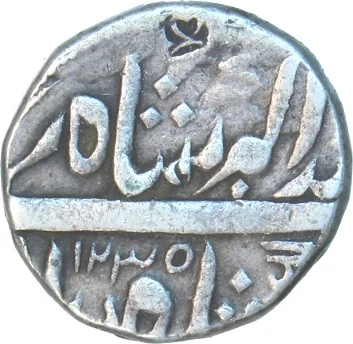
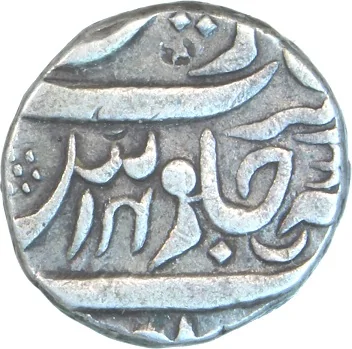
1 Rupee – Hyderabad-Wanaparthy Feudatory
India
Context
Year: 1820
Islamic (Hijri) Year: 1235
Country: India 
Issuer: Hyderabad-Wanaparthy Feudatory
Ruler: Akbar Shah II
Currency:
Demonetized: Yes
Material
References
Numista: #141109
Value
Bullion value: $31.33
Obverse
Edge
Plain
Mintings
| Year | Mint Mark | Mintage | Quality | Collection |
|---|---|---|---|---|
| 1820 | — | — |
Historical background
In 1820, the currency situation in the Wanaparthy Feudatory, a samsthanam (estate) under the Nizam of Hyderabad, was characterized by a complex and layered monetary system. The region did not have a single, sovereign currency but operated within the broader Hyderabad State's framework, where the primary silver coin was the Hyderabadi Rupee, issued by the Nizam's government. However, the authority of local feudal rulers like the Wanaparthy samsthanam allowed for the circulation of a variety of coins, leading to a multi-currency environment.
Alongside the official Hyderabadi Rupee, other major Indian currencies like the British East India Company's Rupee and older Mughal-era coins remained in circulation, their values often determined by fluctuating exchange rates based on metal purity and weight. Furthermore, the Wanaparthy rulers, like other samsthanamdars, likely exercised the privilege of minting their own local token or copper coins (paisa) for smaller, everyday transactions within their domain. This created a hierarchy of money: high-value state silver for larger trade and revenue, and local feudal coinage for the peasant economy.
This system was inherently fragmented and posed challenges for trade and administration. The coexistence of multiple coins required constant evaluation and conversion, inviting confusion and potential exploitation. The year 1820 falls within a period of transition, as the British East India Company's political and economic influence was growing steadily across India, including within the Nizam's territories. While the old feudal monetary customs persisted, they were increasingly under the shadow of the more standardized currency systems that British paramountcy would eventually impose across the subcontinent.
Alongside the official Hyderabadi Rupee, other major Indian currencies like the British East India Company's Rupee and older Mughal-era coins remained in circulation, their values often determined by fluctuating exchange rates based on metal purity and weight. Furthermore, the Wanaparthy rulers, like other samsthanamdars, likely exercised the privilege of minting their own local token or copper coins (paisa) for smaller, everyday transactions within their domain. This created a hierarchy of money: high-value state silver for larger trade and revenue, and local feudal coinage for the peasant economy.
This system was inherently fragmented and posed challenges for trade and administration. The coexistence of multiple coins required constant evaluation and conversion, inviting confusion and potential exploitation. The year 1820 falls within a period of transition, as the British East India Company's political and economic influence was growing steadily across India, including within the Nizam's territories. While the old feudal monetary customs persisted, they were increasingly under the shadow of the more standardized currency systems that British paramountcy would eventually impose across the subcontinent.
💎 Extremely Rare