

5 francs – Tunisia
Add to wishlist
Tunisia
Context
Year: 1946
Islamic (Hijri) Year:: 1365
Issuer: Tunisia
Currency:
(1891—1957)
Demonetization: 1956
Total mintage: 10,000,000
Material
Diameter: 31 mm
Weight: 12 g
Thickness: 2.28 mm
Shape: Round
Composition: Aluminium bronze
Magnetic: No
Technique: Milled
Alignment: Coin alignment
flip
References
KM: #
Numista: #3648
Value
Exchange value: 5 TNF
Obverse
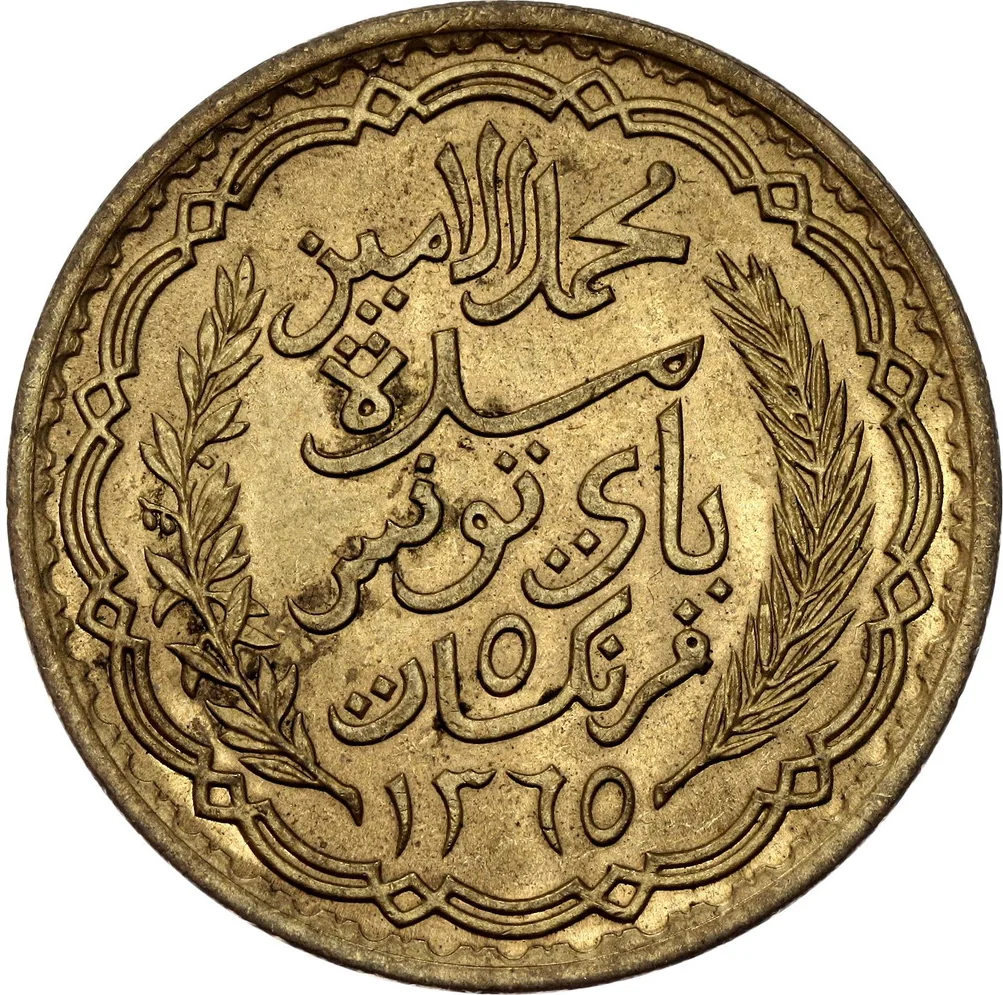
Description:
Arabic ruler with value and Hijri date.
Inscription:
محمد الامين
مدة
باي تونس
٥
فرنكات
١٣٦٥
مدة
باي تونس
٥
فرنكات
١٣٦٥
Translation:
Muhammad al-Amin
Struck
in Tunis
5
Francs
1365
Struck
in Tunis
5
Francs
1365
Script: Arabic
Language: Arabic
Engraver: Lucien Georges Bazor
Reverse
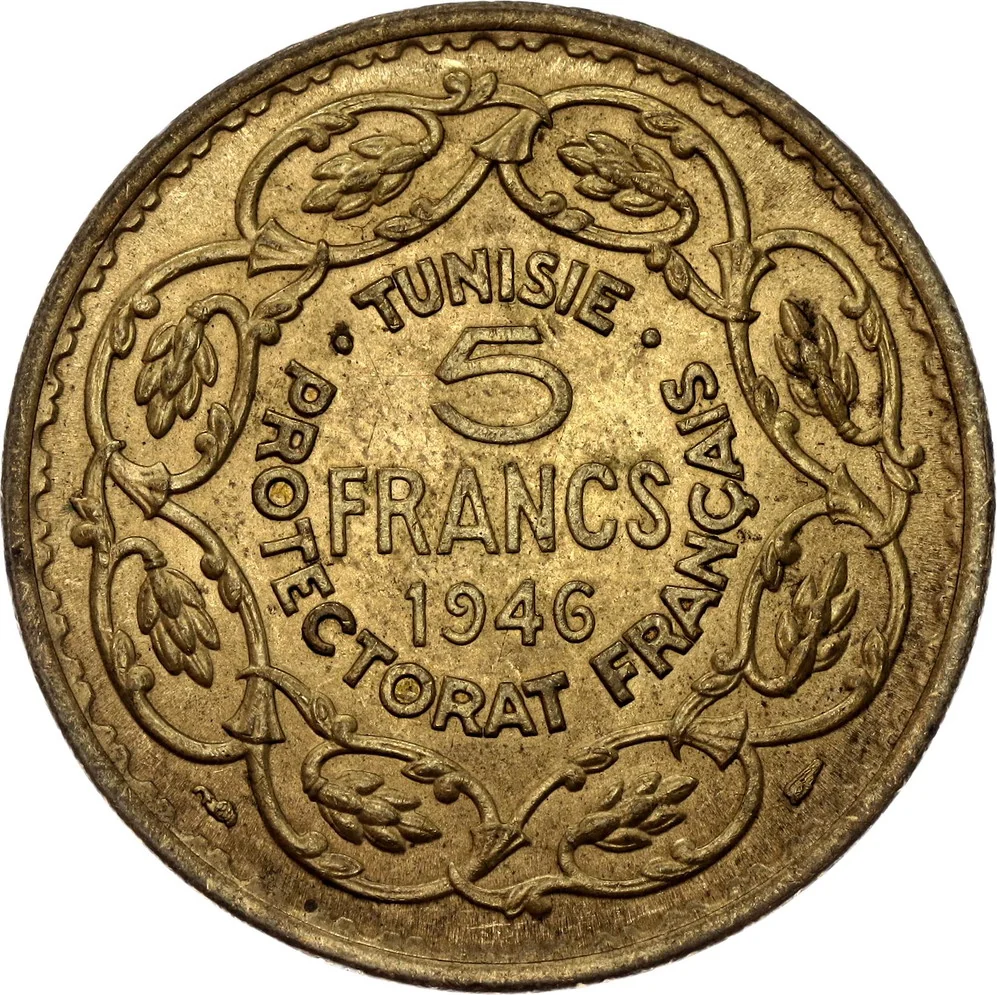
Description:
Tunisia: French name, value, and Gregorian date.
Inscription:
TUNISIE
5
FRANCS
1946
· PROTECTORAT FRANÇAIS ·
5
FRANCS
1946
· PROTECTORAT FRANÇAIS ·
Translation:
TUNISIA
5
FRANCS
1946
· FRENCH PROTECTORATE ·
5
FRANCS
1946
· FRENCH PROTECTORATE ·
Script: Latin
Language: French
Engraver: Lucien Georges Bazor
Edge
Plain
Mints
| Name | Mark |
|---|---|
| Monnaie de Paris | — |
Mintings
| Year | Mint Mark | Mintage | Quality | Collection |
|---|---|---|---|---|
| 1946 | — | 10,000,000 |
Historical background
In 1946, Tunisia's currency situation was a direct reflection of its political status as a French protectorate, established in 1881. The monetary system was fully integrated into the French franc zone, with the Tunisian franc (franc tunisien) being the official currency. It was pegged at par with the French franc, and its issuance was controlled by the Banque de l'Algérie et de la Tunisie, a private French institution that acted as the central bank for both territories. This arrangement ensured that Tunisia's monetary policy was subordinate to the needs and stability of the French economy, facilitating colonial trade and financial extraction.
The post-World War II period was one of significant economic strain and inflation across the franc zone, impacting Tunisia directly. France itself was grappling with reconstruction and a depreciating currency, pressures which were transmitted to the protectorate. While the fixed parity provided nominal stability, it did not shield Tunisia from the broader inflationary trends and shortages affecting the region. This economic hardship, coupled with the growing nationalist movement, began to fuel criticisms of the colonial financial structure as a tool of economic domination.
Consequently, the currency situation in 1946 became increasingly politicized. Tunisian nationalists, advocating for greater autonomy and eventual independence, started to view monetary sovereignty as a key component of self-determination. The control of currency issuance by a French bank was seen as symbolic of the broader lack of economic control. Thus, while the system technically functioned with stability on paper, it existed within a volatile political and economic climate, laying the groundwork for future monetary reforms that would accompany Tunisia's journey to independence a decade later.
The post-World War II period was one of significant economic strain and inflation across the franc zone, impacting Tunisia directly. France itself was grappling with reconstruction and a depreciating currency, pressures which were transmitted to the protectorate. While the fixed parity provided nominal stability, it did not shield Tunisia from the broader inflationary trends and shortages affecting the region. This economic hardship, coupled with the growing nationalist movement, began to fuel criticisms of the colonial financial structure as a tool of economic domination.
Consequently, the currency situation in 1946 became increasingly politicized. Tunisian nationalists, advocating for greater autonomy and eventual independence, started to view monetary sovereignty as a key component of self-determination. The control of currency issuance by a French bank was seen as symbolic of the broader lack of economic control. Thus, while the system technically functioned with stability on paper, it existed within a volatile political and economic climate, laying the groundwork for future monetary reforms that would accompany Tunisia's journey to independence a decade later.
🌱 Very Common