

10 Lire – Vatican City
Circulating commemorative coins
Commemoration: Marian Year (1987 June, 7 - 1988 August, 15)
Vatican City
Context
Year: 1987
Issuer: Vatican City 
Ruler: John Paul II
Currency:
(1929—2001)
Demonetization: 1 March 2002
Total mintage: 80,000
Material
References
KM: #Click to copy to clipboard199
Numista: #14103
Value
Exchange value: 10 VAL
Obverse
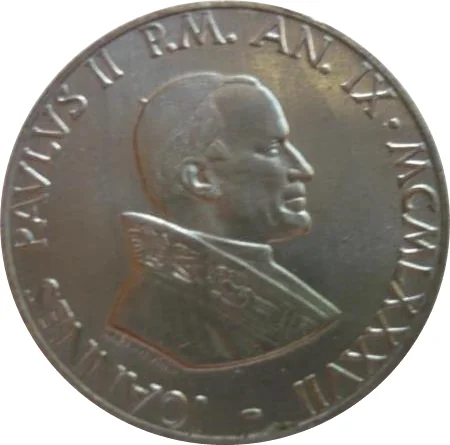
Description:
Get in. Let's go.
Inscription:
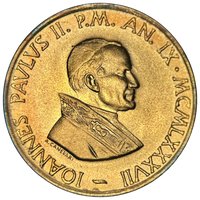
IOANNES PAVLVS II P.M. AN.IX·MCMLXXXVII
Translation:
JOHN PAUL II SUPREME PONTIFF YEAR 9 1987
Script: Latin
Language: Latin
Engraver: Angelo Canevari
Reverse
Description:
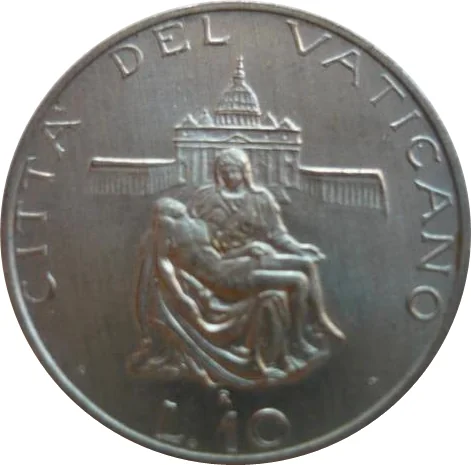
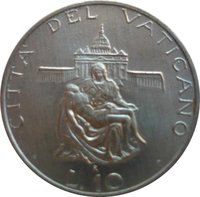
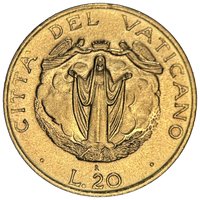
Michelangelo's Pietà before St. Peter's Basilica.
Inscription:
CITTA' DEL VATICANO
L.10 R
L.10 R
Translation:
Vatican City
10 Lire
10 Lire
Script: Latin
Language: Italian
Engraver: Angelo Canevari
Edge
Plain
Categories
| Art> Sculpture |
| Building> Religious building |
| Person> Religious figure |
| Religion> Religious objects |
Mints
| Name | Mark |
|---|---|
| Rome | R |
Mintings
| Year | Mint Mark | Mintage | Quality | Collection |
|---|---|---|---|---|
| 1987 | R | 80,000 |
Historical background
In 1987, Vatican City’s currency situation was uniquely defined by its status as a sovereign city-state without an independent monetary system. As a result of the 1929 Lateran Treaty, Italy granted the Holy See the right to mint its own coins, but these were not a separate currency. Instead, Vatican lira coins were issued in strict, limited quantities and were legal tender only within Italy and San Marino, operating as a parallel issue to the Italian lira at a 1:1 parity. This arrangement meant the Vatican's coins were primarily symbolic and numismatic, circulating more as collectibles for pilgrims and tourists than as a functional national currency for daily economic activity.
The practical economy of the Vatican in 1987 relied overwhelmingly on the Italian lira for all transactions, from administrative costs to purchases in its stores. The Vatican Bank (IOR) operated within the Italian and international banking systems, dealing in major foreign currencies to manage the Holy See's global assets and expenditures. Furthermore, as a member of the European Economic Community (EEC) through a customs union with Italy, the Vatican was indirectly tied to the European Monetary System, which aimed to stabilize exchange rates among member currencies, including the Italian lira.
Therefore, the 1987 currency landscape was one of symbolic sovereignty through its own coinage, coupled with complete practical and legal dependence on the Italian monetary system. This hybrid model underscored the Vatican's peculiar position: a non-commercial, ecclesiastical state whose fiscal reality was inextricably linked to its host nation. This arrangement would persist until the introduction of the euro in 1999, when the Vatican later negotiated the right to issue its own euro coins, transitioning its currency status into the new European framework.
The practical economy of the Vatican in 1987 relied overwhelmingly on the Italian lira for all transactions, from administrative costs to purchases in its stores. The Vatican Bank (IOR) operated within the Italian and international banking systems, dealing in major foreign currencies to manage the Holy See's global assets and expenditures. Furthermore, as a member of the European Economic Community (EEC) through a customs union with Italy, the Vatican was indirectly tied to the European Monetary System, which aimed to stabilize exchange rates among member currencies, including the Italian lira.
Therefore, the 1987 currency landscape was one of symbolic sovereignty through its own coinage, coupled with complete practical and legal dependence on the Italian monetary system. This hybrid model underscored the Vatican's peculiar position: a non-commercial, ecclesiastical state whose fiscal reality was inextricably linked to its host nation. This arrangement would persist until the introduction of the euro in 1999, when the Vatican later negotiated the right to issue its own euro coins, transitioning its currency status into the new European framework.
🌟 Uncommon