


1 dollar (1918 Armistice) – New Zealand
Add to wishlist
Non-circulating coins
Commemoration: Centenary of 1918 Armistice
New Zealand
Context
Year: 2018
Issuer: New Zealand
Issuing organization: New Zealand Post
Ruler: Elizabeth II
Currency:
(since 1967)
Total mintage: 1,000
Material
Diameter: 40 mm
Weight: 31.1 g
Silver Weight:: 31.07 g
Shape: Round
Composition: 99.9% Silver
Standard: Silver ounce
Magnetic: No
Alignment: Medal alignment
flip

References
Numista: #364088
Value
Exchange value: 1 NZD
Bullion value: $79.39
Inflation-adjusted value: 1.17 NZD
Obverse
Description:
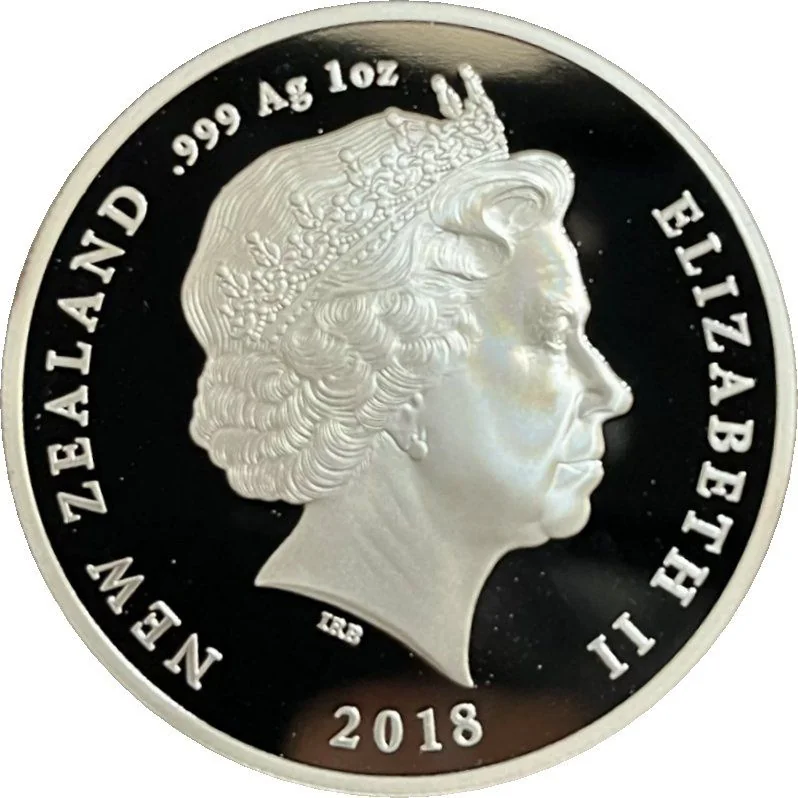
Queen Elizabeth II facing right in tiara, legend around, date below.
Inscription:
NEW ZEALAND .999 Ag 1oz
ELIZABETH II
IRB
2018
ELIZABETH II
IRB
2018
Script: Latin
Designer: Ian Rank-Broadley
Reverse
Description:
RNZRSA poppies
Inscription:
ARMISTICE
II·II·II
ONE DOLLAR
II·II·II
ONE DOLLAR
Script: Latin
Designer: Dave Burke
Edge
Reeded
Mints
| Name | Mark |
|---|---|
| Royal Australian Mint | — |
Mintings
| Year | Mint Mark | Mintage | Quality | Collection |
|---|---|---|---|---|
| 2018 | — | 1,000 | Proof |
Historical background
In 2018, New Zealand's currency situation was characterised by a period of relative stability for the New Zealand Dollar (NZD) against its major trading partners, albeit within a context of global uncertainty and domestic policy shifts. The NZD/USD exchange rate traded within a moderate band, primarily between 0.67 and 0.74. This stability was supported by robust fundamentals: a strong domestic economy, solid dairy export prices, and historically low unemployment. However, the currency faced persistent headwinds from a strengthening US Dollar, driven by aggressive Federal Reserve interest rate hikes, and ongoing concerns over global trade tensions, particularly between the US and China, which impacted market sentiment for commodity-linked currencies.
Domestically, monetary policy was a key focus. The Reserve Bank of New Zealand (RBNZ) held the Official Cash Rate (OCR) at a record low of 1.75% throughout the year, a level maintained since late 2016. Governor Adrian Orr, who assumed the role in March, signalled a patient and data-dependent approach, noting that inflation remained subdued despite solid growth. This dovish stance, especially as the US tightened policy, created a widening interest rate differential that placed downward pressure on the NZD. Furthermore, the new coalition government's proposed policies, including increases to the minimum wage and potential changes to the Reserve Bank Act to add employment to its mandate, introduced a layer of uncertainty for investors.
Overall, 2018 saw the "Kiwi" dollar demonstrate resilience due to New Zealand's healthy economic performance, but it failed to gain significant upward traction. It ended the year near the lower end of its annual range, reflecting the broader strength of the US Dollar and the market's cautious assessment of the shifting domestic policy landscape under the new government and RBNZ leadership. The currency's performance was ultimately a balance between local economic strength and the powerful countervailing forces of international monetary policy divergence and trade-related risk aversion.
Domestically, monetary policy was a key focus. The Reserve Bank of New Zealand (RBNZ) held the Official Cash Rate (OCR) at a record low of 1.75% throughout the year, a level maintained since late 2016. Governor Adrian Orr, who assumed the role in March, signalled a patient and data-dependent approach, noting that inflation remained subdued despite solid growth. This dovish stance, especially as the US tightened policy, created a widening interest rate differential that placed downward pressure on the NZD. Furthermore, the new coalition government's proposed policies, including increases to the minimum wage and potential changes to the Reserve Bank Act to add employment to its mandate, introduced a layer of uncertainty for investors.
Overall, 2018 saw the "Kiwi" dollar demonstrate resilience due to New Zealand's healthy economic performance, but it failed to gain significant upward traction. It ended the year near the lower end of its annual range, reflecting the broader strength of the US Dollar and the market's cautious assessment of the shifting domestic policy landscape under the new government and RBNZ leadership. The currency's performance was ultimately a balance between local economic strength and the powerful countervailing forces of international monetary policy divergence and trade-related risk aversion.


✨ Legendary