

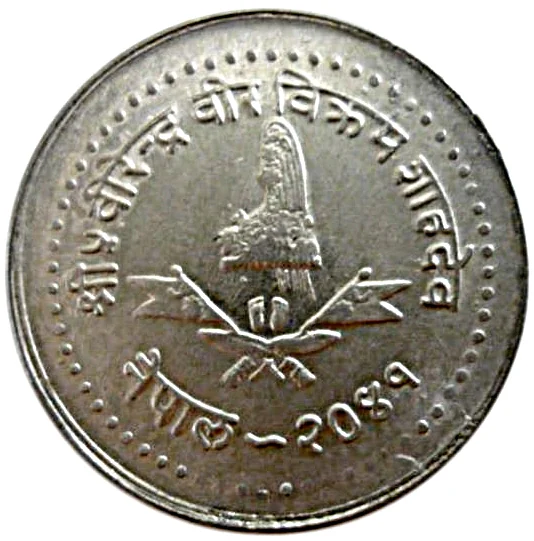
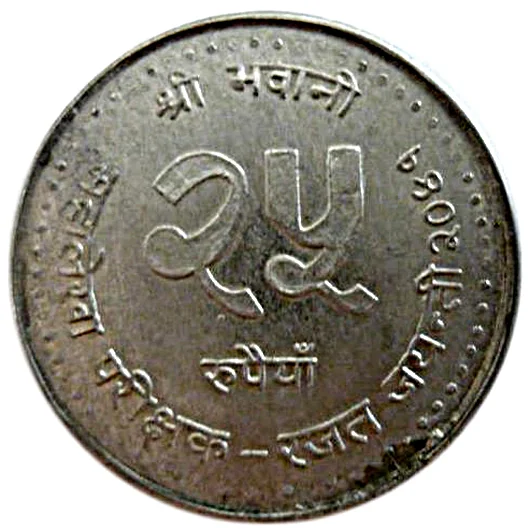
25 rupees (Office of the Auditor General) – Nepal
Add to wishlist
Non-circulating coins
Commemoration: 25th Anniversary of the Office of the Auditor General
Nepal
Context
Year: 1984
Vikram Samvat Year:: 2041
Issuer: Nepal
Ruler: Birendra Bir Bikram Shah
Currency:
(since 1932)
Total mintage: 15,000
Material
References
KM: #
Numista: #14093
Value
Exchange value: 25 NPR
Mints
| Name | Mark |
|---|---|
| Mint Division of the Central Bank of Nepal | — |
Mintings
| Year | Mint Mark | Mintage | Quality | Collection |
|---|---|---|---|---|
| 1984 | — | 15,000 |
Historical background
In 1984, Nepal's currency situation was characterized by a tightly controlled and dual exchange rate system under a fixed parity with the Indian rupee (INR), a legacy of the 1960 Nepal-India Trade and Transit Treaty. The Nepalese rupee (NPR) was pegged at NPR 1.00 = INR 0.625, a rate that had been stable for decades. This formal parity facilitated extensive cross-border trade but also created a significant disparity with market forces, leading to a thriving black market for foreign exchange, particularly for currencies other than the Indian rupee. The country's foreign exchange reserves were managed conservatively by the Nepal Rastra Bank (NRB), with the primary objective of maintaining this peg and ensuring monetary stability rather than pursuing independent monetary policy.
Economically, Nepal remained one of the world's least developed countries, heavily reliant on agriculture, remittances from Gurkha soldiers, and foreign aid. The limited and import-dependent industrial sector created consistent trade deficits, putting pressure on foreign currency holdings. The government's strict licensing system for all foreign exchange transactions, under the Foreign Exchange Regulation Act of 1962, meant that access to hard currencies like US dollars for travel or imports was highly restricted and required bureaucratic approval. This control was intended to conserve scarce foreign reserves but also stifled private sector growth and encouraged illicit flows.
The year 1984 fell within a period of gradual economic liberalization that would accelerate in the early 1990s. While the core peg to the Indian rupee remained unchallenged, discussions about reforming the financial sector and moving towards a more realistic exchange rate regime were beginning to surface among policymakers. The situation was one of relative stability in official terms, but underlying pressures from a weak economic base, a growing informal currency market, and the inefficiencies of a controlled system were setting the stage for significant financial reforms later in the decade.
Economically, Nepal remained one of the world's least developed countries, heavily reliant on agriculture, remittances from Gurkha soldiers, and foreign aid. The limited and import-dependent industrial sector created consistent trade deficits, putting pressure on foreign currency holdings. The government's strict licensing system for all foreign exchange transactions, under the Foreign Exchange Regulation Act of 1962, meant that access to hard currencies like US dollars for travel or imports was highly restricted and required bureaucratic approval. This control was intended to conserve scarce foreign reserves but also stifled private sector growth and encouraged illicit flows.
The year 1984 fell within a period of gradual economic liberalization that would accelerate in the early 1990s. While the core peg to the Indian rupee remained unchallenged, discussions about reforming the financial sector and moving towards a more realistic exchange rate regime were beginning to surface among policymakers. The situation was one of relative stability in official terms, but underlying pressures from a weak economic base, a growing informal currency market, and the inefficiencies of a controlled system were setting the stage for significant financial reforms later in the decade.
⭐ Rare