



100 Lei (World War I) – Romania
Non-circulating coins
Commemoration: 100 years since the end of World War I
Romania

Obverse
Description:
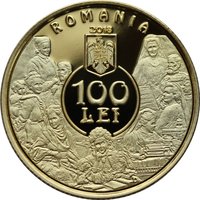
Romania's 100 Lei coin from 2018 features the Caraiman Peak WWI heroes' cross, the arched inscription "ROMANIA", the national coat of arms, and the face value.
Inscription:
ROMANIA
100 LEI
2018
100 LEI
2018
Script: Latin
Reverse
Description:
King Ferdinand I and Queen Maria entering Bucharest; the inscriptions “100 DE ANI DE LA INCHEIEREA PRIMULUI RAZBOI MONDIAL” and “1918”.
Inscription:
100 DE ANI DE LA INCHEIEREA PRIMULUI RAZBOI MONDIAL
1918
1918
Translation:
ONE HUNDRED YEARS SINCE THE END OF THE FIRST WORLD WAR
1918
1918
Script: Latin
Language: Romanian
Edge
Milled
Mintings
| Year | Mint Mark | Mintage | Quality | Collection |
|---|---|---|---|---|
| 2018 | — | 250 | Proof |
Historical background
In 2018, Romania's currency situation was characterized by a period of relative stability for the Romanian Leu (RON) against the Euro, but within a context of significant macroeconomic pressures. The year saw the RON trading in a managed float regime, with the National Bank of Romania (NBR) actively intervening to curb excessive volatility. The key exchange rate band hovered around 4.6 to 4.7 RON per Euro for much of the year, a stability achieved despite twin deficits—a widening current account deficit and a large budget deficit—that typically put downward pressure on a currency.
The primary domestic challenge was robust domestic demand, fueled by sharp increases in wages and government spending, which spurred inflation and a growing import bill. This contributed to the current account deficit widening to nearly 4.5% of GDP, raising concerns about external sustainability. In response, the NBR pursued a tightening monetary policy, raising its key interest rate five times throughout the year to combat inflation, which peaked above 5%. These hikes helped support the Leu by making RON-denominated assets more attractive to investors seeking higher yields.
Internationally, the year brought headwinds from emerging market volatility and a stronger US dollar, which pressured currencies globally. However, the RON's relative resilience was also underpinned by strong GDP growth (over 4%) and EU fund inflows. Ultimately, 2018 was a year where the central bank successfully balanced competing priorities, using its reserves and interest rate policy to maintain currency stability while addressing inflationary pressures, though the underlying structural deficits pointed to longer-term vulnerabilities.
The primary domestic challenge was robust domestic demand, fueled by sharp increases in wages and government spending, which spurred inflation and a growing import bill. This contributed to the current account deficit widening to nearly 4.5% of GDP, raising concerns about external sustainability. In response, the NBR pursued a tightening monetary policy, raising its key interest rate five times throughout the year to combat inflation, which peaked above 5%. These hikes helped support the Leu by making RON-denominated assets more attractive to investors seeking higher yields.
Internationally, the year brought headwinds from emerging market volatility and a stronger US dollar, which pressured currencies globally. However, the RON's relative resilience was also underpinned by strong GDP growth (over 4%) and EU fund inflows. Ultimately, 2018 was a year where the central bank successfully balanced competing priorities, using its reserves and interest rate policy to maintain currency stability while addressing inflationary pressures, though the underlying structural deficits pointed to longer-term vulnerabilities.
✨ Legendary