

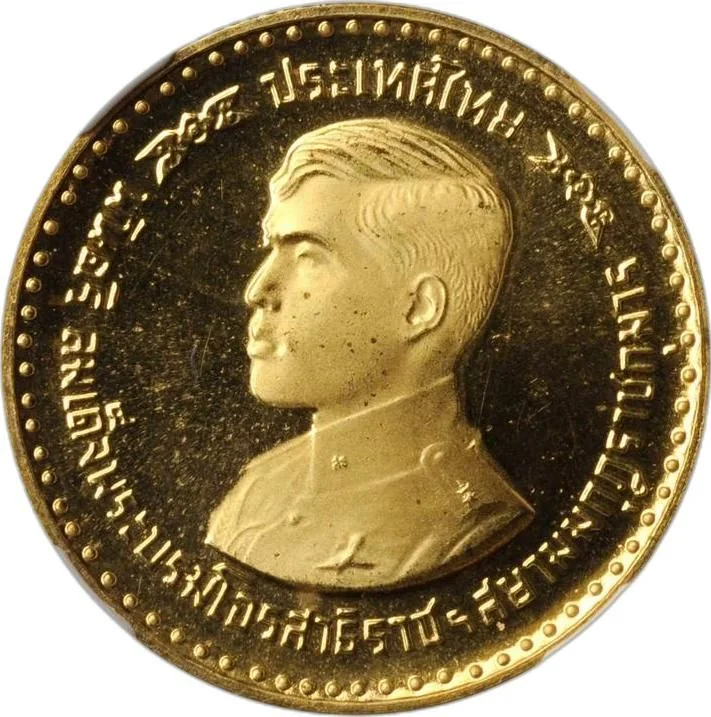
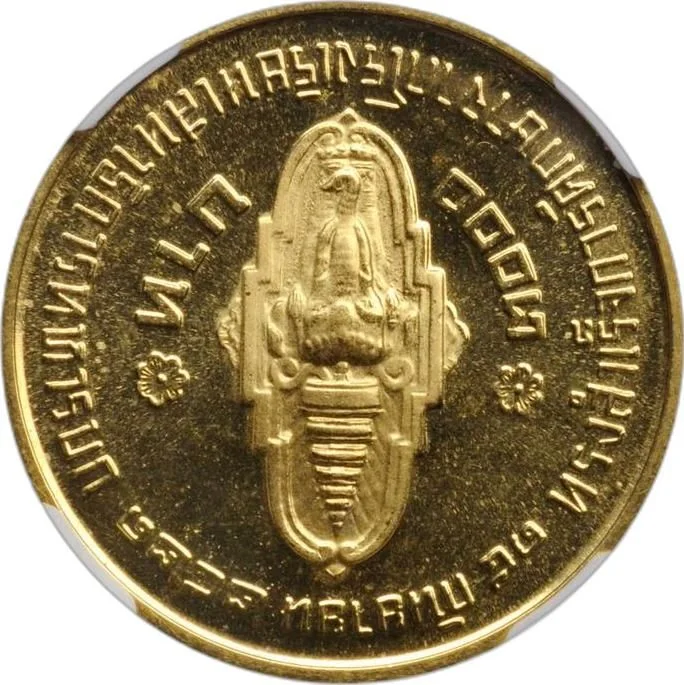
3000 Bahts – Thailand
Non-circulating coins
Commemoration: Graduation of H.R.H. Crown Prince Maha Vajiralongkorn
Thailand
Context
Year: 1979
Thai Year: 2521
Issuer: Thailand 
Ruler: Bhumibol Adulyadej
Currency:
(since 1897)
Total mintage: 10,000
Material
References
Y: #Click to copy to clipboard129
Numista: #362204
Value
Exchange value: 3000 THB = $96.59
Bullion value: $2500.38
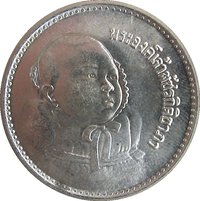
Obverse
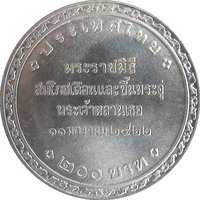
Reverse
Edge
Mintings
| Year | Mint Mark | Mintage | Quality | Collection |
|---|---|---|---|---|
| 1979 | — | 10,000 |
Historical background
In 1979, Thailand's currency, the baht, operated under a fixed exchange rate system pegged to a weighted basket of currencies of its major trading partners, with the U.S. dollar being the dominant component. This system, managed by the Bank of Thailand, provided stability for trade and investment but required significant foreign exchange reserves to maintain the peg. The global economic landscape of the late 1970s, marked by the second oil crisis, presented acute challenges. Soaring global oil prices dramatically increased Thailand's import bill and widened its current account deficit, putting persistent downward pressure on the baht's value.
Domestically, the Thai economy was grappling with high inflation, which reached approximately 10% in 1979, driven by both imported oil inflation and robust domestic growth. The government, led by Prime Minister General Kriangsak Chomanan, faced a difficult policy trilemma: defending the fixed exchange rate, maintaining free capital movement, and pursuing an independent monetary policy to control inflation. To conserve foreign reserves and defend the peg, the Bank of Thailand was forced to maintain high interest rates and impose various capital controls and trade restrictions, which stifled some economic activity.
Consequently, 1979 represented a year of mounting strain on Thailand's monetary framework. The fixed exchange rate, while a symbol of stability, was becoming increasingly costly to uphold in the face of external shocks. The pressures witnessed this year foreshadowed the gradual shift toward a more flexible exchange rate system that would evolve in the following decades. The situation underscored the vulnerability of a small, open economy with a fixed currency to global commodity price volatility, setting the stage for future financial and policy reforms.
Domestically, the Thai economy was grappling with high inflation, which reached approximately 10% in 1979, driven by both imported oil inflation and robust domestic growth. The government, led by Prime Minister General Kriangsak Chomanan, faced a difficult policy trilemma: defending the fixed exchange rate, maintaining free capital movement, and pursuing an independent monetary policy to control inflation. To conserve foreign reserves and defend the peg, the Bank of Thailand was forced to maintain high interest rates and impose various capital controls and trade restrictions, which stifled some economic activity.
Consequently, 1979 represented a year of mounting strain on Thailand's monetary framework. The fixed exchange rate, while a symbol of stability, was becoming increasingly costly to uphold in the face of external shocks. The pressures witnessed this year foreshadowed the gradual shift toward a more flexible exchange rate system that would evolve in the following decades. The situation underscored the vulnerability of a small, open economy with a fixed currency to global commodity price volatility, setting the stage for future financial and policy reforms.
✨ Legendary