


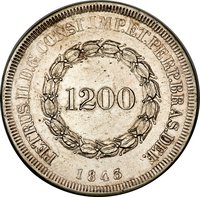
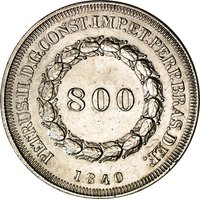
Obverse
Description:
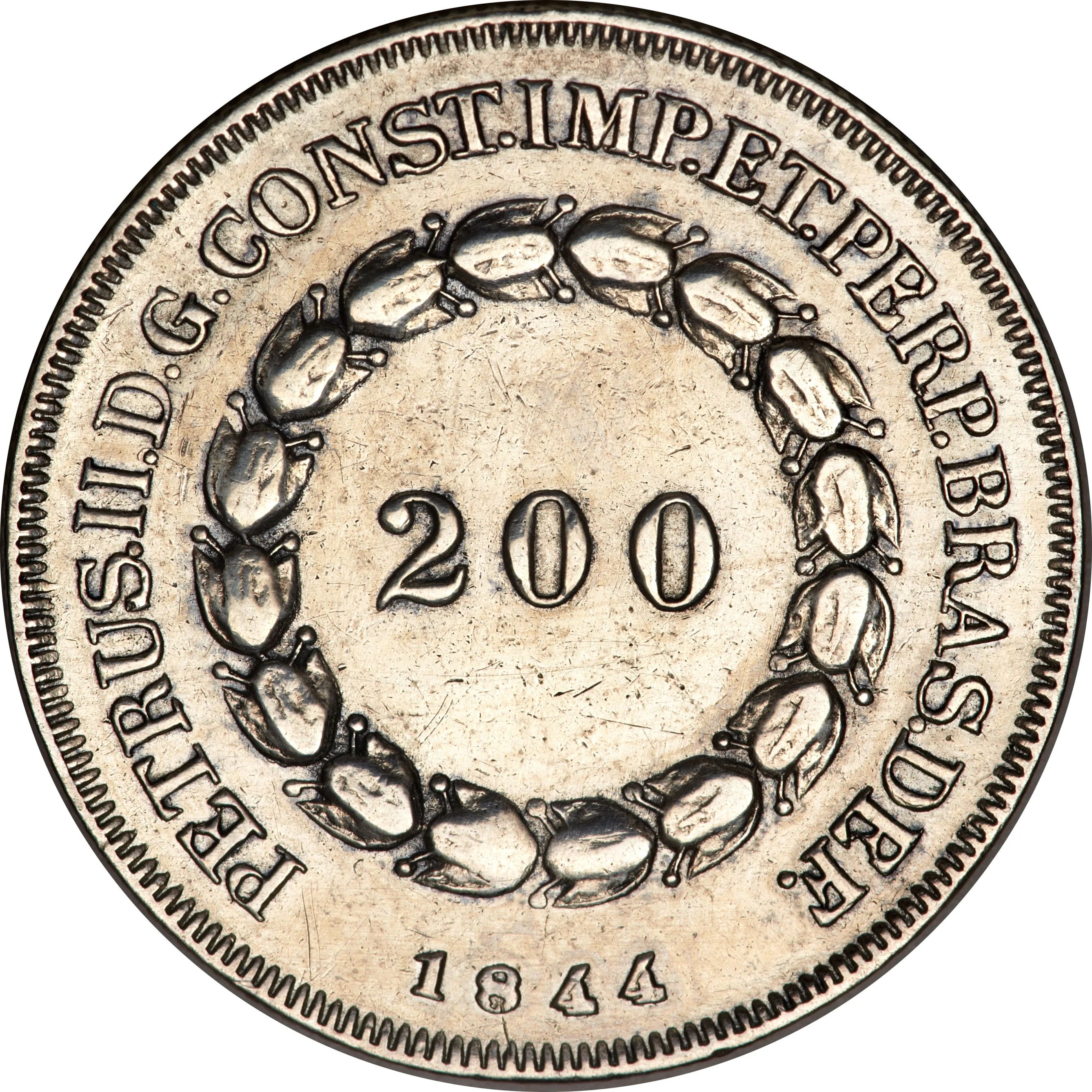
Dashed border. Legend: "PRETRUS.II.D.G.CONST.IMP.ET.PERP.BRAS.DEF." Exergue: 1844. Center: 200 within tulip wreath.
Inscription:
PRETRUS.II.D.G.CONST.IMP.ET.PERP.BRAS.DEF.
200
1848
200
1848
Translation:
Peter II, by the Grace of God, Constant and Perpetual Emperor of Brazil, Defender.
Script: Latin
Language: Latin
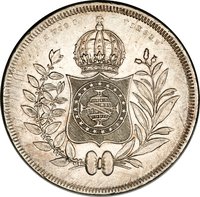
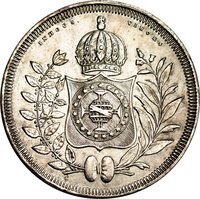
Reverse
Edge
Reeded
Categories
| Symbols> Coat of Arms |
Mintings
| Year | Mint Mark | Mintage | Quality | Collection |
|---|---|---|---|---|
| 1835 | — | 4,894 | ||
| 1837 | — | 5,007 | ||
| 1840 | — | 624 | ||
| 1844 | — | 893 | ||
| 1846 | — | 406 | ||
| 1847 | — | 2,936 | ||
| 1848 | — | 501 |
Historical background
In 1835, Brazil's currency situation was characterized by profound instability and fragmentation, a direct legacy of the political and economic turmoil following independence from Portugal in 1822. The nation lacked a unified, trusted monetary system. Copper and low-quality silver coins circulated alongside a bewildering variety of foreign currencies, particularly British pounds, Portuguese réis, and Spanish-American coins. Most significantly, the economy was flooded with paper money—papel-moeda—irresponsibly issued by the Banco do Brasil since 1829 to cover massive government deficits, leading to severe depreciation and a loss of public confidence.
This monetary chaos was exacerbated by the Regency period (1831-1840), a time of weak central authority while Emperor Pedro II was a minor. Regional revolts, like the Ragamuffin War in the south (beginning in 1835), further strained finances and disrupted economic activity. The result was a classic vicious cycle: the government printed more paper money to fund its operations and military campaigns, which in turn fueled inflation, eroded purchasing power, and deepened the distrust in paper currency. Different regions often valued coins and notes at wildly different rates, crippling internal trade.
Consequently, a "dual currency" system effectively existed, where sound metallic coinage (when available) was hoarded and traded at a premium, while the discredited paper réis circulated at a steep discount for everyday transactions. This environment of uncertainty and devaluation stifled investment, complicated long-term contracts, and placed a heavy burden on the populace. The crisis of 1835 thus set the stage for future, more aggressive attempts at monetary reform, which would become a central challenge for the Brazilian state as it sought to consolidate national authority and economic coherence.
This monetary chaos was exacerbated by the Regency period (1831-1840), a time of weak central authority while Emperor Pedro II was a minor. Regional revolts, like the Ragamuffin War in the south (beginning in 1835), further strained finances and disrupted economic activity. The result was a classic vicious cycle: the government printed more paper money to fund its operations and military campaigns, which in turn fueled inflation, eroded purchasing power, and deepened the distrust in paper currency. Different regions often valued coins and notes at wildly different rates, crippling internal trade.
Consequently, a "dual currency" system effectively existed, where sound metallic coinage (when available) was hoarded and traded at a premium, while the discredited paper réis circulated at a steep discount for everyday transactions. This environment of uncertainty and devaluation stifled investment, complicated long-term contracts, and placed a heavy burden on the populace. The crisis of 1835 thus set the stage for future, more aggressive attempts at monetary reform, which would become a central challenge for the Brazilian state as it sought to consolidate national authority and economic coherence.
💎 Very Rare