

100 lire – Vatican City
Add to wishlist
Circulating commemorative coins
Commemoration: Catechism of the Catholic Church
Vatican City
Context
Year: 1993
Issuer: Vatican City
Ruler: John Paul II
Currency:
(1929—2001)
Demonetization: 1 March 2002
Total mintage: 41,000
Material
Diameter: 22 mm
Weight: 4.5 g
Thickness: 1.5 mm
Shape: Round
Composition: Copper-nickel
Technique: Milled
Alignment: Coin alignment
flip
References
KM: #
Numista: #3613
Value
Exchange value: 100 VAL
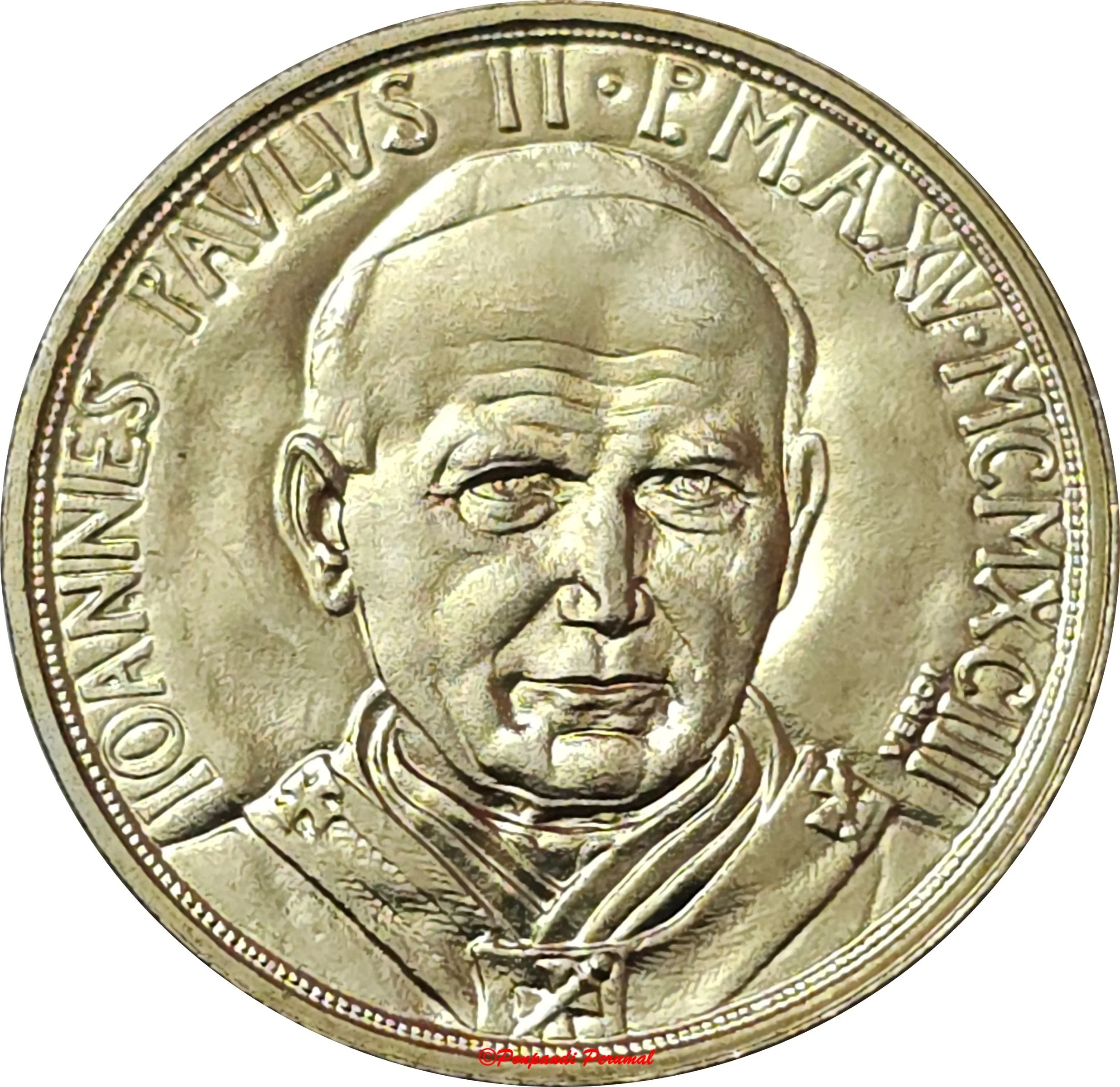
Obverse
Description:
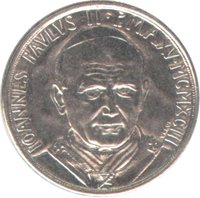
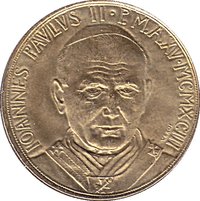
Pope John Paul II, front-facing.
Inscription:
IOANNES PAUVLVS II·P.MAXV·MCMXCIII
VEROI
VEROI
Translation:
JOHN PAUL II, PONTIFEX MAXIMUS, 1994. ROME
Script: Latin
Language: Latin
Engraver: Guido Veroi
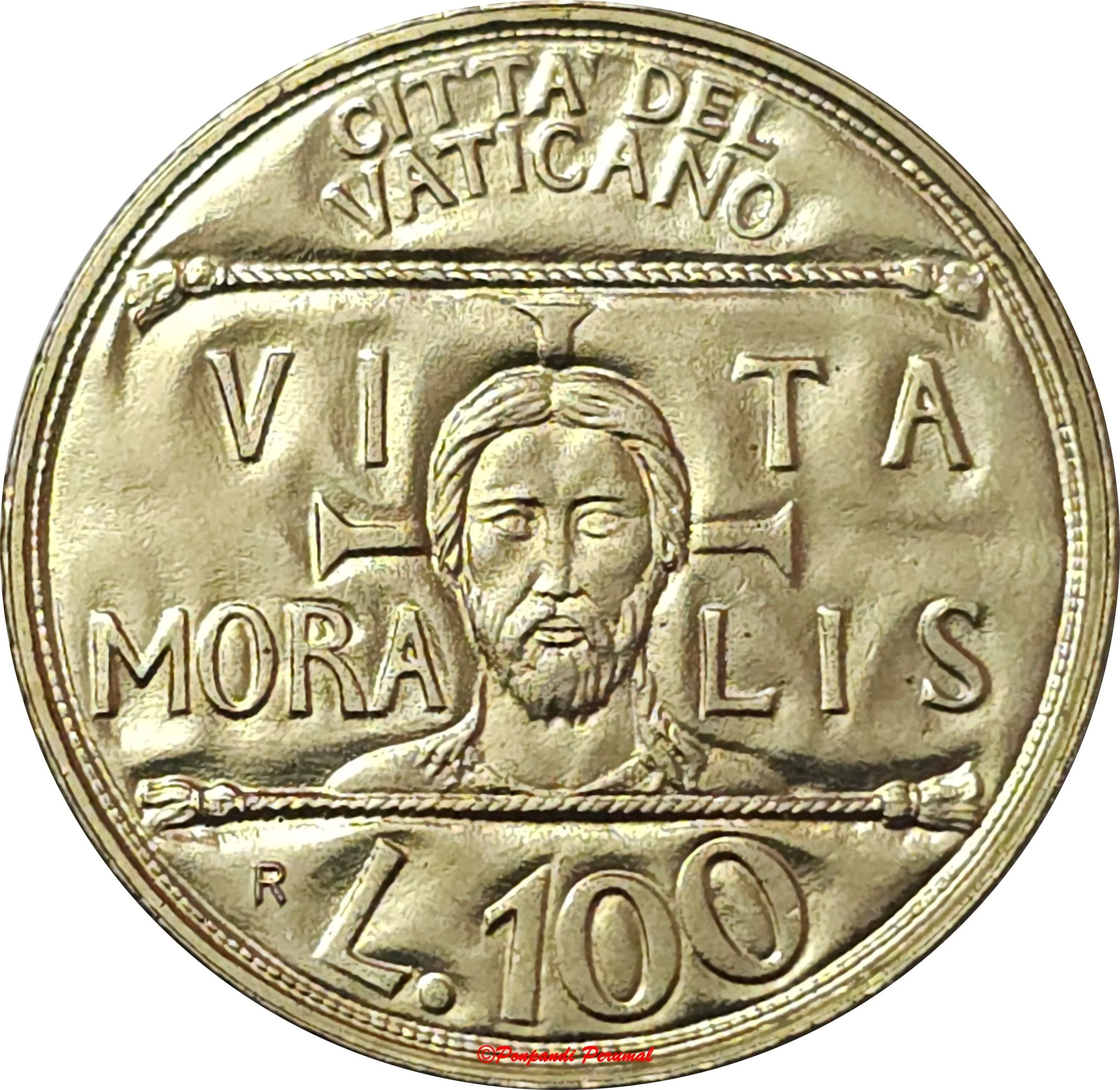
Reverse
Description:
Christ, frontal view.
Inscription:
CITTA' DEL VATICANO
VITA MORALIS
R L.100
VITA MORALIS
R L.100
Translation:
Vatican City
Moral Life
100 Lire
Moral Life
100 Lire
Script: Latin
Engraver: Guido Veroi
Edge
Segmented Reeding
Categories
| Person> Religious figure |
| Religion> Religious objects |
Mints
| Name | Mark |
|---|---|
| Rome | R |
Mintings
| Year | Mint Mark | Mintage | Quality | Collection |
|---|---|---|---|---|
| 1993 | R | 41,000 |
Historical background
In 1993, the currency situation in Vatican City was defined by its unique status as a sovereign state without an independent monetary policy. It operated under the terms of the 1929 Lateran Treaty with Italy, which granted it the right to issue its own coinage. However, in practice, its monetary system was fully integrated with that of Italy, with the Italian Lira (ITL) serving as the official legal tender for all everyday transactions. The Vatican's own coins, minted in limited quantities and primarily intended for collectors and tourists, were legal tender only within its borders but were pegged 1:1 to the Italian Lira and accepted interchangeably in Italy due to a bilateral agreement.
This arrangement was part of a broader European monetary transition. The Vatican, along with Italy, was a signatory to the European Monetary System (EMS) and was preparing for the eventual launch of the single European currency. A critical development occurred in 1992 when the Vatican and Italy signed a new monetary convention, superseding the 1930 agreement. This new convention, which took full effect in 1993, explicitly committed the Vatican to conform its coin issuance to the standards and quotas set by the European Community (EC) in anticipation of Economic and Monetary Union (EMU). It strictly limited the face value and quantity of coins the Vatican could mint, ensuring they would not disrupt the Italian—and future Eurozone—money supply.
Therefore, 1993 was a year of legal and administrative alignment for the Vatican's currency, positioning it within the emerging European framework rather than representing a period of domestic monetary crisis or change. The focus was on compliance and preparation, ensuring that when the Euro eventually replaced the Lira, Vatican City would be included in the new system. This foresight guaranteed its continued ability to issue its own distinctive, non-inflationary coinage, a key symbol of its sovereignty, under the umbrella of the European Central Bank's authority.
This arrangement was part of a broader European monetary transition. The Vatican, along with Italy, was a signatory to the European Monetary System (EMS) and was preparing for the eventual launch of the single European currency. A critical development occurred in 1992 when the Vatican and Italy signed a new monetary convention, superseding the 1930 agreement. This new convention, which took full effect in 1993, explicitly committed the Vatican to conform its coin issuance to the standards and quotas set by the European Community (EC) in anticipation of Economic and Monetary Union (EMU). It strictly limited the face value and quantity of coins the Vatican could mint, ensuring they would not disrupt the Italian—and future Eurozone—money supply.
Therefore, 1993 was a year of legal and administrative alignment for the Vatican's currency, positioning it within the emerging European framework rather than representing a period of domestic monetary crisis or change. The focus was on compliance and preparation, ensuring that when the Euro eventually replaced the Lira, Vatican City would be included in the new system. This foresight guaranteed its continued ability to issue its own distinctive, non-inflationary coinage, a key symbol of its sovereignty, under the umbrella of the European Central Bank's authority.
🌱 Fairly Common