

100 lire – Vatican City
Add to wishlist
Vatican City
Context
Years: 1955–1958
Issuer: Vatican City
Ruler: Pius XII
Currency:
(1929—2001)
Demonetized: Yes
Total mintage: 4,452,000
Material
Diameter: 27.75 mm
Weight: 8 g
Thickness: 2 mm
Shape: Round
Composition: Stainless steel
Technique: Milled
Alignment: Coin alignment
flip
References
KM: #
Numista: #3603
Value
Exchange value: 100 VAL
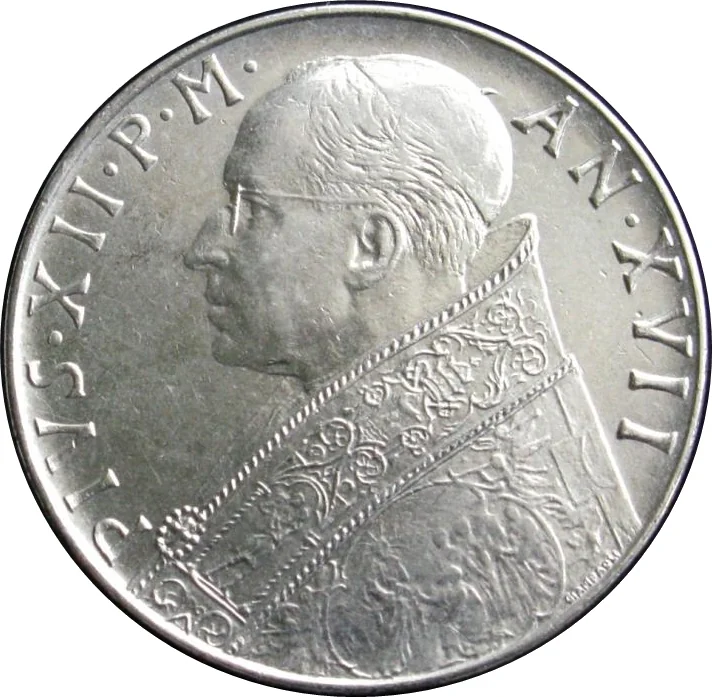
Obverse
Description:
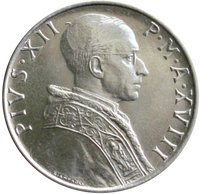
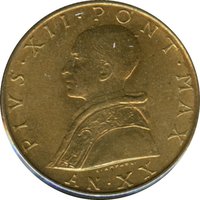
Pius XII, left profile.
Inscription:
PIVS·XII·P·M·AN·XVII
GIAMPAOLI
GIAMPAOLI
Translation:
Pius XII, Supreme Pontiff, in the 17th Year of his Reign.
Script: Latin
Language: Latin
Engraver: Pietro Giampaoli
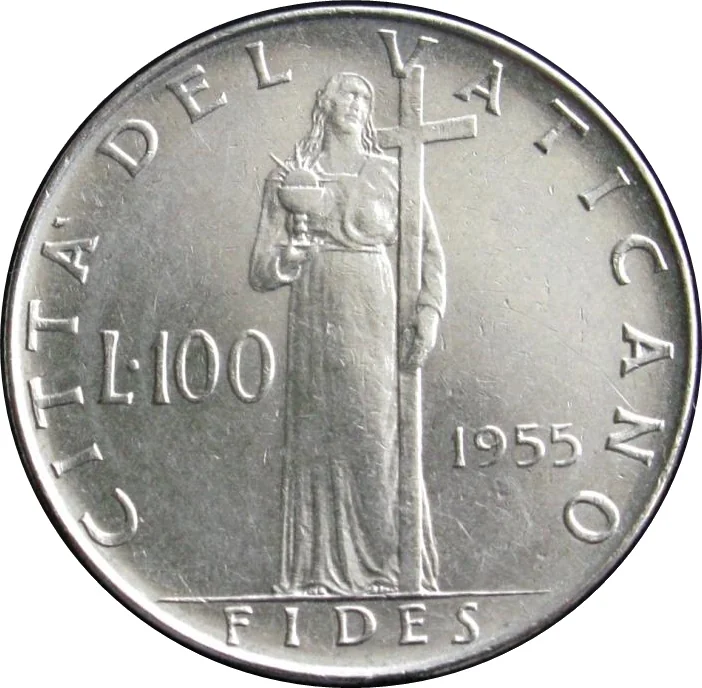
Reverse
Description:
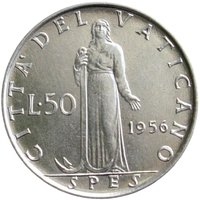
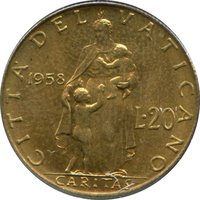
Faith in the Cross
Inscription:
CITTA' DEL VATICANO
L·100 1955
FIDES
L·100 1955
FIDES
Translation:
Vatican City
Lire 100 1955
Faith
Lire 100 1955
Faith
Script: Latin
Engraver: Pietro Giampaoli
Edge
Reeded
Categories
| Person> Religious figure |
| Object> Container or tableware |
| Religion> Religious objects |
| Symbol> Allegory |
| Symbol> Cross |
Mints
| Name | Mark |
|---|---|
| Rome | — |
Mintings
| Year | Mint Mark | Mintage | Quality | Collection |
|---|---|---|---|---|
| 1955 | — | 1,300,000 | ||
| 1956 | — | 1,400,000 | ||
| 1957 | — | 900,000 | ||
| 1958 | — | 852,000 |
Historical background
In 1955, Vatican City’s currency situation was defined by its unique status as a sovereign city-state without an independent national currency. Operating within the Italian monetary system, the official currency in daily use was the Italian lira. This practical arrangement was governed by the Lateran Treaty of 1929, which established Vatican City’s independence but also integrated it into Italy’s economic and monetary sphere. Everyday transactions, from administrative costs to public services, were conducted in lire, reflecting the enclave's deep economic entanglement with the surrounding Italian state.
However, the Vatican possessed the sovereign right to issue its own coinage. Since 1929, it had minted distinct Vatican lire coins, which were legal tender within its walls and, crucially, circulated at par with Italian coins throughout Italy and San Marino due to a monetary convention. These coins, featuring the image of Pope Pius XII in 1955, were primarily numismatic and commemorative in nature, aimed at collectors and as papal gifts, rather than for routine commerce. Their issuance was limited and carefully coordinated with Italy to prevent any disruption to the Italian monetary supply.
The year 1955 fell within a period of monetary stability for the Vatican, as the post-World War II economic turmoil in Italy had subsided with the "Italian economic miracle." There were no major currency reforms or crises specific to the Vatican that year. The situation remained one of a stable, dual-system dependency: reliance on the Italian lira for function, complemented by symbolic sovereign coinage. This arrangement would persist until Italy’s adoption of the euro in 2002, which the Vatican subsequently followed under new agreements.
However, the Vatican possessed the sovereign right to issue its own coinage. Since 1929, it had minted distinct Vatican lire coins, which were legal tender within its walls and, crucially, circulated at par with Italian coins throughout Italy and San Marino due to a monetary convention. These coins, featuring the image of Pope Pius XII in 1955, were primarily numismatic and commemorative in nature, aimed at collectors and as papal gifts, rather than for routine commerce. Their issuance was limited and carefully coordinated with Italy to prevent any disruption to the Italian monetary supply.
The year 1955 fell within a period of monetary stability for the Vatican, as the post-World War II economic turmoil in Italy had subsided with the "Italian economic miracle." There were no major currency reforms or crises specific to the Vatican that year. The situation remained one of a stable, dual-system dependency: reliance on the Italian lira for function, complemented by symbolic sovereign coinage. This arrangement would persist until Italy’s adoption of the euro in 2002, which the Vatican subsequently followed under new agreements.
🌱 Very Common