

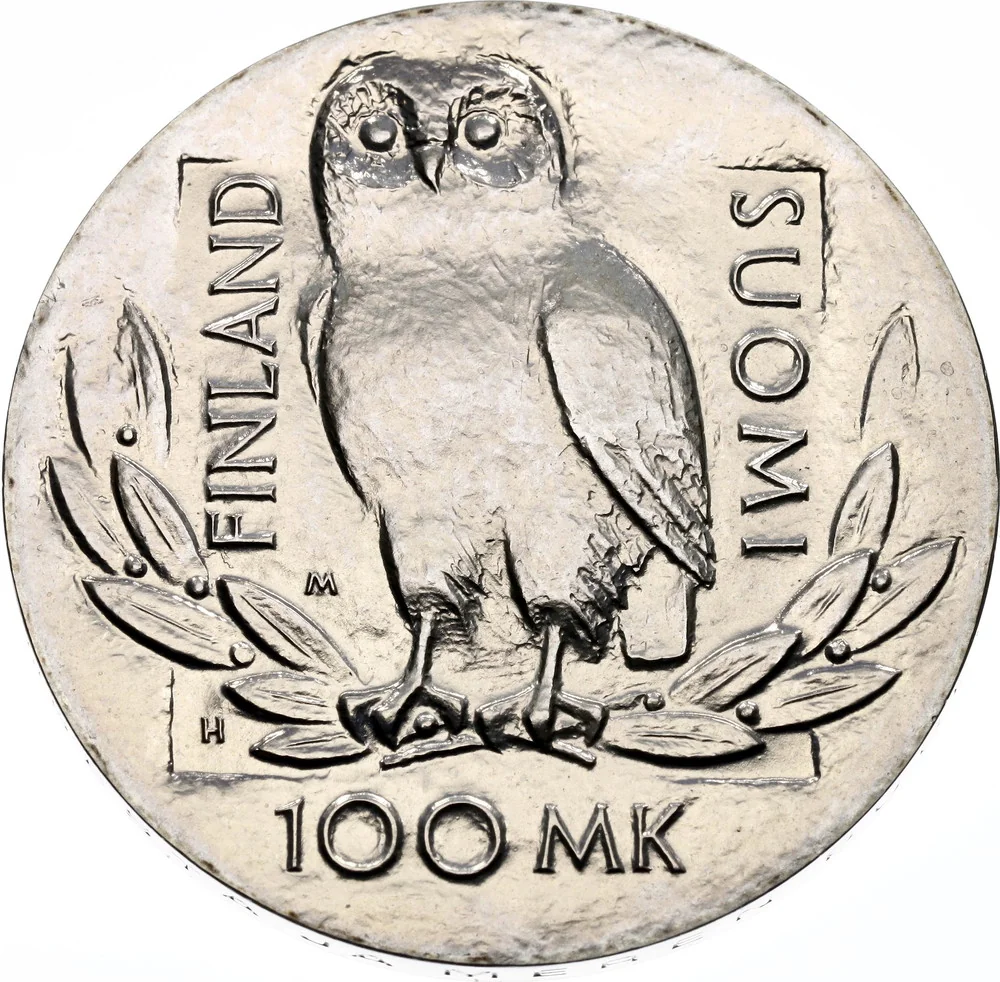
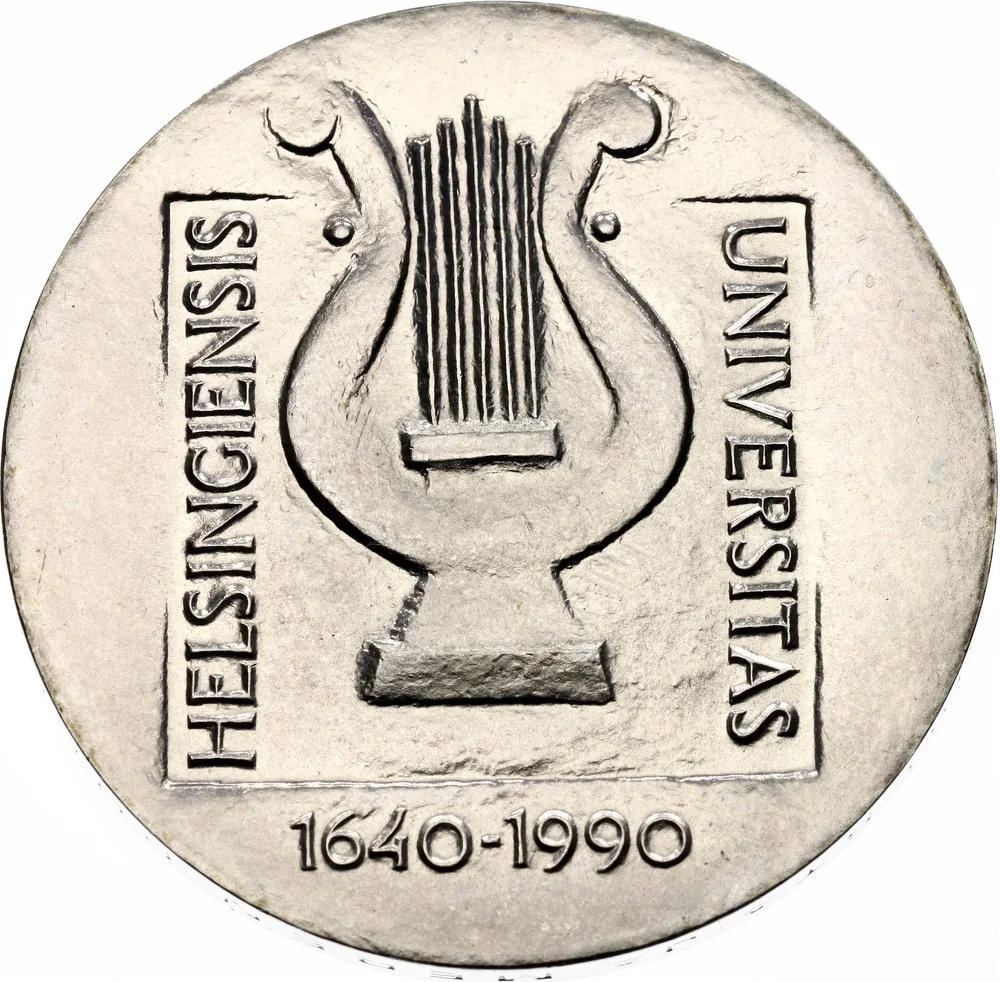
100 Markkaa – Finland
Non-circulating coins
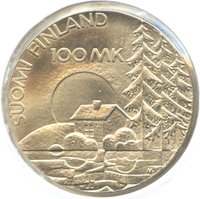
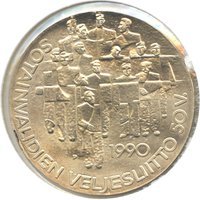
Commemoration: 350th Ann - University of Helsinki
Finland

Obverse
Reverse
Edge
Inscripted
Legend:
POHJOISESTA JA MEREN PUOLELTA HÄN HEIDÄT KOKOSI
Translation:
From the North and from the side of the Sea, he gathered them.
Language: Finnish
Mints
| Name | Mark |
|---|---|
| Mint of Finland | — |
Mintings
| Year | Mint Mark | Mintage | Quality | Collection |
|---|---|---|---|---|
| 1990 | H | 150,000 |
Historical background
In 1990, Finland's currency, the markka (FIM), operated under a managed floating exchange rate system, but it was de facto pegged to a trade-weighted currency basket. This arrangement, established in the late 1970s, aimed to provide stability for the small, open economy heavily reliant on foreign trade, particularly with the Soviet Union and Western Europe. However, this stability was becoming increasingly fragile. The collapse of the Soviet Union, a major trading partner, triggered a severe loss of export revenue just as the country was entering a domestic overheating phase characterized by a credit boom and soaring asset prices.
The Bank of Finland was committed to defending the markka's peg, which required maintaining high interest rates to prevent capital outflow and curb inflation. This policy stance, however, exacerbated the looming economic crisis. As the recession deepened in 1991 with a sharp decline in GDP, the high cost of borrowing crushed indebted corporations and households. The currency peg became a straitjacket, preventing the use of monetary policy to stimulate the economy and leading to a painful deflationary spiral.
Consequently, 1990 marked the beginning of the end for the old currency regime. Intense speculative pressure against the markka mounted through 1991, forcing the Bank of Finland to devalue the currency in November 1991 and eventually abandon the peg altogether in September 1992, allowing the markka to float freely. This currency crisis was a central catalyst for the deep Finnish banking crisis and depression of the early 1990s, one of the most severe experienced by any OECD country in the postwar era.
The Bank of Finland was committed to defending the markka's peg, which required maintaining high interest rates to prevent capital outflow and curb inflation. This policy stance, however, exacerbated the looming economic crisis. As the recession deepened in 1991 with a sharp decline in GDP, the high cost of borrowing crushed indebted corporations and households. The currency peg became a straitjacket, preventing the use of monetary policy to stimulate the economy and leading to a painful deflationary spiral.
Consequently, 1990 marked the beginning of the end for the old currency regime. Intense speculative pressure against the markka mounted through 1991, forcing the Bank of Finland to devalue the currency in November 1991 and eventually abandon the peg altogether in September 1992, allowing the markka to float freely. This currency crisis was a central catalyst for the deep Finnish banking crisis and depression of the early 1990s, one of the most severe experienced by any OECD country in the postwar era.
🌟 Uncommon