

25 pesos – Argentina
Add to wishlist
Non-circulating coins
Commemoration: Historical coins
Argentina
Obverse
Description:
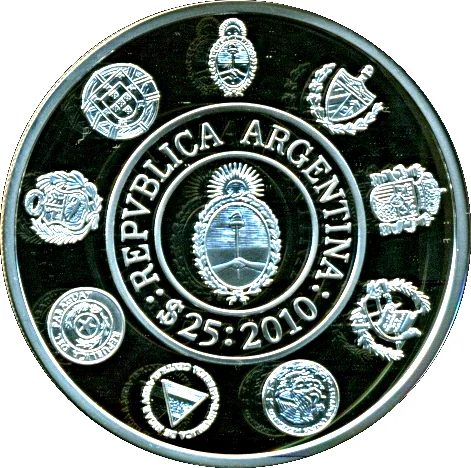
The Argentine National Coat of Arms features "REPVBLICA ARGENTINA", "$ 25", and "2010", surrounded by the shields of all participating countries.
Inscription:
REPÚBLICA ARGENTINA
$25 * 2010
$25 * 2010
Translation:
Argentine Republic
$25 * 2010
$25 * 2010
Script: Latin
Language: Spanish
Engraver: Carlos Pedro Rodríguez Dufour
Reverse
Description:
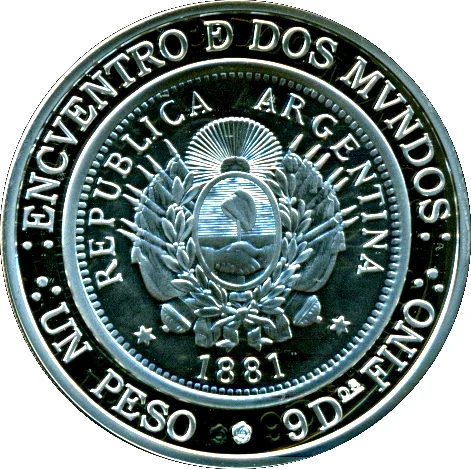
The central imprint replicates the obverse of the "patacón," featuring a shield flanked by 14 flags, laurel branches, cannons, and the inscriptions "REPUBLICA ARGENTINA" and "1881." The upper arch reads "ENCVENTRO DE DOS MUNDOS," and the lower arch "UN PESO - 9 DOS FINO," denoting the denomination and metal purity.
Inscription:
ENCVENTRO DE DOS MVNDOS
UN PESO * 9 Dos FINO
REPUBLICA ARGENTINA
1881
UN PESO * 9 Dos FINO
REPUBLICA ARGENTINA
1881
Translation:
ENCOUNTER OF TWO WORLDS
ONE PESO * .900 FINE
ARGENTINE REPUBLIC
1881
ONE PESO * .900 FINE
ARGENTINE REPUBLIC
1881
Script: Latin
Language: Spanish
Engraver: Carlos Pedro Rodríguez Dufour
Edge
Reeded
Categories
| Symbols> Coat of Arms |
| Currency> Coin depiction |
Mints
| Name | Mark |
|---|---|
| Empresa Cubana de Acuñaciones | — |
Mintings
| Year | Mint Mark | Mintage | Quality | Collection |
|---|---|---|---|---|
| 2010 | — | 3,500 | Proof |
Historical background
Argentina entered 2010 with a sense of cautious optimism following the global financial crisis, but underlying currency pressures persisted. The official exchange rate was tightly managed by the Central Bank, which maintained a policy of a "dirty float" to keep the peso relatively stable, trading around 3.8 to 4 pesos per US dollar for much of the year. However, this stability was artificial and maintained through heavy intervention, depleting foreign reserves. A growing gap emerged with the informal "blue dollar" market, where pesos traded at a significant discount, reflecting widespread public distrust in the official rate and the government's economic policies, particularly concerning high inflation which official statistics were widely seen as underreporting.
The currency situation was fundamentally shaped by the economic model of President Cristina Fernández de Kirchner's administration, which prioritized domestic growth and social spending over fiscal and monetary orthodoxy. To finance this and control the exchange rate, the government imposed strict capital controls and limited access to official dollars for both businesses and individuals. These cepos cambiarios (exchange restrictions) created a complex web of parallel markets—including the "blue," "tourist," and "financial" dollars—distorting the economy. Exporters were disadvantaged by an overvalued official peso, while a booming demand for dollars as a safe-haven asset fueled the black market.
By the end of 2010, the contradictions of the system were becoming more pronounced. Despite strong GDP growth driven by high global commodity prices for Argentina's soy and grain exports, inflation was eroding purchasing power and fueling capital flight. The Central Bank's reserves, though bolstered by a controversial debt restructuring deal earlier in the year, remained under constant pressure to defend the peso. Thus, while a full-blown crisis was temporarily averted, the currency controls and multi-exchange rate regime established in 2010 laid an unstable foundation, setting the stage for more severe economic turmoil and a sharp devaluation in the years to follow.
The currency situation was fundamentally shaped by the economic model of President Cristina Fernández de Kirchner's administration, which prioritized domestic growth and social spending over fiscal and monetary orthodoxy. To finance this and control the exchange rate, the government imposed strict capital controls and limited access to official dollars for both businesses and individuals. These cepos cambiarios (exchange restrictions) created a complex web of parallel markets—including the "blue," "tourist," and "financial" dollars—distorting the economy. Exporters were disadvantaged by an overvalued official peso, while a booming demand for dollars as a safe-haven asset fueled the black market.
By the end of 2010, the contradictions of the system were becoming more pronounced. Despite strong GDP growth driven by high global commodity prices for Argentina's soy and grain exports, inflation was eroding purchasing power and fueling capital flight. The Central Bank's reserves, though bolstered by a controversial debt restructuring deal earlier in the year, remained under constant pressure to defend the peso. Thus, while a full-blown crisis was temporarily averted, the currency controls and multi-exchange rate regime established in 2010 laid an unstable foundation, setting the stage for more severe economic turmoil and a sharp devaluation in the years to follow.
💎 Very Rare